Showing posts with label Jordan. Show all posts
Showing posts with label Jordan. Show all posts
Tuesday, November 12, 2013
Video: The Desert Challenge Ultra-Marathon Race
In 2014 an amazing new competition is set to take place with ultra-marathons being held in Jordan and Oman, which will set the stage for a bigger, longer race to follow. Known as the Desert Challenge, this epic set of races is set to become one of the top endurance events on the ultra-running calendar. The video below gives us a glimpse of what to expect out of this competition. As you might imagine, it won't be for the feint of heart.
The Desert Challenge from TransArabia on Vimeo.

Friday, April 12, 2013
Announcing The Desert Challenge Ultramarathons, Two Races Across Two Deserts In 2014
 Attention ultrarunners! Are you looking for a new challenge to add to your race schedule in 2014? If so, the the newly announced Desert Challenge may be just what you're looking for. The event will feature two races, in two very different deserts next year, both of which will lead up to a third event which has yet to be named.
The first race is called the TransOmania and as the name implies, it will be taking place in the country of Oman. The full course will run coast-to-coast across that country, covering a distance of 300 km (186 miles). Two shorter routes, one 200 km (124 miles) in length, the other 130 km (80 miles), will also be available, each running through the very heart of the Wahiba Sands, a beautiful desert with diverse landscapes and wildlife. The TransOmania ultramarathon is scheduled to take place in January.
The second race in the Desert Challenge will be the TransArabia, which will run from the Dead Sea to the Red Sea in Jordan. This race will feature three courses that include lengths of 300 km , 200 km and 100 km (62 miles). Competitors will of course run non-stop, passing through the spectacular Wadi Rum desert and the incomparable Petra along the way. The TransArabia is scheduled to take place in November of 2014.
The two races are being managed by Raid Sahara and my friends at Lost World Racing, both of which have years of experience organizing long distance running events in extreme environments. They've come up with an interesting new concept in desert races, beginning and ending on coastlines, while still featuring plenty of wide-open desert along the length of the rest of the course. Both races will be tough and demanding, yet incredibly rewarding at the same time. These two new ultra marathons are set to make a very big splash on endurance scene next year.
The Desert Challenge was just announced yesterday, so there isn't a lot more information available just yet. the website domain for the TransArabia race has been claimed, but as of this writing, the site hasn't launched just yet. Keep an eye on the page for future updates.
On a side note, I visited Jordan last year and had an absolutely wonderful time. The country is beautiful, with a rich and ancient culture. The people there couldn't have been more friendly and visiting both Wadi Rum and Petra were amongst the highlights of my travels. The fact this race will put you right into the heart of those environments is amazing.
Stay tuned for more information soon.
Friday, January 4, 2013
Trekking The World: 50+ Countries On Six Continents In 424 Days

That was exactly the premise behind the Trekking the Planet expedition, a 14-month journey undertaken by the husband and wife team of Darren and Sandy Van Soye. The duo set out on January 28th of last year and have been circling the globe ever since. During that time, they have managed to visit 40 different countries on six continents, most of which have been in the developing world. The expedition has another three and half months to go before it is done, and the Van Soye's hope to add another 13 countries to their passports before heading home.
Making this kind of journey is a dream for many of us who have longed to hit the open road for an extended period of time. And while Darren and Sandy have had numerous adventures on their world-spanning adventure, they didn't set out just for their own enjoyment and enrichment. They conceived Trekking the Planet is a tool for helping to reach out to students in classrooms and help engage their curiosity about geography more fully. With that in mind, they've established a series of geography education modules that highlight the various places that they have visited. Those lessons are designed to work in classrooms with students ranging in age from 6 to 17 and can be modified to fit nearly any type of curriculum. Their lesson plans have been so successful in fact that they are now followed by 55,000 students in 850 classrooms spread out over 20 countries.
While on the road, the Van Soye's prefer to travel on foot as much as possible. As a result, they have often found themselves in a number of places that are far from the beaten path. Their journey has taken them to a number of remote regions, including the Mustang region in Nepal, into the Simien Mountains of Ethiopia and along ancient Bedouin trails in Jordan. This approach to travel allows them to get closer to the people living in the countries they visit and have experiences that are out of the norm. They've even had the opportunity to speak at 18 different schools along the way, allowing them to share their adventures even more directly with students in different countries.
You can follow Darren and Sandy's adventures, as well as subscribe to their newsletter, on their Trekking the Planet website.
Thursday, May 24, 2012
Visiting Jordan: Exploring Petra

The ancient city of Petra was originally founded in the 6th Century BC, when it was founded as part of an effort by a tribe of Bedouins known as the Nabataeans. Over the centuries they built up a trade empire and used the city as their capital. Later it was conquered by the Romans and eventually abandoned altogether. As the centuries passed it was all but forgotten, until it was rediscovered by explorer Johann Ludwig in 1812.
Images of the place have always intrigued travelers, who are fascinated by the stone buildings carved directly into the sandstone walls. The best known of those structures is called the Treasury, although in truth it was actually a tomb. As I point out in my story for Gadling, for many people the Treasury is Petra and what they don't realize is that it stands at the entrance of a massive complex of stone structures that can take several days to explore completely.
When I visited the site back in April I was surprised to find so many other ruins there, including a Roman amphitheater, a temple, and dozens of other structures. There was even one ruin known as the Monastery that was every bit as well preserved and impressive as the Treasury, but it is lesser known in part because it sits atop a high plateau that requires a hike up 900 stairs to reach. A similar site, known as the High Place of Sacrifice, is also worth the climb (in this case a mere 700 steps!) as it provides excellent views of the city.
Before I went I already knew that Petra was a wonder, but until I saw it first hand I didn't realize just how impressive it is. Walking through the place is like walking through history and I feel that it is worth visiting Jordan for Petra alone. Obviously there are many more things to do and see in the country, but Petra is, without a doubt, the one destination you shouldn't miss.

Thursday, May 17, 2012
Visiting Jordan: Desert Adventures

The early part of my journey through Jordan was spent in and around the capital city of Amman, which is a vibrant, modern metropolis with a population of more than two million. But a couple of days in and I was ready for some peace and solitude in the desert. Lucky for me our first destination after leaving the city was a quiet eco-lodge called Feynan located to the south.
Feynan is the perfect antithesis of the hustle and bustle of Amman. Quiet and peaceful, the lodge uses solar power to heat water and generate what little electricity that it actually uses. At night, the walkways and guest rooms are lit by candles that give the place a tranquil glow, and the almost exclusively vegetarian meals are made from locally sourced foods. It is all part of Feynan's pledge to have as little of an impact on the environment as possible, and while you're there you may lack for a few amenities, but you'll also never notice. National Geographic called Feynan one of the 50 best ecolodges in the world and it doesn't take very long understand why.

As if Feynan wasn't amazing enough on its own, it also happens to sit on the edge of the the Dana Biosphere Reserve, the largest nature reserve in all of Jordan. Dana is nearly 192 sq. km (120 sq. miles) in size and consists of wildly varying landscapes. In the highlands of the Qadisiyah Plateau it reaches an altitude of about 1500 meters (4500 ft) but it also gives way to the sprawling desert flats far below. Sandstone, limestone and granite cliffs abound, and slot canyons slice through the rock, just begging to be explored.
I had the opportunity to take two hikes while in the area, one at sunset and another at sunrise, and both were spectacular. The red glow of the rising and setting sun cast the area around Feynan in a warm light that was both foreign and familiar at the same time. That light brought the reds, oranges and pinks of the desert alive in a gorgeous kaleidoscope that can't be completely conveyed in photos, but will always stay with me in my mind. It was easily one of the quietest, most peaceful places I've had the opportunity to visit in my travels.
Unfortunately my stay in Feynan was far too brief and we were on the road once again the next day. But if if I had to pick one place to return to in Jordan, it would likely be here. I'm told that those mysterious canyons offer fantastic trekking and climbing, and that deep inside there are hidden waterfalls and rock formations that few are lucky enough to ever see. I would like to go back and spend a few days just trekking those valleys and enjoying the serene life at the eco-lodge.
I can't say I was entirely happy to leave the Dana Biosphere behind, but another fantastic destination lay ahead. Located in southernmost Jordan is the Wadi Rum desert, which is another wide-open expanse that broken up by towering sandstone and granite formations. Wadi Rum is another one of Jordan's premiere adventure destinations and visitors looking for a wilderness experience will not go away disappointed. There are trekking and climbing opportunities in abundance and camel safaris offer a unique way to explore the rolling dunes.
We took in the beauty of Wadi Rum from the back of a couple of 4x4's and spent the better part of the afternoon following in the footsteps of Lawrence of Arabia. There we saw his Seven Pillars of Wisdom and learned how the British officer helped to organize and lead the Arab revolt agains the Ottoman Empire during World War I. Lawrence still casts a large shadow over Jordan, although his myth is not so grand as it is in the West.

Our drive took us past natural rock bridges, spiraling towers and granite walls that would leave many climbers licking their lips with anticipation. We plowed through deep sands and careened over sand dunes 20 stories high, while soaking up the stark beauty that has made Wadi Rum a favorite destination for travelers. And at the end of the day we stopped at a Bedouin camp that would be our resting spot for the night. That evening we partook in a traditional Bedouin meal, sang songs, danced and smoked the Hookah pipe, while overhead a billion stars twinkled brightly. It was one of the most breathtaking night skies I have ever seen, and well worth a trip deep into the desert alone.
The next morning a group of us were up at the break of dawn in order to get an entirely different perspective of Wadi Rum. Scrambling into a hot air balloon, we spent the early hours of the day drifting a thousand meters above the desert floor, watching from the perfect vantage point as the suns rays crawled across the landscape below. It was my first time in a hot air balloon, and I found it to be a wonderfully serene experience. When the flame wasn't blasting hot air into the balloon above, we quietly drifted along wherever the wind took us. It was the perfect way to start the day and a reminder of just how vast and beautiful the desert truly was.
Once again, my time in Wadi Rum was far too short and it is yet another Jordanian destination that I would love to return to. Adventurous travelers can actually trek across the desert on foot, camping out beneath the stars each night. If you have the time, that is the way I would recommend seeing this place that has captivated visitors for hundreds of years.
My visits to the both the Dana Biosphere Reserve and Wadi Rum showed me a completely different side to Jordan than I had seen while visiting its historical wonders. It reaffirmed its standing as a great destination for adventure travelers as well. Trekkers and climbers will find plenty to love in both places, provided they schedule enough time in their itineraries to take it all in.
Friday, May 11, 2012
Visiting Jordan: History and Culture at the Crossroads of the World

Of course, the most famous reminder of Jordan's past is undoubtedly Petra, the ancient city built by the Nabateans in the 6th century BC. The place is a UNESCO World Heritage Site and it is truly unlike any other place on Earth. Carved directly from the rose red rock common in southern Jordan, Petra served as the capital for the industrious Nabateans who used skill and foresight to divert merchant caravans to the region, turning it into a center for trade and mercantilism. During that era the kingdom became rich and influential, until catching the attention of the Romans, who later conquered the Nabateans, altering the trade routes once again.
There is much to tell about Petra. So much so that it will receive its own post in the very near future. But in the context of this story, just know that it is one of many amazing historical sites that help to tell the rich story of Jordan and its colorful past. But it is also just one of many wonderfully preserved historical sites that dot the landscape, telling a tale that spans across millennia.
One of those sites is found in a town called Jarash which is located in northern Jordan, a short drive from the capital of Amman. Modern Jarash is a small, thriving city with a vibrant population that is not unlike many others in Jordan. Except at the heart of Jarash is an ancient secret – a Greco-Roman city that is amongst the best preserved in the entire world.

Sharp eyed readers may have noticed that the temples I alluded to above were named for Zeus and Artemis, which are decidedly not Roman gods. Those names are an indication that ancient city of Gerasa, as Jarash was known two thousand years ago, was first influenced by the Greeks. The wealthy and influential patrons that lived in the region at the time were not quick to give up their traditions, even as the Romans claimed power across much of the known world. While the inhabitants of Gerasa welcomed their inclusion in the Empire, they held on to their past for hundreds of years. Because of this history, visitors to Jarash will discover not just Latin inscriptions around the city, but plenty of Greek as well.
That same Greek and Roman influence can be found in Amman as well, where a large site known as the Citadel dominates a prominent hill at the center of town. The ruins there include towering Corinthian columns and the remains of a temple that is believed to have been dedicated to Hercules. A massive stone hand is all that remains of the statue that once stood guard over that place, but it does offer clues of the former grandeur of the place. A small museum also offers glimpses of Jordan's past in the form of artifacts collected from across the country.
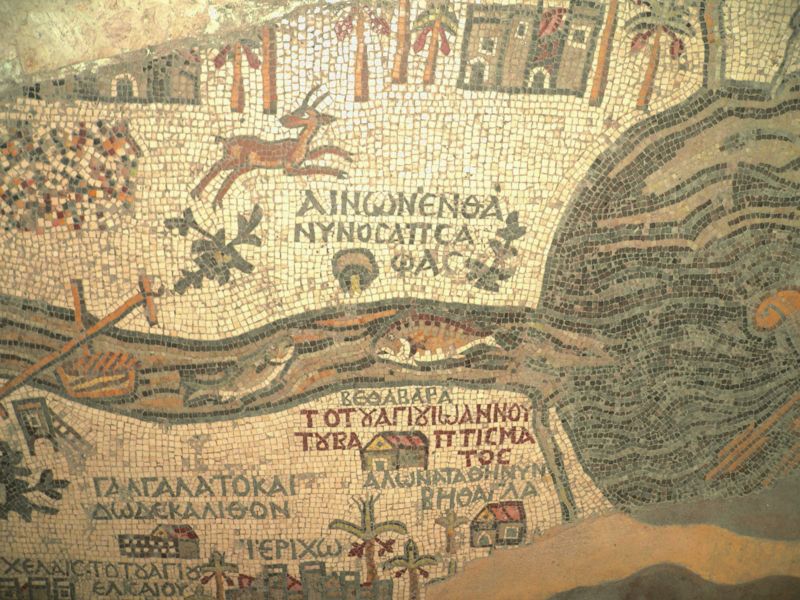
Jordan's connection to the Holy Land runs far deeper than an ancient map on the floor of a church however. Some of the most important religious sites in the world are located within its borders and Christians, Jews and Muslims alike all make pilgrimages to visit those places. For instance, Mt. Nebo is believed to be the site where Moses looked upon the Holy Land, which he was foretold that he would see but never enter. On a clear day visitors to the summit can catch a glimpse of Jericho, the West Bank, and even Jerusalem itself. The River Jordan cuts a swath across the arid valley floor, which sits some 817 meters (2680 ft) below and the view from the top is most definitely worth the short hike.
Speaking of the River Jordan, a visit to its banks can yield a host of great religious and historical sites as well. Visitors to Bethany Beyond the Jordan for instance will discover not only the Spring of John the Baptist but also the site where he baptized Jesus Christ. For many, this is the literal birthplace of Christianity itself. It is also possible to walk down the banks of the river itself, which is a rather underwhelming waterway until you take into account the numerous references in religious texts. There is a reason why many of the world's different religious sects have built churches, temples and mosques along its banks.
If you're a traveler who loves history and culture, then Jordan has plenty to offer. The sites that I named here will fill up many days of travel on their own, particularly if you stop and take some time to reflect on their importance and meaning. Understanding the influence of Jordan's past gives us a better connection to its present and I count myself lucky that I had the chance to experience that history first hand.
Thursday, April 19, 2012
Site News: I'm A Traveling Man...
,_Petra.jpg/399px-The_Monastery_(Al_Dier),_Petra.jpg)
While I'm away there is likely to be quite a bit of news out of the Himalaya as the climbing teams continue to make progress on their various expeditions. For excellent news and updates be sure to drop by Alan Arnette's Everest Blog and Explorers Web. Both sites will keep you well informed as to what is happening on the Big Hill and across the region, and I'll be back in time to catch the first summit pushes that will begin in early May.
While in Jordan I'll be busy exploring the extraordinary culture and history of that country, visiting places like Petra and the amazing desert wilderness that is Wadi Rum. Of course, when I get back I'll share all kinds of details on what I saw while I was there and I'm sure I'll have plenty of photos (and possibly some video!) to pass along as well.
I hope while I'm away you all have some great adventures of your own. I'll expect full reports upon my return!
Subscribe to:
Posts (Atom)