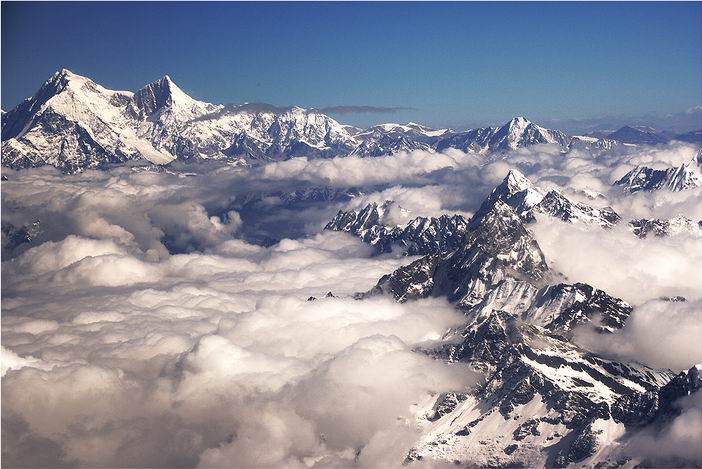
As expected, there were a number of summit pushes across the 8000 meter peaks this past weekend, with climbers finding success on several mountains. It was a busy couple of days in the Himalaya, where teams sought to take advantage of a weather window, and top out during a period of relatively calm winds and good all around conditions.
We'll start on Kangchenjunga, where Denis Urubko summited the mountain solo after his teammates turned back out of fear of an unstable approach to the summit. Climbing along the North Face, Denis completed a new route that is a variant of the British Route used in the past. He has already returned to Camp 4, where his teammates, Alex Txikon, Adam Bielecki, Artjom Braun and Dmitri Sinev, were waiting. Alex and Adam had hoped to summit, and traverse down the South Face, but conditions were not good for such an attempt. All members of the team will now head down to Base Camp, and most likely prepare to head home.
On the South Side of Kangchenjunga, ExWeb is reporting that Spanish climber Carlos Soria has also topped out, nabbing his eleventh 8000-meter peak at the age of 75. He was joined on the summit by Italian Marco Camandona and Finnish climber Samuli Mansikka, who topped out without the use of supplemental oxygen.
Jumping over to Cho Oyu, Mike and Matt Moniz successfully topped out on Saturday, right on schedule. They had a very narrow weather window for their summit bid, as high winds are expected back on that mountain today. After setting out at 4 AM, the reached the summit at 11 AM that morning, before descending all the way back down to ABC before taking a rest. The father-son team had originally planned to now travel to the South Side of Everest, and attempt a double-summit of that mountain and Lhotse. With things shut down on the South Side however, we'll have to wait to see if they just head home instead.
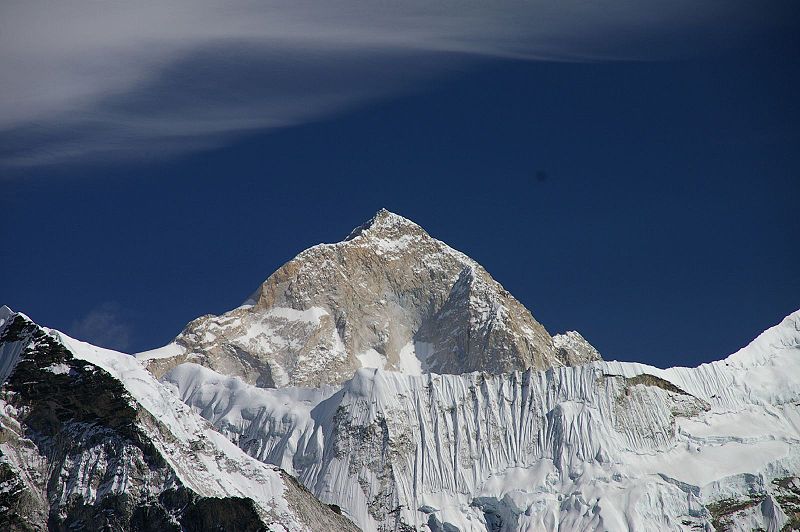
Mike Horn and Fred Roux found success on Makalu on Saturday as well. They reached the summit of that 8463 meter (27,765 ft) mountain without supplemental oxygen or high altitude Sherpa support. Fred topped out at about 10:30 AM local time, while Mike followed along at 4:00 PM in the afternoon. That should give you an indication of how good the weather was, at that is late in the day for summit. Both men descended the mountain safely and reunited in ABC.
Other climbers who have reportedly topped out on Makalu this weekend include Serbian climber Dragan Celikovic, Canadians Al Hancock and Monique Richard, Norwegian Arvid Lennard Lahit, and French alpinist Philippe Gatta with Pasang Gombu.
Not everyone was successful on Makalu however, as ExWeb reports that a team of Indian climbers led by Arjun Vajpai were forced to turn back just 150 meters below the summit due to exhaustion and a lack of fixed ropes going to the top. Other teams were in position to summit yesterday and today, but we'll have to wait for further confirmation on their success.
ExWeb also reports that there were 10 summits on Dhaulagiri this weekend as well, with clients of Seven Summits Treks topping out on Saturday that includes two Chinese climbers Jing Luo and Zhu Gang, Peruvian Rimac Trejo Victor and Nepalese clients Nirmal Purja and Krishna Thapa Magar.
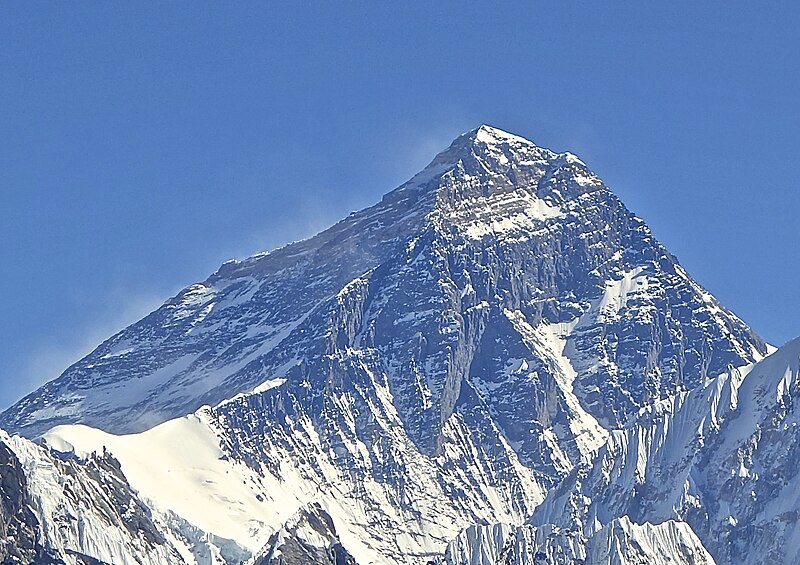
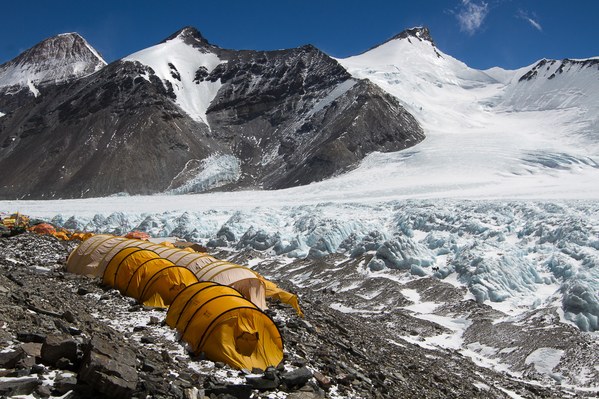
Meanwhile, the climbers on Everest's North Side continue to wait for their turn to come. A weather window is now expected later this week so that rope fixing can be completed at long last. Most teams are now looking at making their summit push starting on Friday and extending into the weekend. We'll just have to wait to see how things play out then.
Stay tuned for more updates.
Showing posts with label Tibet. Show all posts
Monday, May 19, 2014
Friday, May 16, 2014
Himalaya 2014: It is Go Time in the Himalaya!
After weeks of acclimatizing, and days of waiting for a weather window, it appears that it is finally time for the summit season to begin in the Himalaya. All across the region there are reports of good conditions in the mountains, with the high winds that have been buffeting the area quieting down at last. That means it should be a busy weekend on the 8000-meter peaks, where teams have launched their summit bids at last.
We'll start on Shishapangma, where ExWeb is reporting that there have already been successful summits, with more yet to come. A team of four French climbers, Sébastien Moatti, Sébastien Ratel, Antoine Bletton and Max Bonniot topped out on Wednesday via the South Face, and are already safely back in Base Camp. Meanwhile, teams on the North Side of the mountain are on the move as well, and should have a legitimate shot at reaching the summit sometime this weekend.
Over on Makalu, Mike Horn and Fred Roux have launched their summit bid. They climbed up to 6800 meters (22,309 ft) yesterday, and are homing to move up to Camp 2 at 7500 meters (24,606 ft) today. They report that high winds are still making things difficult on the upper slopes, but they expect them to quiet down, and allow for an attempt on the summit on Sunday.
Other teams are on the move on Makalu as well, which is where Chris Jensen Burke is tuning up for an attempt on K2 later this summer. She expects her squad to be heading up this weekend as well, as everyone looks to take advantage of the weather window ahead. There hasn't been an update from Chris in a couple of days, but it is safe to assume that she, along with the rest of her team, are eying a summit on Sunday too.
The team of Alex Txikon, Adam Bielecki and Dmitri Sinev, Denis Urubko and Artem Braun are looking to open a new route on Kangchenjunga, and after acclimatizing along the normal route on the North Face, they are on the move as well. If everything goes as scheduled, they should top out tomorrow or Sunday, with Txikon and Bielecki looking to descend on the South Side, completing a traverse of the mountain. The team is climbing without supplemental oxygen, or high altitude Sherpa support.
On Cho Oyu, it seems this will be a very narrow weather window, with storms predicted to move in early next week. With that in mind, Mike and Matt Moniz have launched their summit bid, with the hopes of moving quickly to the top, and getting back down before the weather window slams shut. They left Advanced Base Camp yesterday, and should be Camp 2 today, where they'll rest for a brief period before making a push all the way to the summit, which should happen tomorrow morning local time.
Conspicuous with its absence on this update is Everest of course. The North Side has been effectively shut down the past few days due to high winds. The ropes are reportedly fixed up to Camp 3, and Sherpa teams are preparing to install them all the way to the summit, which looks to be finished around the 20th or 21st of the month. After that, teams will begin heading up, and may even be in a position to summit soon after the rope fixing is complete.
On the South Side of the mountain, where the two women climbers are making attempts on Everest and Lhotse, it is impossible to say what their schedule is. Rope fixing needs to be done there as well, and both of the ladies are probably still acclimatizing to the altitude. That story is an evolving one of course, so we'll just have to wait to see how it plays out once they come back down the mountain.
I'll post updates next week with results of these summit bids. Hopefully everyone gets up and down safely this weekend.
We'll start on Shishapangma, where ExWeb is reporting that there have already been successful summits, with more yet to come. A team of four French climbers, Sébastien Moatti, Sébastien Ratel, Antoine Bletton and Max Bonniot topped out on Wednesday via the South Face, and are already safely back in Base Camp. Meanwhile, teams on the North Side of the mountain are on the move as well, and should have a legitimate shot at reaching the summit sometime this weekend.
Over on Makalu, Mike Horn and Fred Roux have launched their summit bid. They climbed up to 6800 meters (22,309 ft) yesterday, and are homing to move up to Camp 2 at 7500 meters (24,606 ft) today. They report that high winds are still making things difficult on the upper slopes, but they expect them to quiet down, and allow for an attempt on the summit on Sunday.
Other teams are on the move on Makalu as well, which is where Chris Jensen Burke is tuning up for an attempt on K2 later this summer. She expects her squad to be heading up this weekend as well, as everyone looks to take advantage of the weather window ahead. There hasn't been an update from Chris in a couple of days, but it is safe to assume that she, along with the rest of her team, are eying a summit on Sunday too.
The team of Alex Txikon, Adam Bielecki and Dmitri Sinev, Denis Urubko and Artem Braun are looking to open a new route on Kangchenjunga, and after acclimatizing along the normal route on the North Face, they are on the move as well. If everything goes as scheduled, they should top out tomorrow or Sunday, with Txikon and Bielecki looking to descend on the South Side, completing a traverse of the mountain. The team is climbing without supplemental oxygen, or high altitude Sherpa support.
On Cho Oyu, it seems this will be a very narrow weather window, with storms predicted to move in early next week. With that in mind, Mike and Matt Moniz have launched their summit bid, with the hopes of moving quickly to the top, and getting back down before the weather window slams shut. They left Advanced Base Camp yesterday, and should be Camp 2 today, where they'll rest for a brief period before making a push all the way to the summit, which should happen tomorrow morning local time.
Conspicuous with its absence on this update is Everest of course. The North Side has been effectively shut down the past few days due to high winds. The ropes are reportedly fixed up to Camp 3, and Sherpa teams are preparing to install them all the way to the summit, which looks to be finished around the 20th or 21st of the month. After that, teams will begin heading up, and may even be in a position to summit soon after the rope fixing is complete.
On the South Side of the mountain, where the two women climbers are making attempts on Everest and Lhotse, it is impossible to say what their schedule is. Rope fixing needs to be done there as well, and both of the ladies are probably still acclimatizing to the altitude. That story is an evolving one of course, so we'll just have to wait to see how it plays out once they come back down the mountain.
I'll post updates next week with results of these summit bids. Hopefully everyone gets up and down safely this weekend.
Wednesday, May 14, 2014
Himalaya 2014: Waiting for a Weather Window
It has been a week or so since I posted a general update from the Himalaya. During that time, not much has changed, as most of the teams have been simply waiting for a weather window to open. As the middle of May fast approaches, most of the climbers are now acclimated, and are just biding their time for the right opportunity to come. Over the past week, high winds and snow have been common across the entire region, but that is about to change, signaling the start of summit pushes on several mountains.
We'll start on the North Side of Everest, where roughly 100 climbers are waiting for their opportunity to go up the hill. Rope fixing is complete up to Camp 3, located at 8300 meters (27,230 ft), but high winds are preventing anyone from going any higher at the moment. Until the Sherpa team from the Chinese-Tibet Mountaineering Association can complete the job of installing the ropes, no one will be able to summit. But a weather window is approaching, and most teams are now expecting their summit pushes to begin next week. Expect possible summits on May 21. Until then, the teams are resting in Base Camp.
Over on the South Side, there continue to be reports of guerrilla climbers who are defying the closure of the mountain to make their own attempts on the summit. As previously mentioned, they include American Cleo Weidlich and Chinese mountaineer Jing Wang, both of whom have reportedly chartered a helicopter to fly them to Camp 2, thus avoiding the dangerous Khumbu Icefall. Rumor has it, these two women may not be alone on the mountain. At least not for long. There are some indications that others may try to join them at Camp 2, using the same helicopter. These stories only help to perpetuate what has already been a strange season on Everest. What happens from here will certainly be interesting to watch unfold, and will make a great story for sure.
Elsewhere, Mike Horn and Fred Roux are prepping for their summit bid on Makalu. They've been waiting for a good window for some time as well, and it looks like it'll come late this week. They hope to begin their push on Friday, and summit over the weekend. They had been planning on an alpine style ascent, but considering the delays, and the general schedule at this point, it appears they'll be moving up with the rest of the teams on the mountain. They will climb without the use of supplemental oxygen, or Sherpa support however.
Aussie climber Chris Jensen Burke is also on Makalu, and she reported in from ABC yesterday. She says that her team is ready to go as well, but high winds are keeping them grounded for now. They are eyeing a summit bid this weekend as well however, with the current schedule having the push set to begin on May 14 or 15, with everyone topping out on May 17 or 18. She indicated that rope fixing is nearly complete, and while there are some challenging sections that will need to be overcome along the way, she is feeling confident as she prepares to head up.
Jumping over to Cho Oyu, Mike and Matt Moniz are in a holding pattern as well. The weather has been poor there too, and it looks like it'll only get worse next week. They are now eyeing a narrow weather window which will arrive over the weekend. The winds are expected to die down on the summit on May 17, which may give them the opportunity they need to dash to the top, and get back down. Hopefully they'll be able to achieve their objective in that time frame.
Denis Urubko has posted an update from Kangchenjunga, where he and his team are attempting a new route along the North Ride. After acclimatizing for some time on the standard route, they are now preparing to begin the real work they came to the Himalaya for. The first pair of climber moved up to Camp 1 yesterday, and should push ahead to Camp 3 today. That will put them at 7500 meters (24,606 ft), with some tricky rock faces to overcome. Denis reports that high winds have been an issue there as well, and that they'll need to die down before they can make their true push to the top. As is usual with this team, they are climbing in alpine style, without Sherpa support, and without oxygen.
Finally, a quick note on Annapurna. You haven't heard me mention it much this season, but there were a couple of summit attempts on the mountain a few weeks back. But conditions were once again far too dangerous, and all climbers were turned back before they could reach the top. Those expeditions then picked up their gear and left Base Camp, determining that Annapurna was simply too dangerous to climb this spring. This is the second year in a row without any successful summits on this mountain during the spring. Last year, there were several summits during the fall, so we'll have to wait to see if success can be found there once again.
That's all for now. More soon.
We'll start on the North Side of Everest, where roughly 100 climbers are waiting for their opportunity to go up the hill. Rope fixing is complete up to Camp 3, located at 8300 meters (27,230 ft), but high winds are preventing anyone from going any higher at the moment. Until the Sherpa team from the Chinese-Tibet Mountaineering Association can complete the job of installing the ropes, no one will be able to summit. But a weather window is approaching, and most teams are now expecting their summit pushes to begin next week. Expect possible summits on May 21. Until then, the teams are resting in Base Camp.
Over on the South Side, there continue to be reports of guerrilla climbers who are defying the closure of the mountain to make their own attempts on the summit. As previously mentioned, they include American Cleo Weidlich and Chinese mountaineer Jing Wang, both of whom have reportedly chartered a helicopter to fly them to Camp 2, thus avoiding the dangerous Khumbu Icefall. Rumor has it, these two women may not be alone on the mountain. At least not for long. There are some indications that others may try to join them at Camp 2, using the same helicopter. These stories only help to perpetuate what has already been a strange season on Everest. What happens from here will certainly be interesting to watch unfold, and will make a great story for sure.
Elsewhere, Mike Horn and Fred Roux are prepping for their summit bid on Makalu. They've been waiting for a good window for some time as well, and it looks like it'll come late this week. They hope to begin their push on Friday, and summit over the weekend. They had been planning on an alpine style ascent, but considering the delays, and the general schedule at this point, it appears they'll be moving up with the rest of the teams on the mountain. They will climb without the use of supplemental oxygen, or Sherpa support however.
Aussie climber Chris Jensen Burke is also on Makalu, and she reported in from ABC yesterday. She says that her team is ready to go as well, but high winds are keeping them grounded for now. They are eyeing a summit bid this weekend as well however, with the current schedule having the push set to begin on May 14 or 15, with everyone topping out on May 17 or 18. She indicated that rope fixing is nearly complete, and while there are some challenging sections that will need to be overcome along the way, she is feeling confident as she prepares to head up.
Jumping over to Cho Oyu, Mike and Matt Moniz are in a holding pattern as well. The weather has been poor there too, and it looks like it'll only get worse next week. They are now eyeing a narrow weather window which will arrive over the weekend. The winds are expected to die down on the summit on May 17, which may give them the opportunity they need to dash to the top, and get back down. Hopefully they'll be able to achieve their objective in that time frame.
Denis Urubko has posted an update from Kangchenjunga, where he and his team are attempting a new route along the North Ride. After acclimatizing for some time on the standard route, they are now preparing to begin the real work they came to the Himalaya for. The first pair of climber moved up to Camp 1 yesterday, and should push ahead to Camp 3 today. That will put them at 7500 meters (24,606 ft), with some tricky rock faces to overcome. Denis reports that high winds have been an issue there as well, and that they'll need to die down before they can make their true push to the top. As is usual with this team, they are climbing in alpine style, without Sherpa support, and without oxygen.
Finally, a quick note on Annapurna. You haven't heard me mention it much this season, but there were a couple of summit attempts on the mountain a few weeks back. But conditions were once again far too dangerous, and all climbers were turned back before they could reach the top. Those expeditions then picked up their gear and left Base Camp, determining that Annapurna was simply too dangerous to climb this spring. This is the second year in a row without any successful summits on this mountain during the spring. Last year, there were several summits during the fall, so we'll have to wait to see if success can be found there once again.
That's all for now. More soon.
Labels:
Annapurna,
Cho Oyu,
Everest,
Himalaya,
Kangchenjunga,
Makalu,
Mountaineering,
Nepal,
Tibet
Monday, May 12, 2014
Everest 2014: Rebel Climbers On The South Side?
It has been a topsy-turvy season in the Himalaya in general, and Everest in particular. With the tragic accident that killed 16 Sherpas shutting down the South Side of the mountain, most climbers have left for home, reflecting on the season that could have been as they go. While it has been widely reported that the season is over on the Nepal side of the mountain, we have received word that not one, but possibly two, climbers are still attempting to summit from the South, despite the fact that the Khumbu Ice Doctors have closed up shop, and gone home for the season. If true, those climbers are facing quite a challenge, and quite possibly legal ramifications from the Nepali government.
Several sources, including Alan Arnette, are reporting that American climber Cleonice (Cleo) Weidlich has defied the closure, and is attempting to summit Everest. She posted a message on her Facebook page last week saying:
It seems Cleo may not be the only one on the mountain however, as there are rumors that Chinese alpinist Jing Wang, who is attempting to complete the 7 Summits and North and South Pole in record time, has also used a helicopter to fly to C2. Reportedly she hired seven Sherpas in Namche Bazaar to provide support, and then flew the entire team up the slope, avoiding the dangerous Khumbu Icefall altogether. Jin Wang owns a large gear company in China, so she reportedly has very deep pockets to help fund her expeditions.
These stories put yet another unusual spin on a season that has already been an odd one on Everest. We now have two women in Camp 2 on the South Side, each attempting an independent climb, without fixed ropes, to the top of the highest mountain on Earth. One apparently has no Sherpa support at all, while the other has small team around her to assist in her efforts. If they can acclimatize relatively quickly, they both still have a shot at the summit, provided the weather cooperates, and the monsoons don't arrive too early.
The ramifications from these two expeditions could be far reaching. We know that there was a group of Sherpas that were very vocal against climbing the mountain this spring, and pressured others to abandon their attempts as well. There could be backlash against the team that is helping Jing Wang in her summit bid after they come off the mountain. Hopefully that won't be the case, but there were indications of threats of violence and extreme pressure when the spring season still hung in the balance.
But aside from that, if Cleo and Jing Wang used a helicopter to reach Camp 2 without permission, they could face stiff fines, and possible banishment from climbing in Nepal. I guess their Everest ambitions were strong enough that they don't seem to care about the ramifications, but it'll definitely be interesting to see how things progress over the next few weeks.
Meanwhile, on the North Side of Everest, things are progressing along as you would expect. The ropes are bing put into place, and should soon reach the summit, while the climbing teams have now wrapped up their acclimatization rounds, and are resting ahead of the first summit push. That is expected to come next week, weather permitting. I'll post a more detailed update on what's happening on the North Side, and elsewhere in the Himalaya, tomorrow.
Several sources, including Alan Arnette, are reporting that American climber Cleonice (Cleo) Weidlich has defied the closure, and is attempting to summit Everest. She posted a message on her Facebook page last week saying:
"This is just to let you know that my climb on the Everest Massif will continue with or without ladders. I have climbed some of the world’s most dangerous mountain WITHOUT them and this mountain is, actually, very tame when I compare it with the likes of Nanga Parbat, Annapurna 1 and Kangchenjunga. I refuse to give in to the pressures of the Everest mafia. I’d like to decide for myself when I have reached my limits. Thanks to ALL of you for all the positive energy; I can feel it.."There are some indications that Weidlich may have chartered a helicopter to carry her, and her gear, up to Camp 2, where she would begin an un-supported summit bid after she has acclimatized. Using a helicopter to reach that point is an expensive affair, and isn't suppose to be done without the permission of the Nepali government. Alan estimates it would cost $2000/person to take a helicopter to Camp 2, and his sources say that no one has asked for specific permission to make such a flight.
It seems Cleo may not be the only one on the mountain however, as there are rumors that Chinese alpinist Jing Wang, who is attempting to complete the 7 Summits and North and South Pole in record time, has also used a helicopter to fly to C2. Reportedly she hired seven Sherpas in Namche Bazaar to provide support, and then flew the entire team up the slope, avoiding the dangerous Khumbu Icefall altogether. Jin Wang owns a large gear company in China, so she reportedly has very deep pockets to help fund her expeditions.
These stories put yet another unusual spin on a season that has already been an odd one on Everest. We now have two women in Camp 2 on the South Side, each attempting an independent climb, without fixed ropes, to the top of the highest mountain on Earth. One apparently has no Sherpa support at all, while the other has small team around her to assist in her efforts. If they can acclimatize relatively quickly, they both still have a shot at the summit, provided the weather cooperates, and the monsoons don't arrive too early.
The ramifications from these two expeditions could be far reaching. We know that there was a group of Sherpas that were very vocal against climbing the mountain this spring, and pressured others to abandon their attempts as well. There could be backlash against the team that is helping Jing Wang in her summit bid after they come off the mountain. Hopefully that won't be the case, but there were indications of threats of violence and extreme pressure when the spring season still hung in the balance.
But aside from that, if Cleo and Jing Wang used a helicopter to reach Camp 2 without permission, they could face stiff fines, and possible banishment from climbing in Nepal. I guess their Everest ambitions were strong enough that they don't seem to care about the ramifications, but it'll definitely be interesting to see how things progress over the next few weeks.
Meanwhile, on the North Side of Everest, things are progressing along as you would expect. The ropes are bing put into place, and should soon reach the summit, while the climbing teams have now wrapped up their acclimatization rounds, and are resting ahead of the first summit push. That is expected to come next week, weather permitting. I'll post a more detailed update on what's happening on the North Side, and elsewhere in the Himalaya, tomorrow.
Tuesday, May 6, 2014
Himalaya 2014: Progress Reports and More Tragedy In The Mountains
The spring season is progressing reasonably well in the Himalaya, where teams have been going about the business of getting acclimated for their summit pushes ahead. The weather has been stable across the region, and this has allowed the climbers to make real progress on their respective mountains. With the calendar now turning to May, things are about to get much busier, but as always, the weather will dictate when any summit bids can begin.
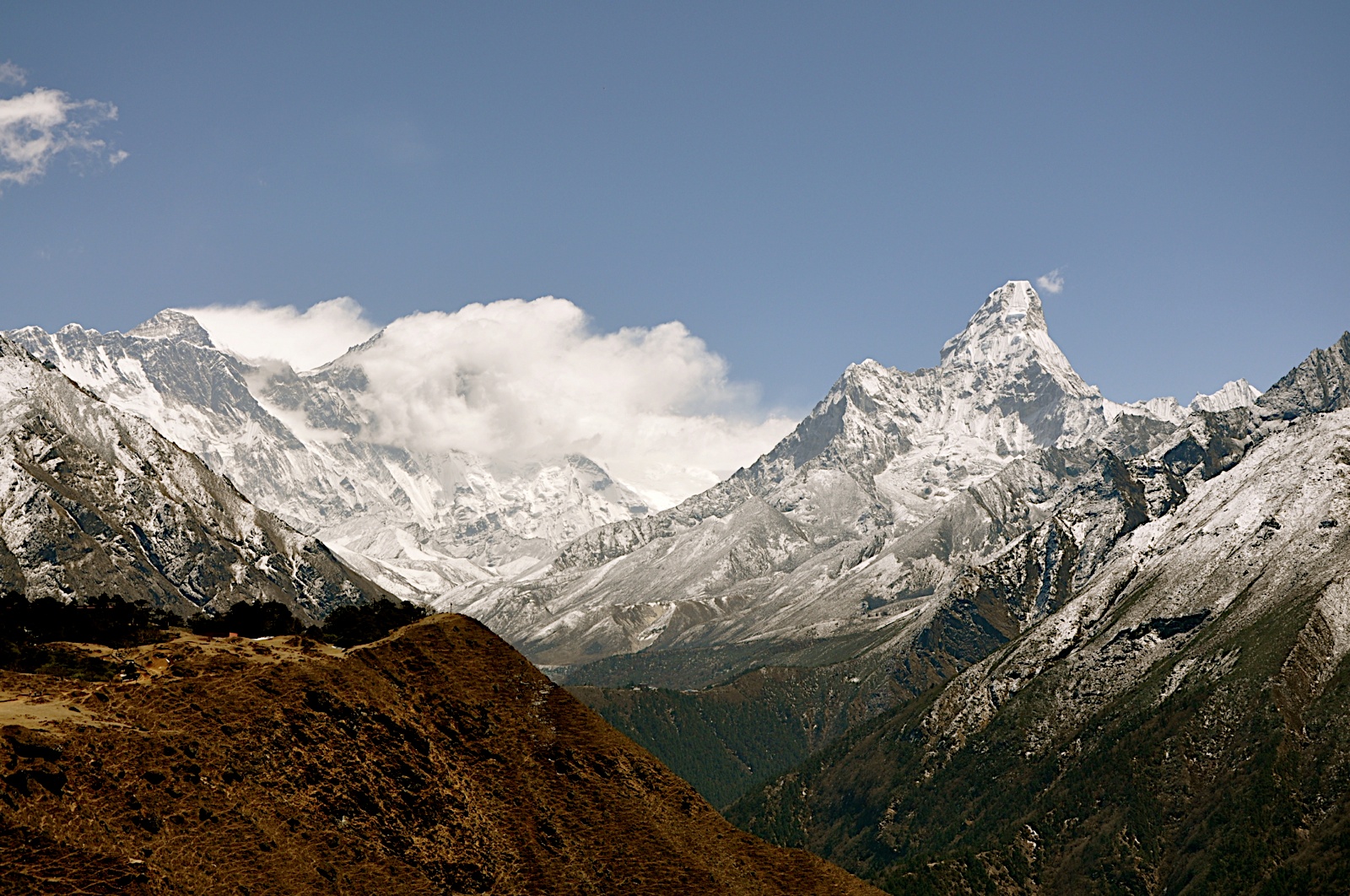
We'll start today with a bit of sad news. Explorer's Web is reporting that two climbers have died on Ama Dablam after suffering from high altitude pulmonary edema (HAPE) or altitude sickness. They were Russian guide Victor Igolkin, and a Russian journalist by the name of Pavel Ivanovsky. They were in Base Camp at 5000 meters (16,404 ft) at the time. The 6812 meter (22,349 ft) mountain is a popular climbing peak for those testing their skills in the Himalaya, and it has one of the more well known, and dramatic profiles of any of the peaks in the Khumbu region. The two men were preparing to make a summit bid when they took ill. My condolences to friend and family.
In the same report, ExWeb also says that a team of Ukrainian climbers have put up a new route on Lobuche East. Details are a bit sparse, but apparently they spent 8 days on the ascent, with 3 nights spent out on the big wall. After completing the route, which they named Two Arrows Flight, they made a harrowing descent in heavy snow, with no visibility. Thankfully, it seems that they were able to get down safely.
Elsewhere, Mike Horn and Fred Roux have returned to Advanced Base Camp on Makalu, where they are preparing to make their summit push over the next three days, weather permitting. They hope to make an alpine style ascent, without bottled oxygen or Sherpa support. The two men have already been as high as 7700 meters (25,262 ft) in a bid for the summit last week, but were turned back due to high winds and a looming storm. They're hoping to have more success this time out.
Chris Jensen Burke is also on Makalu, and her latest audio dispatch says that her team has just returned to ABC after spending a few nights in C1 and C2. She says that they are about five days behind some of the lead teams, and that there are a few teams that are about the same number of days behind hers. That means that everyone is staggered out nicely across the route, which should eliminate any traffic jam issues when summit day comes.
Over on Cho Oyu, Mike and Matt Moniz are back in ABC after spending some time at Camps 1 and 2 as well. They are now waiting for a weather window to open so they can launch their summit bid as well. The next couple of days look dicey, but they may be able start the ascent later in the week. You may recall, this father-son team were hoping to acclimate on Cho Oyu in Tibet, then go back to Nepal to attempt an Everest-Lhotse double header. While Lhotse remains out of reach, the question is whether or not they might get a shot at Everest from the North Side. We know that China is not allowing anyone to cross over into Tibet who wasn't originally scheduled to be there, which has left those climbers from the South Side out in the cold. But perhaps Mike and Matt will be successful in getting on someone else's permit for Everest since they are already on the Tibetan side of the border. They are squarely focused on the challenge of Cho Oyu at the moment, so we'll just have to wait to see how things progress.
Of course, things on Everest are moving ahead as well. Expect a longer update from that mountain in the next day or two, but the teams have now moved up to the North Col, and have done some acclimatization there, while they wait for the Sherpas to fix ropes to the summit. The installation of the ropes will likely be complete sometime late next week, which frees up the teams to start their summit bids as well.
Lots of things happening at the moment. I'll keep you posted of any new developments.
We'll start today with a bit of sad news. Explorer's Web is reporting that two climbers have died on Ama Dablam after suffering from high altitude pulmonary edema (HAPE) or altitude sickness. They were Russian guide Victor Igolkin, and a Russian journalist by the name of Pavel Ivanovsky. They were in Base Camp at 5000 meters (16,404 ft) at the time. The 6812 meter (22,349 ft) mountain is a popular climbing peak for those testing their skills in the Himalaya, and it has one of the more well known, and dramatic profiles of any of the peaks in the Khumbu region. The two men were preparing to make a summit bid when they took ill. My condolences to friend and family.
In the same report, ExWeb also says that a team of Ukrainian climbers have put up a new route on Lobuche East. Details are a bit sparse, but apparently they spent 8 days on the ascent, with 3 nights spent out on the big wall. After completing the route, which they named Two Arrows Flight, they made a harrowing descent in heavy snow, with no visibility. Thankfully, it seems that they were able to get down safely.
Elsewhere, Mike Horn and Fred Roux have returned to Advanced Base Camp on Makalu, where they are preparing to make their summit push over the next three days, weather permitting. They hope to make an alpine style ascent, without bottled oxygen or Sherpa support. The two men have already been as high as 7700 meters (25,262 ft) in a bid for the summit last week, but were turned back due to high winds and a looming storm. They're hoping to have more success this time out.
Chris Jensen Burke is also on Makalu, and her latest audio dispatch says that her team has just returned to ABC after spending a few nights in C1 and C2. She says that they are about five days behind some of the lead teams, and that there are a few teams that are about the same number of days behind hers. That means that everyone is staggered out nicely across the route, which should eliminate any traffic jam issues when summit day comes.
Over on Cho Oyu, Mike and Matt Moniz are back in ABC after spending some time at Camps 1 and 2 as well. They are now waiting for a weather window to open so they can launch their summit bid as well. The next couple of days look dicey, but they may be able start the ascent later in the week. You may recall, this father-son team were hoping to acclimate on Cho Oyu in Tibet, then go back to Nepal to attempt an Everest-Lhotse double header. While Lhotse remains out of reach, the question is whether or not they might get a shot at Everest from the North Side. We know that China is not allowing anyone to cross over into Tibet who wasn't originally scheduled to be there, which has left those climbers from the South Side out in the cold. But perhaps Mike and Matt will be successful in getting on someone else's permit for Everest since they are already on the Tibetan side of the border. They are squarely focused on the challenge of Cho Oyu at the moment, so we'll just have to wait to see how things progress.
Of course, things on Everest are moving ahead as well. Expect a longer update from that mountain in the next day or two, but the teams have now moved up to the North Col, and have done some acclimatization there, while they wait for the Sherpas to fix ropes to the summit. The installation of the ropes will likely be complete sometime late next week, which frees up the teams to start their summit bids as well.
Lots of things happening at the moment. I'll keep you posted of any new developments.
Labels:
Ama Dablam,
Cho Oyu,
Himalaya,
Makalu,
Mountaineering,
Nepal,
Tibet
Friday, May 2, 2014
Everest 2014: Acclimatization and Pujas on the North Side
With the South Side of Everest shut down, it is certainly a much quieter season on the Big Hill than anyone of us could have ever anticipated. Still, work continues on the North Side, where the teams are acclimatizing and preparing themselves for the challenges ahead.
The 7 Summits Club posted an update on their progress this morning, and all seems to be going according to plan. The team has been divided into two groups, with the first squad in Advanced Base Camp, and the other on their way there today. Tomorrow, the first members of the team will go to the Camp 1 at the North Col, and in anticipation of that, they have been working on their fixed rope skills. Once the entire team is together in ABC, they'll also hold their Puja ceremony, asking for the blessing from the mountain before beginning the climb.
Adventure Peaks posted an update a few days back, saying they were in day 3 of their 5 day rest period before they began their next rotation. That should mean that they are ready to proceed up again today, possibly with an eye on heading to the North Col as well. They report that the weather in Base Camp has been warm, and calm, although winds are blowing harder higher up on the mountain.
Similarly, the Asian Trekking squad appears to be on a the same trajectory as the teams mentioned above. They have climbers in ABC at the moment as well, so it looks like everyone is taking advantage of the current weather window to get in some time at altitude, to let their bodies acclimate to the conditions.
It is important to note that climbing on the North Side differs a bit from climbing on the South. In Nepal, the large commercial teams work together to fix the ropes and prepare the route to the summit. On the North Side, a special team of Sherpas, under the guidance of the Chinese Tibet Mountaineering Association (CTMA), takes care of all of the work themselves. So, while the teams are busy prepping for their climb, the CTMA team is ensuring that they'll have a route to the top, including securing the ladder at the Second Step to grant them access.
Obviously the route is much different on this side of the mountain too. Climbers don't have to deal with the Khumbu Icefall, which makes the early portions of the climb safer. But once they near the summit, they are a bit more exposed, and some of the sections of the ascent are a bit more technical as well. The North Side may be a bit more challenging in that respect, although really the level of difficulty is about the same, the challenges are just different.
It appears that most of the teams that are still on the mountain will spend the weekend in Camp 1. I would expect them to drop back to BC next week, before heading higher again after that. Their current schedule has the rope fixing completed around May 15, weather permitting of course. After that, the teams will see when the first window will arrive before they start their summit pushes. With 100 climbers on the Tibetan side of the mountain this spring, there will be a steady stream of people heading up during that first push, but the North Side doesn't have the same issues with over crowding as the South Side does, so it should be a fairly orderly ascent.
Stay tuned for more updates in the days ahead. Lots more to come as the season unfolds.
The 7 Summits Club posted an update on their progress this morning, and all seems to be going according to plan. The team has been divided into two groups, with the first squad in Advanced Base Camp, and the other on their way there today. Tomorrow, the first members of the team will go to the Camp 1 at the North Col, and in anticipation of that, they have been working on their fixed rope skills. Once the entire team is together in ABC, they'll also hold their Puja ceremony, asking for the blessing from the mountain before beginning the climb.
Adventure Peaks posted an update a few days back, saying they were in day 3 of their 5 day rest period before they began their next rotation. That should mean that they are ready to proceed up again today, possibly with an eye on heading to the North Col as well. They report that the weather in Base Camp has been warm, and calm, although winds are blowing harder higher up on the mountain.
Similarly, the Asian Trekking squad appears to be on a the same trajectory as the teams mentioned above. They have climbers in ABC at the moment as well, so it looks like everyone is taking advantage of the current weather window to get in some time at altitude, to let their bodies acclimate to the conditions.
It is important to note that climbing on the North Side differs a bit from climbing on the South. In Nepal, the large commercial teams work together to fix the ropes and prepare the route to the summit. On the North Side, a special team of Sherpas, under the guidance of the Chinese Tibet Mountaineering Association (CTMA), takes care of all of the work themselves. So, while the teams are busy prepping for their climb, the CTMA team is ensuring that they'll have a route to the top, including securing the ladder at the Second Step to grant them access.
Obviously the route is much different on this side of the mountain too. Climbers don't have to deal with the Khumbu Icefall, which makes the early portions of the climb safer. But once they near the summit, they are a bit more exposed, and some of the sections of the ascent are a bit more technical as well. The North Side may be a bit more challenging in that respect, although really the level of difficulty is about the same, the challenges are just different.
It appears that most of the teams that are still on the mountain will spend the weekend in Camp 1. I would expect them to drop back to BC next week, before heading higher again after that. Their current schedule has the rope fixing completed around May 15, weather permitting of course. After that, the teams will see when the first window will arrive before they start their summit pushes. With 100 climbers on the Tibetan side of the mountain this spring, there will be a steady stream of people heading up during that first push, but the North Side doesn't have the same issues with over crowding as the South Side does, so it should be a fairly orderly ascent.
Stay tuned for more updates in the days ahead. Lots more to come as the season unfolds.
Thursday, May 1, 2014
Himalaya 2014: First Summits Of The Season!
With all of the press surrounding Everest over the past few weeks, it is easy to forget that there are other climbs taking place throughout the Himalaya. While everyone watched to see how things would unfold on the Big Hill, other teams were quietly going about their business. As a result, we now have our first successful summits of the season, with a trio of climbers topping out on Shishapangma yesterday.
ExWeb is reporting that Peter Hámor, Horia Colibasanu and Justin Ionescu reached the 8027 meter (26,335 foot) summit of Shisha on the morning of April 30. They made the climb without the use of bottled oxygen, and they did not use high altitude Sherpas to support the expedition. For Hámor, this was his 12 successful summit of an 8000 meter peak, and the 8th for Colibasanu. All three men are reportedly safely back down the mountain.
Elsewhere, Mike Horn and Fred Roux made it up to 7700 meters (25,262 ft) on Makalu before turning back on their summit attempt. High winds and extremely cold temperatures prevented them from reaching the top. They descended to ABC yesterday and will continue down to Base Camp today, where they'll wait for another weather window.
On their way down, they passed a team of Sherpas fixing ropes to the summit. The installation of those ropes will no doubt aid other climbers, such as Chris Jensen Burke, who will be making summit pushes in the days ahead, once they have completed their acclimatization process. Mike and Fred speculated that some of the Sherpas had transferred over from Everest in order to keep working this season.
Over on Cho Oyu, Matt and Mike Moniz are back in BC after spending some time at altitude while they acclimatized. They report that the winds have dropped significantly on that mountain, but heavy snows have followed, making it tough to move up at the moment. They are expecting a storm to hit this weekend, but after that another weather window opens. They hope to take advantage of it to make a possible summit bid.
Stay tuned for more updates in the days ahead. It looks like things are just about to get busy in the Himalaya.
ExWeb is reporting that Peter Hámor, Horia Colibasanu and Justin Ionescu reached the 8027 meter (26,335 foot) summit of Shisha on the morning of April 30. They made the climb without the use of bottled oxygen, and they did not use high altitude Sherpas to support the expedition. For Hámor, this was his 12 successful summit of an 8000 meter peak, and the 8th for Colibasanu. All three men are reportedly safely back down the mountain.
Elsewhere, Mike Horn and Fred Roux made it up to 7700 meters (25,262 ft) on Makalu before turning back on their summit attempt. High winds and extremely cold temperatures prevented them from reaching the top. They descended to ABC yesterday and will continue down to Base Camp today, where they'll wait for another weather window.
On their way down, they passed a team of Sherpas fixing ropes to the summit. The installation of those ropes will no doubt aid other climbers, such as Chris Jensen Burke, who will be making summit pushes in the days ahead, once they have completed their acclimatization process. Mike and Fred speculated that some of the Sherpas had transferred over from Everest in order to keep working this season.
Over on Cho Oyu, Matt and Mike Moniz are back in BC after spending some time at altitude while they acclimatized. They report that the winds have dropped significantly on that mountain, but heavy snows have followed, making it tough to move up at the moment. They are expecting a storm to hit this weekend, but after that another weather window opens. They hope to take advantage of it to make a possible summit bid.
Stay tuned for more updates in the days ahead. It looks like things are just about to get busy in the Himalaya.
Labels:
Cho Oyu,
Himalaya,
Makalu,
Mountaineering,
Nepal,
Shishapangma,
Tibet
Monday, April 28, 2014
Everest 2014: All Eyes Turn North
With all of the climbing expeditions on Everest's South Side cancelled for the year, the mountain has gotten very quiet in terms of the usual activity we see in the spring. But not everyone is done with the world's tallest mountain, as there are still a number of teams climbing on the North Side in Tibet. It is estimated that about 100 climbers will attempt to summit from that side of the mountain in the weeks ahead, and while word of the turmoil on the South Side has no doubt reached their ears, they are busy preparing for the challenges they will face.
The 7 Summits Club is a fixture on the North Side, climbing there every spring season. This year, their team consists of 19 mountaineers, all of whom have moved up to Advanced Base Camp at 6400 meters (20,997 ft) as part of their acclimatization rotation. Their Sherpa team has also built their camp at the North Col, located at 7000 meters (22,965 ft), where they'll proceed upwards later this week. With the South Side teams now all gone, 7 Summit Clubs holds the distinction of being the largest team on the mountain, something I'm sure their guides never thought they'd see.
The Asian Trekking squad has been following a similar path, spending some time in ABC before descending back to Base Camp. This is all part of their normal acclimatization rotations as they get ready for the higher altitudes to come. If the weather cooperated, they had hoped to move up to the North Col this past weekend, but there hasn't been any word yet if they actually reached this point.
Climbing on the North Side of Everest is very different in a lot of way. Obviously the route to the summit is complete unique, with its own set of challenges that need to be overcome, including the infamous Second Step, which is negotiated with the help of a ladder. But aside from that, the climate in North Side Base Camp is quite different from that on the South Side. The Chinese control all aspects of the climb, and rather than having the large commercial teams working together to fix ropes, they employ a team of Sherpas with the specific task of ensuring a safe route to the summit. This allows the teams to focus on acclimatizing, while the ropes are installed by a completely independent group.
Of course, the North Side is also much less crowded. In recent years, the Chinese have shut down climbing on that side of Everest due to political unrest, and their own agenda for taking the Olympic torch so the summit a few years back. Because of the uncertainty this has created, many climbers have decided to go to the South Side in order to avoid these kinds of issues. While there hasn't been a shutdown for several years now, the North Side remains much quieter than the South as a result.
Updates from Everest will continue in the days and weeks ahead. There will be fewer teams to report on of course, but the season will continue to unfold as it always has. Look for the first summit bids to begin sometime around mid-May, depending on how the weather shapes up. Wish so few people still on the mountain, there could be just one or two summit waves, and then it'll all be over. We'll just have to wait to see how the season develops.
Back on the South Side, some Sherpas were flown to Camp 1 and 2 by helicopter to collect gear. They've stashed much of their supplies for next season at C2, which is an unprecedented move. Most of the teams have left the mountain, and are now on their way back home, while a few others will focus on some of the lesser peaks in the region before calling it a day. A great deal of uncertainty remains about the future of climbing on Everest in Nepal, and there will be many issues to resolve before the 2015 season gets underway. It will certainly be interesting to see how things shape up in the months ahead.
More updates will follow, both on the progress on the North Side, and the political developments.
The 7 Summits Club is a fixture on the North Side, climbing there every spring season. This year, their team consists of 19 mountaineers, all of whom have moved up to Advanced Base Camp at 6400 meters (20,997 ft) as part of their acclimatization rotation. Their Sherpa team has also built their camp at the North Col, located at 7000 meters (22,965 ft), where they'll proceed upwards later this week. With the South Side teams now all gone, 7 Summit Clubs holds the distinction of being the largest team on the mountain, something I'm sure their guides never thought they'd see.
The Asian Trekking squad has been following a similar path, spending some time in ABC before descending back to Base Camp. This is all part of their normal acclimatization rotations as they get ready for the higher altitudes to come. If the weather cooperated, they had hoped to move up to the North Col this past weekend, but there hasn't been any word yet if they actually reached this point.
Climbing on the North Side of Everest is very different in a lot of way. Obviously the route to the summit is complete unique, with its own set of challenges that need to be overcome, including the infamous Second Step, which is negotiated with the help of a ladder. But aside from that, the climate in North Side Base Camp is quite different from that on the South Side. The Chinese control all aspects of the climb, and rather than having the large commercial teams working together to fix ropes, they employ a team of Sherpas with the specific task of ensuring a safe route to the summit. This allows the teams to focus on acclimatizing, while the ropes are installed by a completely independent group.
Of course, the North Side is also much less crowded. In recent years, the Chinese have shut down climbing on that side of Everest due to political unrest, and their own agenda for taking the Olympic torch so the summit a few years back. Because of the uncertainty this has created, many climbers have decided to go to the South Side in order to avoid these kinds of issues. While there hasn't been a shutdown for several years now, the North Side remains much quieter than the South as a result.
Updates from Everest will continue in the days and weeks ahead. There will be fewer teams to report on of course, but the season will continue to unfold as it always has. Look for the first summit bids to begin sometime around mid-May, depending on how the weather shapes up. Wish so few people still on the mountain, there could be just one or two summit waves, and then it'll all be over. We'll just have to wait to see how the season develops.
Back on the South Side, some Sherpas were flown to Camp 1 and 2 by helicopter to collect gear. They've stashed much of their supplies for next season at C2, which is an unprecedented move. Most of the teams have left the mountain, and are now on their way back home, while a few others will focus on some of the lesser peaks in the region before calling it a day. A great deal of uncertainty remains about the future of climbing on Everest in Nepal, and there will be many issues to resolve before the 2015 season gets underway. It will certainly be interesting to see how things shape up in the months ahead.
More updates will follow, both on the progress on the North Side, and the political developments.
Monday, April 21, 2014
Everest 2014: Picking Up The Pieces
It was a sad, somber weekend on both the North and South Side of Everest following the massive avalanche that claimed as many as 16 lives on the Nepali side of the mountain last Friday. It was the single most deadly accident in Everest history, and it will not only have a lasting impact on this season, but many seasons to come.
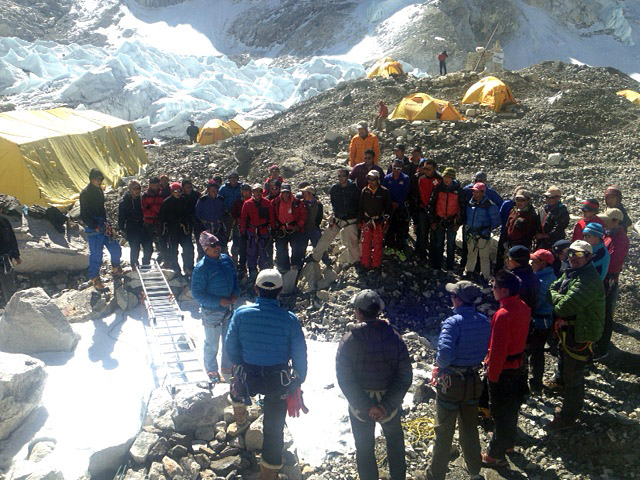
While the efforts to retrieve the bodies of the fallen continue, climbing on the South Side has come to a complete standstill. The Sherpa community is in shock, and mourning the loss of their brethren. As a result, they have asked for a 7-day moratorium on operations on the mountain, while they sort through their grief and come to terms with how to proceed. That means, none of the clients are moving up the slopes at the moment, while everyone waits to see what will happen next.
Over the weekend, the Sherpas met in BC and discussed their plans moving forward. Out of that meeting came a list of demands that they wanted to see fulfilled before they would resume their work. Alan Arnette summarized those demands, and they are as follows:
While the efforts to retrieve the bodies of the fallen continue, climbing on the South Side has come to a complete standstill. The Sherpa community is in shock, and mourning the loss of their brethren. As a result, they have asked for a 7-day moratorium on operations on the mountain, while they sort through their grief and come to terms with how to proceed. That means, none of the clients are moving up the slopes at the moment, while everyone waits to see what will happen next.
Over the weekend, the Sherpas met in BC and discussed their plans moving forward. Out of that meeting came a list of demands that they wanted to see fulfilled before they would resume their work. Alan Arnette summarized those demands, and they are as follows:
- Increment of immediate relief announced for avalanche victims
- Provide Rs 10 million (US$103,590) each to families of deceased
- Set up a memorial park in the name of the deceased in Kathmandu
- Cover all expenses for treatment of the injured
- Provide Rs 10 million (US$103,590) to critically hurt who cannot rejoin mountaineering activities
- Set up mountaineering relief fund with 30 per cent of royalty collected from issuing permits to different mountains (est $1M for 2014)
- Double the insurance amount to the mountaineering workers
- Provide additional chopper rescue to mountaineering support staff if insurance fails to cover the cost
- Provide perks and salaries, except summit bonus, through concerned agencies to Sherpas if they want to call off climbing this season
- Manage chopper to bring logistics and equipment from different camps if mountaineers decide to abandon climbing this season
- Don’t take action against SPCC icefall doctors if they refuse to fix ropes and ladders on the route this season
- Let the expedition members call off this season’s climbing if they wish so
If these demands are not met by the end of the week, there is a real chance that the Everest climbing season could be cancelled this year. The Sherpas are essentially threatening to walk off the mountain, which would bring a halt to the vast majority of expeditions. It is unclear at this time, what the response to these demands will be.
In the wake of the tragic accident, the Discovery Channel has cancelled its planned coverage of Joby Ogwyn's attempt to summit, then jump off the top in a wing-suit. Ogwyn says that he is still going ahead with his plans, it just won't be televised now.
The rest of the teams are in a holding pattern while they decide what to do. There are some reports of climbers already leaving BC and heading back to Kathmandu, while others wait to see how things will unfold. Dave Hahn, one of the top guides in the world working for RMI, said in a dispatch: "Our Sherpa partners love their jobs and love to climb, but nobody is climbing now and all are struggling to come to terms with how to proceed in a way that honors those lost and protects those left alive."
Similarly, my friend Gulnur Tumbat, who is in Base Camp now, posted this to her blog: "The mountain is shut down at the moment and this season is to bedeclared as "Black Year" with the deadliest day ever. We are exhausted and broken. We are trying to figure out what to do."
Both quotes give you an idea of the mood on the mountain right now.
Word of the tragic events that occurred on the South Side, spread quickly to the North as well, where, the Sherpa teams are mourning the loss of friends and family too. But teams like the 7 Summits Club and Adventure Peaks have begun to arrive in Base Camp there, and work is proceeding on that side of the mountain. There are preliminary plans for the first climbers to head up to Advanced Base Camp today, as the acclimatization rotations begin. There will be further reports from the North Side as things unfold.
As you can see, it is another strange year on Everest, with tragedy creating unusual circumstances. What will happen over the next few days remains to be seen, and it is possible that even if he Nepali government meets on the requirements of the Sherpas, that the season will be cancelled anyway. It is a sad, uncertain time on the mountain, and my heart goes out to everyone who is there right now.
Friday, April 18, 2014
Himalaya 2014: Progress Reports From Other Mountains
While hearts are heavy with the news from Everest today, climbers on other peaks have been checking in with progress reports as well. Much like the teams on the Big Hill, they are mostly just getting underway, and starting their acclimatization process. But with the season starting to roll, there will be more things to report soon.
Denis Urubko and his team, which includes, Artem Brown, Adam Bielecki, and Alex Txikon, are on their way to Kangchenjunga where they will soon begin their attempt of a new route on the North Face of that mountain. At 8586 meters (28,169 feet) in height, it is the third tallest peak in the world, behind only K2 and Everest. It is also a considerable challenge to climb no matter which route you choose. After acclimatizing in the region, Denis and company will attempt an alpine style ascent, without Sherpa support at altitude. They should arrive in Base Camp this weekend.
Mike Horn and Fred Roux are now in BC on Makalu, where they'll be attempting an alpine style ascent as well. They'll also being going up without Sherpa support, and sans bottled oxygen. They are just starting to get settled into place, and haven't posted too many updates just yet, but expect to hear more from them soon. Makalu is the fifth tallest mountain in the world, standing 8481 meters (27,825 ft) in height.
Aussie climber Chris Jensen Burke has her sights set squarely on Makalu this spring as well, and should arrive in Base Camp today. She reports heavy snow on the trail, but BC is said to have no powder at the moment. This will serve as a warm-up for other things to come. This summer, Chris will head to Pakistan to attempt K2.
Finally, Mike and Matt Moniz are on Cho Oyu, where they are acclimatizing for their first 8000 meter peak of the year. The father and son team (Matt is just 16 years old), are attempting to put together a Himalayan triple-header this spring. Once they wrap up their climb in Tibet, they'll jump back across the border to Nepal, where they'll attempt Everest and Lhotse as well. They report that things are going great so far, and their first rotations have been successful ones.
Denis Urubko and his team, which includes, Artem Brown, Adam Bielecki, and Alex Txikon, are on their way to Kangchenjunga where they will soon begin their attempt of a new route on the North Face of that mountain. At 8586 meters (28,169 feet) in height, it is the third tallest peak in the world, behind only K2 and Everest. It is also a considerable challenge to climb no matter which route you choose. After acclimatizing in the region, Denis and company will attempt an alpine style ascent, without Sherpa support at altitude. They should arrive in Base Camp this weekend.
Mike Horn and Fred Roux are now in BC on Makalu, where they'll be attempting an alpine style ascent as well. They'll also being going up without Sherpa support, and sans bottled oxygen. They are just starting to get settled into place, and haven't posted too many updates just yet, but expect to hear more from them soon. Makalu is the fifth tallest mountain in the world, standing 8481 meters (27,825 ft) in height.
Aussie climber Chris Jensen Burke has her sights set squarely on Makalu this spring as well, and should arrive in Base Camp today. She reports heavy snow on the trail, but BC is said to have no powder at the moment. This will serve as a warm-up for other things to come. This summer, Chris will head to Pakistan to attempt K2.
Finally, Mike and Matt Moniz are on Cho Oyu, where they are acclimatizing for their first 8000 meter peak of the year. The father and son team (Matt is just 16 years old), are attempting to put together a Himalayan triple-header this spring. Once they wrap up their climb in Tibet, they'll jump back across the border to Nepal, where they'll attempt Everest and Lhotse as well. They report that things are going great so far, and their first rotations have been successful ones.
Labels:
Cho Oyu,
Himalaya,
Kangchenjunga,
Makalu,
Mountaineering,
Nepal,
Tibet
Wednesday, April 16, 2014
Everest 2014: Into The Icefall
Communications from Everest Base Camp on the South Side continue to be sporadic, as cloud cover and snowfall limit access to satellites and keep solar panels from charging the comms equipment. Still, there have been a few reports from the mountain the past few days, where the teams are busy making themselves at home, and starting to acclimatize to the altitude. The first groups have even begun to make their way through the dreaded Khumbu Icefall, as they prepare for their first rotations in Camp 1 and Camp 2.
As I've mentioned previously, the Icefall is a treacherous section of the climb that sits just above Base Camp on the Nepali side of the mountain. It marks the spot where the Khumbu Glacier begins to calve, which makes it highly unstable. Each year, a special team of Sherpas called the Icefall Doctors build and maintain a route through the Icefall using ladders and ropes. That route will shift and change throughout the season, forcing them to rebuild the route over the course of the three months that it is in place.
Crossing the Icefall is one of the scariest and most dangerous sections of Everest. As a result, teams will try to minimize the number of times that they have to pass through it while on the mountain. IN recent years, that has meant starting their acclimatization on other nearby mountains, such as Lobuche and Pumori. But even that just delays the inevitable, and as I write this, the first teams are venturing into the Icefall to get themselves use to walking on, and climbing, the ladders while wearing their heavy mountaineering boots. It can be a tricky bit of work, but most will become accustomed to it in short order.
The Sherpas have already moved through the Icefall multiple times at this point. Reports indicate that they have been as high as Camp 2 on the South Side, where they have begun building tents and storing gear for the acclimatization climbs, and ultimately the final summit push, ahead. All of this is according to schedule, and before long they'll begin the hard work of fixing the ropes up to Camp 3 and higher.
Since the comms blackout is preventing much news from coming from the mountain just yet, I'll make this a fairly short update. But before I close things out, I wanted to point out an excellent essay written by Melissa Arnot for National Geographic Adventure. It is entitled "Everest: Now and Then, Again and Again," and in it, she shares her thoughts on why Everest is such a special place, not only for her, but the hundreds of other climbers that go there every year. Melissa is back in Base Camp again this season, where she is looking to add two more summits to her resume. With five already under her belt, she holds the record for a western climber, and could claim the record outright if successful this season.
That's all for today. Hopefully the comms situation will be sorted out soon, and we'll start to hear from more of the individual climbers in the days ahead.
As I've mentioned previously, the Icefall is a treacherous section of the climb that sits just above Base Camp on the Nepali side of the mountain. It marks the spot where the Khumbu Glacier begins to calve, which makes it highly unstable. Each year, a special team of Sherpas called the Icefall Doctors build and maintain a route through the Icefall using ladders and ropes. That route will shift and change throughout the season, forcing them to rebuild the route over the course of the three months that it is in place.
Crossing the Icefall is one of the scariest and most dangerous sections of Everest. As a result, teams will try to minimize the number of times that they have to pass through it while on the mountain. IN recent years, that has meant starting their acclimatization on other nearby mountains, such as Lobuche and Pumori. But even that just delays the inevitable, and as I write this, the first teams are venturing into the Icefall to get themselves use to walking on, and climbing, the ladders while wearing their heavy mountaineering boots. It can be a tricky bit of work, but most will become accustomed to it in short order.
The Sherpas have already moved through the Icefall multiple times at this point. Reports indicate that they have been as high as Camp 2 on the South Side, where they have begun building tents and storing gear for the acclimatization climbs, and ultimately the final summit push, ahead. All of this is according to schedule, and before long they'll begin the hard work of fixing the ropes up to Camp 3 and higher.
Since the comms blackout is preventing much news from coming from the mountain just yet, I'll make this a fairly short update. But before I close things out, I wanted to point out an excellent essay written by Melissa Arnot for National Geographic Adventure. It is entitled "Everest: Now and Then, Again and Again," and in it, she shares her thoughts on why Everest is such a special place, not only for her, but the hundreds of other climbers that go there every year. Melissa is back in Base Camp again this season, where she is looking to add two more summits to her resume. With five already under her belt, she holds the record for a western climber, and could claim the record outright if successful this season.
That's all for today. Hopefully the comms situation will be sorted out soon, and we'll start to hear from more of the individual climbers in the days ahead.
Monday, April 14, 2014
Everest 2014: Puja Ceremonies, Base Camp Arrivals and the Beginning Of The Climb
As expected, it was a busy weekend in the Himalayas, where most of the early teams have now arrived in Everest Base Camp on the South Side, or are en route to Chinese Base Camp on the North Side. After spending a couple of days getting settled in, most are now resting, acclimatizing, and going through a series of skills checks before they start their first forays up the mountain, where the weather reportedly remains cold and heavy snows have fallen.
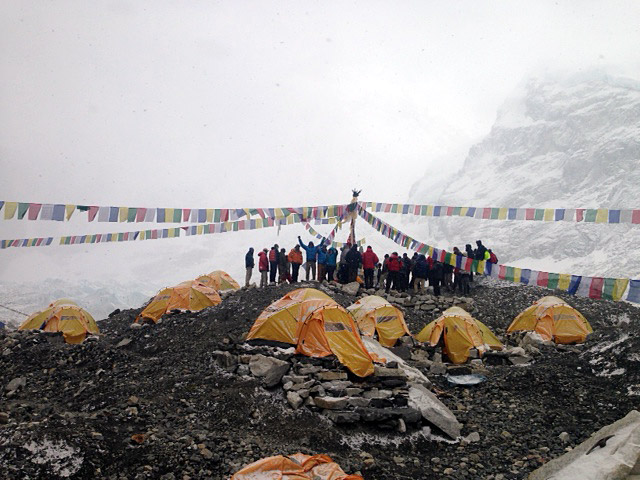
One of the most important steps before anyone begins their climb on Everest is to take part in a Puja ceremony. During the Puja, a Buddhist monk blesses the climbers, and their gear, while asking for permission from the mountain for them to climb its slopes. The Puja is especially significant to the Sherpas, who generally won't go above Base Camp without first receiving the blessing. While it is conducted in all seriousness, and is marks the true start of the climb, the Puja is also a good opportunity for the climbers to get to know their teammates better, and celebrate ahead of the start of the serious work.
Over the past few days, a number of teams have completed their Puja ceremony and are now prepping for their first rotation up to Camp 1, or have left BC to acclimatize on one of the lesser peaks in the region, such as Lobuche. That's where the IMG team is at right now, and they hope to summit today, before heading back to Everest. Similarly, the Peak Freaks squad will be headed off to Island Peak for their acclimatization climb. After which, these climbers will venture into the Khumbu Icefall for the first time.
Several teams are reporting issues with their communications systems in BC at the moment, with Himex, RMI and the Altitude Junkies weighing in on the topic. The satellite BGAN system is not working properly, while the cell towers in Gorak Shep have intermittent access at best. Heavy cloud cover in the region is mostly to blame, as that won't just prevent satellite connections, but the cell towers are powered by solar panels. As the season progresses, clearer skies will make help to facilitate better comms, but for now they'll have to be patient.
My friend Gulnur Tumbat reached Base Camp last Friday, but the communications problems are preventing her from sharing too much about the experience just yet. She is hoping to become the first Turkish woman to summit Everest. Blind German climber Andy Holzer should be there now as well, as he looks to become the second person to summit without the use of his eyes. Melissa Arnot has not checked in just yet, but she should be settling into BC on the South Side as well.
If you're interested to know more about the logistics of an Everest climb, check out this article from Outside Online which introduces us to Adrian Ballinger, the founder of Alpenglow Expeditions. The company takes a unique approach to a climb up the highest mountain not he planet, that is both quicker and more expensive than most other guide services. It is an interesting read about how Adrian is trying to change the approach to climbing Everest, which he says has mostly gone unchanged for decades.
Expect some updates to begin to flow in from the Tibetan side of the mountain in the next few days. Base Camp on the North Side is still becoming fully operational, but there should be plenty of action to report there soon as well. I would expect a major team meeting to take place on the South Side this week, as they begin organizing the efforts to fix ropes to the summit. That isn't a concern on the North Side, where the Chinese take full responsibility for that process.
Once the comms situation is sorted out, I'm sure we'll start to get more news. For now, sit tight and know that things are just getting started.
One of the most important steps before anyone begins their climb on Everest is to take part in a Puja ceremony. During the Puja, a Buddhist monk blesses the climbers, and their gear, while asking for permission from the mountain for them to climb its slopes. The Puja is especially significant to the Sherpas, who generally won't go above Base Camp without first receiving the blessing. While it is conducted in all seriousness, and is marks the true start of the climb, the Puja is also a good opportunity for the climbers to get to know their teammates better, and celebrate ahead of the start of the serious work.
Over the past few days, a number of teams have completed their Puja ceremony and are now prepping for their first rotation up to Camp 1, or have left BC to acclimatize on one of the lesser peaks in the region, such as Lobuche. That's where the IMG team is at right now, and they hope to summit today, before heading back to Everest. Similarly, the Peak Freaks squad will be headed off to Island Peak for their acclimatization climb. After which, these climbers will venture into the Khumbu Icefall for the first time.
Several teams are reporting issues with their communications systems in BC at the moment, with Himex, RMI and the Altitude Junkies weighing in on the topic. The satellite BGAN system is not working properly, while the cell towers in Gorak Shep have intermittent access at best. Heavy cloud cover in the region is mostly to blame, as that won't just prevent satellite connections, but the cell towers are powered by solar panels. As the season progresses, clearer skies will make help to facilitate better comms, but for now they'll have to be patient.
My friend Gulnur Tumbat reached Base Camp last Friday, but the communications problems are preventing her from sharing too much about the experience just yet. She is hoping to become the first Turkish woman to summit Everest. Blind German climber Andy Holzer should be there now as well, as he looks to become the second person to summit without the use of his eyes. Melissa Arnot has not checked in just yet, but she should be settling into BC on the South Side as well.
If you're interested to know more about the logistics of an Everest climb, check out this article from Outside Online which introduces us to Adrian Ballinger, the founder of Alpenglow Expeditions. The company takes a unique approach to a climb up the highest mountain not he planet, that is both quicker and more expensive than most other guide services. It is an interesting read about how Adrian is trying to change the approach to climbing Everest, which he says has mostly gone unchanged for decades.
Expect some updates to begin to flow in from the Tibetan side of the mountain in the next few days. Base Camp on the North Side is still becoming fully operational, but there should be plenty of action to report there soon as well. I would expect a major team meeting to take place on the South Side this week, as they begin organizing the efforts to fix ropes to the summit. That isn't a concern on the North Side, where the Chinese take full responsibility for that process.
Once the comms situation is sorted out, I'm sure we'll start to get more news. For now, sit tight and know that things are just getting started.
Thursday, April 10, 2014
Everest 2014: A Wedding In Base Camp
As I write this, teams of climbers are now en route to Everest Base Camp from both sides of the mountain. For the past week or so, we've been following the teams trekking in the Khumbu Valley on their way to BC on the South Side in Nepal. But as of today, the borders into Tibet have opened to climbers as well, allowing the teams heading to the North Side to start their journey at last. On that side of the mountain, it is possible to actually drive to the campsite, although they'll still take a couple of days to get there, as they slowly acclimatize along the way. A few years back, the Chinese actually paved the road leading up to Base Camp, which makes for a faster and smoother ride, but the body can't handle the transition at such a fast pace, so most will travel at their leisure, stopping frequently along the way. Expect to start getting news from the North Side in just a few days.
Meanwhile, the teams on the South Side continue to stream into BC as expected. Himex boss Russell Brice arrived on Tuesday, and reports that his Sherpa teams have everything ready for his clients when they arrive. Russell is well known for being an innovator in terms of services he offers his climbers, and this year is no exception. Himex is working with a Nepalese telecom company called Mercantile to provide data connections while in Base Camp. That means that his climbers will be able to use their own laptops and other device to send and receive email, via WiFi that is hooked up in the famous "White Pod" that is part of the Himex campsite. While they won't be streaming Netflix while in the Khumbu, they will be able to stay more connected to friends and family back home.
The second IMG team arrived in BC yesterday, reuniting their entire group. But the best news from their dispatches is that two members of the team were married in the shadow of Everest on Tuesday. Team members "Loretta and Jim" exchanged vows in what has to be one of the best settings for a wedding in history. Jim will stay to climb Everest this spring, while his new bride came along for the trek. She has already left for the hike back down the valley and will be back in Kathmandu in a few days.
The rest of the IMG squad hasn't been resting on their laurels. Since the climbers arrived a few days back, they've been honing their climbing skills on the glacier and learning to work together as a team. Some of they have already transferred over to Lobuche Peak, where they will under go an acclimatization climb before heading up the slopes of Everest.
There haven't been any updates from the Altitude Junkies or Peak Freaks for a few days, but both should be quickly approaching Base Camp now. Once there, they should be able to send off a dispatch once again, letting us know their status and plans. The Adventure Consultants were departing Pheriche yesterday, which means they should probably arrive in BC tomorrow. '
A couple of other climbers to keep your eye on this spring include Andy Holzer, a blind climber who will attempt to become the second person to scale Everest without sight. He reached Namche Bazzaar yesterday, so is still a few days away from Base Camp. Also, Chris Jensen Burke is up to her old tricks in the Himalaya this spring. The Aussie alpinist is headed to Makalu this spring as a tune-up climb for her attempt on K2 later this year. We've followed Chris' climbs with great interest over the past few years, and will continue to do so this year. She is quickly becoming one of the more decorated female mountaineers in the world.
That's all for today. As you can tell, things are starting to heat up in the Himalaya. There will be lots more to report following this weekend I'm sure.
Tuesday, April 8, 2014
Everest 2014: Cold In The Khumbu
Just a brief update from the Himalaya this morning, as not much has changed since yesterday. The teams are continuing their trek to Everest Base Camp, with a few more climbers trickling into that point each day. Most will arrive by the end of the week, but for now, BC remains fairly quiet. Those who are there however, will likely begin their first acclimatization rotations in the next day or two, as the Icefall route is open, and the ropes are in place all the way up to Camp 2.
Weather in the Khumbu Valley is said to be on the poor side at the moment. Alan Arnette reports that flights to Lukla have been canceled, leaving some teams to take a bus to Jiri, which allows them to get to Lukla on foot. It adds some time on the trail for their trek, but at this point the they're happy to just be moving.
The Peak Freaks are on their way to EBC, and they checked in with a report on conditions in Pheriche, one of the villages that is a popular stop over spot on the hike up the valley. They report "bone chilling" cold, mixed with rain, which is never a good mix when you're trying to stay warm. Temperatures are said to be about -4ºC/24.8ºF at the moment, and they'll continue to drop as the team draws closer to Base Camp, where the mercury is hovering around -20ºC/-4ºF. But as Becky Rippel, wife of team leader Tim, points out, this is normal for early spring in the Himalaya, and things will start to warm up soon. In contrast, the temperatures on the summit are currently -60ºC/-76ºF, with 95km/h (59 mph) winds. Both will have to improve greatly before anyone goes near the summit too.
The route to Base Camp on the South Side has been busy for nearly a week, but those climbers waiting to head to the North Side in Tibet will have to remain patient for another couple of days. The Chinese will start to allow climbers to enter on Thursday, April 10, so we should start to see movement in that direction soon too. Unlike their counterparts on the South Side, the North Side climbers can actually drive to Base Camp, although they still have to take a couple of days to do so, in order to let their bodies become accustomed to the altitude.
That's the latest from the Himalaya this morning. More updates soon!
Weather in the Khumbu Valley is said to be on the poor side at the moment. Alan Arnette reports that flights to Lukla have been canceled, leaving some teams to take a bus to Jiri, which allows them to get to Lukla on foot. It adds some time on the trail for their trek, but at this point the they're happy to just be moving.
The Peak Freaks are on their way to EBC, and they checked in with a report on conditions in Pheriche, one of the villages that is a popular stop over spot on the hike up the valley. They report "bone chilling" cold, mixed with rain, which is never a good mix when you're trying to stay warm. Temperatures are said to be about -4ºC/24.8ºF at the moment, and they'll continue to drop as the team draws closer to Base Camp, where the mercury is hovering around -20ºC/-4ºF. But as Becky Rippel, wife of team leader Tim, points out, this is normal for early spring in the Himalaya, and things will start to warm up soon. In contrast, the temperatures on the summit are currently -60ºC/-76ºF, with 95km/h (59 mph) winds. Both will have to improve greatly before anyone goes near the summit too.
The route to Base Camp on the South Side has been busy for nearly a week, but those climbers waiting to head to the North Side in Tibet will have to remain patient for another couple of days. The Chinese will start to allow climbers to enter on Thursday, April 10, so we should start to see movement in that direction soon too. Unlike their counterparts on the South Side, the North Side climbers can actually drive to Base Camp, although they still have to take a couple of days to do so, in order to let their bodies become accustomed to the altitude.
That's the latest from the Himalaya this morning. More updates soon!
Thursday, March 27, 2014
Everest 2014: Teen Goes For Triple-Header, New Route On Kangchenjunga
As mentioned earlier in the week, it is a busy time in Kathmandu, where the climbing teams are now arriving ahead of the official start of their expeditions. Nepal's capital is a bit chaotic anytime of the year, but that is even more true now. Most are still organizing their gear and planning the last minute logistics of their adventure, while also trying to relax before they have to truly go to work. Over the next couple of months, we'll be sharing their stories as we follow along with their progress.
One climber that you'll be hearing a lot about in the weeks ahead is Matt Moniz. At the ripe old age of 16, Matt is already a veteran climber who has summited Kilimanjaro, Elbrus, Aconcagua, and Denali. A few years back, he and his dad Mike reached the highest point in each of the 50 U.S. states, accomplishing that task in just 43 days, and earning Matt the honor of being named one of National Geographic's adventurers of the year. Since then, his passion for the mountains has only grown, and this spring he'll attempt his first 8000 meter peak. Well, technically he'll attempt three of them.
Matt and Mike will head to Nepal next week, where they will begin an ambitious expedition. They'll first travel to Tibet where they'll acclimatize and test teen's skill on Cho Oyu, an 8201 meter (26,906 ft) mountain that is considered one of the easier 8-thousanders, if you can call any of them easy. If all goes according to plan, they'll summit around mid-May, then transfer back to Nepal, where they'll travel to Everest Base Camp on the South Side. From there, they'll have a go at the 8848 meter (29,029 ft) summit of Everest. If successful on the tallest mountain on the planet, and conditions are right, they'll then try to summit nearby Lhotse (8516 meters/27,940 ft) as well. Since Everest and Lhotse share much of the same route, they hopefully won't need to descend back to BC, but can link up both summits in a single push.
Whether or not they'll be successful has yet to be seen, as a number of factors such as weather and health, will have an impact. Last year, Mike was able to bag both Everest and Lhotse however, and that experience will prove invaluable on this expedition as well.
On a personal note, I had the pleasure of meeting both Mike and Matt in person at last year's Outdoor Retailer show. They are incredibly down to Earth, humble individuals who simply love to climb. I am wishing them the very best on this big adventure, and I'll be following their progress all the way. If there is one young man who is capable of pulling off this triple header in the Himalaya, it is Matt, and I look forward to reading about their progress.
While the mountaineering community will be squarely focused on Everest in the days ahead, it won't be the only big Himalayan peak to see action this spring. In fact, some of the more interesting climbs will probably be taking place away from the Big Hill, as top mountaineers look to avoid the large crowds that are now associated with climbing the tallest mountain on the planet. Take for example, Denis Urubko, who will be leading a team at they attempt a new route on Kangchenjunga, the third highest mountain on the planet at 8586 meters (28,169 ft).
Denis will be joined by Artem Brown, Adam Bielecki, and Alex Txikon on this adventure, in which they'll be trying to open a new line up the mountain's North Face. This experienced and talented team will have their work cut out for them, as Kangchenjunga is no easy mountain to climb, and can be very dangerous when conditions are poor. But each of them is looking to put a challenging 2013 behind them and try something new in the Himalaya this spring. They'll likely travel light and could possibly even attempt an alpines style ascent. Their expedition will be another one that I'll be keeping a close eye on this spring.
Good luck to everyone traveling to Nepal in the next few days. Be safe and enjoy a bit of calm before the hard work begins. You'll be on the mountain soon enough.
One climber that you'll be hearing a lot about in the weeks ahead is Matt Moniz. At the ripe old age of 16, Matt is already a veteran climber who has summited Kilimanjaro, Elbrus, Aconcagua, and Denali. A few years back, he and his dad Mike reached the highest point in each of the 50 U.S. states, accomplishing that task in just 43 days, and earning Matt the honor of being named one of National Geographic's adventurers of the year. Since then, his passion for the mountains has only grown, and this spring he'll attempt his first 8000 meter peak. Well, technically he'll attempt three of them.
Matt and Mike will head to Nepal next week, where they will begin an ambitious expedition. They'll first travel to Tibet where they'll acclimatize and test teen's skill on Cho Oyu, an 8201 meter (26,906 ft) mountain that is considered one of the easier 8-thousanders, if you can call any of them easy. If all goes according to plan, they'll summit around mid-May, then transfer back to Nepal, where they'll travel to Everest Base Camp on the South Side. From there, they'll have a go at the 8848 meter (29,029 ft) summit of Everest. If successful on the tallest mountain on the planet, and conditions are right, they'll then try to summit nearby Lhotse (8516 meters/27,940 ft) as well. Since Everest and Lhotse share much of the same route, they hopefully won't need to descend back to BC, but can link up both summits in a single push.
Whether or not they'll be successful has yet to be seen, as a number of factors such as weather and health, will have an impact. Last year, Mike was able to bag both Everest and Lhotse however, and that experience will prove invaluable on this expedition as well.
On a personal note, I had the pleasure of meeting both Mike and Matt in person at last year's Outdoor Retailer show. They are incredibly down to Earth, humble individuals who simply love to climb. I am wishing them the very best on this big adventure, and I'll be following their progress all the way. If there is one young man who is capable of pulling off this triple header in the Himalaya, it is Matt, and I look forward to reading about their progress.
While the mountaineering community will be squarely focused on Everest in the days ahead, it won't be the only big Himalayan peak to see action this spring. In fact, some of the more interesting climbs will probably be taking place away from the Big Hill, as top mountaineers look to avoid the large crowds that are now associated with climbing the tallest mountain on the planet. Take for example, Denis Urubko, who will be leading a team at they attempt a new route on Kangchenjunga, the third highest mountain on the planet at 8586 meters (28,169 ft).
Denis will be joined by Artem Brown, Adam Bielecki, and Alex Txikon on this adventure, in which they'll be trying to open a new line up the mountain's North Face. This experienced and talented team will have their work cut out for them, as Kangchenjunga is no easy mountain to climb, and can be very dangerous when conditions are poor. But each of them is looking to put a challenging 2013 behind them and try something new in the Himalaya this spring. They'll likely travel light and could possibly even attempt an alpines style ascent. Their expedition will be another one that I'll be keeping a close eye on this spring.
Good luck to everyone traveling to Nepal in the next few days. Be safe and enjoy a bit of calm before the hard work begins. You'll be on the mountain soon enough.
Tuesday, March 25, 2014
Everest 2014: A New Season Begins!
Last Friday marked the official arrival of spring here in the northern hemisphere, which most people see as a sign of blossoming flowers and trees, with warmer weather ahead. But of course, spring also means the start of a new climbing season in the Himalaya, which will soon become the epicenter of mountaineering activity once again. As I write this, scores of climbers are arriving in Kathmandu ahead of the start of the new season. And while their is quiet anticipation in the air there, it is also the calm before the storm.
As always, our friend Alan Arnette will be providing excellent coverage of the spring climbing season, both on Everest and beyond. A veteran of numerous expeditions to the region, Alan not only knows what it takes to summit Everest, he has a great relationship with the guides there. If you don't already have his site bookmarked, you'll want to add it to your favorites for sure. There is no better resource on the Internet for keeping track of the daily progress on the Big Hill.
This past weekend, Alan wrote a blog entry that offers insights into what is going through the minds of the climbers right now. Most are finishing up their gear prep and taking care of last minute business before they depart for Kathmandu. They're saying goodbye to friends and family, who they won't see again for two months. They're also thinking about the monumental task ahead, which will require just the right amount of physical and mental toughness, not to mention a fair bit of luck. If everything comes together as expected, and the weather cooperates, they'll get their chance to stand on the highest point on the planet in mid- to late-May.
Following that blog entry, Alan wrote another that looks at the big picture of for the season ahead. He covers a wide range of topics in that article, touching on the higher than normal media attention for Everest this year, his thoughts on adding a ladder to the Hillary Step, the change in climbing fees, teams collecting trash on the mountain, and so much more. It is a good look at some of the trends that will influence how this season will go.
Alan is certainly right in the fact that the mountain seems to be collecting lots of pre-season attention this year. Often Everest only hits the mainstream media when there are multiple deaths or some strange occurrence such as the fight between the European climbers and the Sherpas that took place last year. But this season, there seems to be media attention for just about everything that Nepal is doing leading up to the beginning of the season. For instance, the Associated Press put out this story yesterday, which summarizes a lot of the changes that climbers can expect this season, including the presence of government officials in South Side Base Camp to keep an watchful eye on what is going on there.
The same article indicates that there will be two ropes on the Hillary Step once again this year. One will be used for ascending and the other for descending. This is another attempt to to mitigate traffic jams, although the same plan last year yielded only marginal improvements. That section of the mountain is simply a bottleneck for climbers, especially when there are so many of them on the mountain.
While teams are indeed already arriving in Kathmandu, it'll be awhile before they actually reach Base Camp. On the South Side they'll face an 8-10 day trek through the Khumbu Valley that will begin their acclimatization process. Those heading to the North Side will have to wait for the Chinese to open the border to the climbers, after which they can spend a few days driving to BC. I wouldn't expect the first climbers to reach either camp until the first week of April. After that, things will start to get interesting.
At the moment, only Sherpas are on the mountain. They are busy preparing the camp for the arrival of the paying clients. On the South Side, the Icefall Doctors have already begun their work in building a path through the treacherous Khumbu Icefall, which they will maintain for the entire season. Once that path is built – using ladders and rope – the teams will be able to head up to Camp 1 and start their first rotations. But that is still some time off. For now, everyone is still in pre-game mode, as they wait to get started.
As usual, I will be posting regular updates on the Everest climbing season. There will likely be plenty to share in the days and weeks ahead. Stay tuned. This is always one of the most exciting periods on the adventure calendar.
As always, our friend Alan Arnette will be providing excellent coverage of the spring climbing season, both on Everest and beyond. A veteran of numerous expeditions to the region, Alan not only knows what it takes to summit Everest, he has a great relationship with the guides there. If you don't already have his site bookmarked, you'll want to add it to your favorites for sure. There is no better resource on the Internet for keeping track of the daily progress on the Big Hill.
This past weekend, Alan wrote a blog entry that offers insights into what is going through the minds of the climbers right now. Most are finishing up their gear prep and taking care of last minute business before they depart for Kathmandu. They're saying goodbye to friends and family, who they won't see again for two months. They're also thinking about the monumental task ahead, which will require just the right amount of physical and mental toughness, not to mention a fair bit of luck. If everything comes together as expected, and the weather cooperates, they'll get their chance to stand on the highest point on the planet in mid- to late-May.
Following that blog entry, Alan wrote another that looks at the big picture of for the season ahead. He covers a wide range of topics in that article, touching on the higher than normal media attention for Everest this year, his thoughts on adding a ladder to the Hillary Step, the change in climbing fees, teams collecting trash on the mountain, and so much more. It is a good look at some of the trends that will influence how this season will go.
Alan is certainly right in the fact that the mountain seems to be collecting lots of pre-season attention this year. Often Everest only hits the mainstream media when there are multiple deaths or some strange occurrence such as the fight between the European climbers and the Sherpas that took place last year. But this season, there seems to be media attention for just about everything that Nepal is doing leading up to the beginning of the season. For instance, the Associated Press put out this story yesterday, which summarizes a lot of the changes that climbers can expect this season, including the presence of government officials in South Side Base Camp to keep an watchful eye on what is going on there.
The same article indicates that there will be two ropes on the Hillary Step once again this year. One will be used for ascending and the other for descending. This is another attempt to to mitigate traffic jams, although the same plan last year yielded only marginal improvements. That section of the mountain is simply a bottleneck for climbers, especially when there are so many of them on the mountain.
While teams are indeed already arriving in Kathmandu, it'll be awhile before they actually reach Base Camp. On the South Side they'll face an 8-10 day trek through the Khumbu Valley that will begin their acclimatization process. Those heading to the North Side will have to wait for the Chinese to open the border to the climbers, after which they can spend a few days driving to BC. I wouldn't expect the first climbers to reach either camp until the first week of April. After that, things will start to get interesting.
At the moment, only Sherpas are on the mountain. They are busy preparing the camp for the arrival of the paying clients. On the South Side, the Icefall Doctors have already begun their work in building a path through the treacherous Khumbu Icefall, which they will maintain for the entire season. Once that path is built – using ladders and rope – the teams will be able to head up to Camp 1 and start their first rotations. But that is still some time off. For now, everyone is still in pre-game mode, as they wait to get started.
As usual, I will be posting regular updates on the Everest climbing season. There will likely be plenty to share in the days and weeks ahead. Stay tuned. This is always one of the most exciting periods on the adventure calendar.
Wednesday, March 19, 2014
Everest 2014: A Ladder On The Hillary Step?
The start of the spring climbing season on Everest may still be a couple of weeks off, but news from the Big Hill continues to stream in none the less. We already know that there will be a military presence in South Side Base Camp this year, and that Nepal is cracking down on climbers who leave trash behind as well. Now, we've also learned that the Himalayan nation is taking steps to ensure the mountain is safer as well, with the possible inclusion of a ladder to the famed Hillary Step.
Earlier in the week, representatives of the Ministry of Tourism indicated that Sherpas would fix extra ropes to the summit of Everest this season in an effort to ease traffic jams on the mountain. In recent years, the route to the top of the world's highest peak has become quite congested, leading many to question the safety of such a climb. The additional ropes would help to make things safer, while hopefully allowing traffic to flow more quickly as well.
Amongst the other possibilities for improving safety on the mountain is the installation of a ladder on the Hillary Step. That section of the climb is a rock face that is the final major hurdle to overcome on the way to the summit, and it is a bottleneck where slower climbers can really cause things to come to a halt. To make matters worse, it is a narrow section, which has often had mountaineers going both up and down on the same ropes in the past.
Adding the ladder would make it easier to get over the Hillary Step, but purists say it also takes something away from the climb. The Step was the last hurdle that Edmund Hillary and Tenzing Norgay had to clear on their first summit of Everest back in 1953, and it has remained part of the mountain's lore ever since.
Using a ladder is not unheard of on Everest. On the North Side of the mountain in Tibet, there has been a ladder on the Second Step for years. It is another tough rock face for climbers to overcome, and the Chinese have maintained a ladder at that section to aid the ascent for some time. This would be the first time that such assistance would be included on the South Side however, where ladders have only been employed in the dangerous Khumbu Icefall in the past.
The 2014 climbing season is shaping up to be an interesting one. While it will be tough to top last year's crazy Everest news, there is already plenty of controversy to go around this year. Hopefully things will quiet down as the season gets underway, but it seems there could be a lot of interesting stories to share once again this year.
Earlier in the week, representatives of the Ministry of Tourism indicated that Sherpas would fix extra ropes to the summit of Everest this season in an effort to ease traffic jams on the mountain. In recent years, the route to the top of the world's highest peak has become quite congested, leading many to question the safety of such a climb. The additional ropes would help to make things safer, while hopefully allowing traffic to flow more quickly as well.
Amongst the other possibilities for improving safety on the mountain is the installation of a ladder on the Hillary Step. That section of the climb is a rock face that is the final major hurdle to overcome on the way to the summit, and it is a bottleneck where slower climbers can really cause things to come to a halt. To make matters worse, it is a narrow section, which has often had mountaineers going both up and down on the same ropes in the past.
Adding the ladder would make it easier to get over the Hillary Step, but purists say it also takes something away from the climb. The Step was the last hurdle that Edmund Hillary and Tenzing Norgay had to clear on their first summit of Everest back in 1953, and it has remained part of the mountain's lore ever since.
Using a ladder is not unheard of on Everest. On the North Side of the mountain in Tibet, there has been a ladder on the Second Step for years. It is another tough rock face for climbers to overcome, and the Chinese have maintained a ladder at that section to aid the ascent for some time. This would be the first time that such assistance would be included on the South Side however, where ladders have only been employed in the dangerous Khumbu Icefall in the past.
The 2014 climbing season is shaping up to be an interesting one. While it will be tough to top last year's crazy Everest news, there is already plenty of controversy to go around this year. Hopefully things will quiet down as the season gets underway, but it seems there could be a lot of interesting stories to share once again this year.
Tuesday, March 18, 2014
Everest 2014: Sherpas Arrive In BC!
Much like the melting of the snow and birds migrating north, one of the true signs that spring is just around the corner is the arrival of Sherpas in Everest Base Camp. That annual even began this past weekend with the first porters and team leaders reaching the mountain on the South Side in Nepal. In recent years, the big commercial teams have started sending their support team to BC early in order to stake their claim to their favorite camping spots. The Sherpas will now spend a few weeks getting things organized ahead of the arrival of the climbers in early April.
Of course, the most important of the Sherpas in Base Camp are the Icefall Doctors. They make up the team that are charged with finding and maintaining a safe path through the Khumbu Icefall each season. They arrived last week and have already started building the route that will allow the other climbers to make their way through the dangerous icefall throughout the season. It will take them several weeks to build the route, using ladders and rope to cross large crevasses. They'll also be the final people to leave in June as well, since they have to ensure that the path remains viable until everyone gets up and down the mountain.
The support teams that are in EBC right now are busy clearing campsites of rocks, leveling the ground, and building the tent city that will be home for the climbers for the next two months. That includes kitchen tents and shared communal tents with television sets, satellite Internet connections, games, books and various other items to keep them occupied during their downtime.
Meanwhile, back in Kathmandu, the first commercial climbing guides and team leaders are starting to arrive. They're busy organizing the logistics of their climb and seeing to all the last minute details before their clients arrive. It is a busy time in Nepal's capital, which is where all of the climbers arrive and depart from, no matter if they're climbing from the North or South Side.
Finally, at this moment, the climbers themselves are putting the final touches on their preparation and gear organization. By the end of the month, they'll start to arrive in Kathmandu themselves, where the streets will go from simply loud and chaotic, to completely jammed with people. The influx of climbers and trekkers each spring is vital to the economy in Nepal, where many people make their living based on the travel and climbing industries.
In a few short weeks we'll start getting regular updates on the status of the teams. On the South Side they'll need to spend 8-10 days trekking through the Khumbu Valley just to get to Base Camp. Those heading north will have to wait for the Chinese to open the border to climbers. That usually takes a week or so longer, after which they can travel to Tibet and drive to Base Camp on the North Side to start their climbs.
It is the calm before the storm, but soon the spring climbing season in the Himalaya will begin. I'm personally looking forward to another interesting year.
Of course, the most important of the Sherpas in Base Camp are the Icefall Doctors. They make up the team that are charged with finding and maintaining a safe path through the Khumbu Icefall each season. They arrived last week and have already started building the route that will allow the other climbers to make their way through the dangerous icefall throughout the season. It will take them several weeks to build the route, using ladders and rope to cross large crevasses. They'll also be the final people to leave in June as well, since they have to ensure that the path remains viable until everyone gets up and down the mountain.
The support teams that are in EBC right now are busy clearing campsites of rocks, leveling the ground, and building the tent city that will be home for the climbers for the next two months. That includes kitchen tents and shared communal tents with television sets, satellite Internet connections, games, books and various other items to keep them occupied during their downtime.
Meanwhile, back in Kathmandu, the first commercial climbing guides and team leaders are starting to arrive. They're busy organizing the logistics of their climb and seeing to all the last minute details before their clients arrive. It is a busy time in Nepal's capital, which is where all of the climbers arrive and depart from, no matter if they're climbing from the North or South Side.
Finally, at this moment, the climbers themselves are putting the final touches on their preparation and gear organization. By the end of the month, they'll start to arrive in Kathmandu themselves, where the streets will go from simply loud and chaotic, to completely jammed with people. The influx of climbers and trekkers each spring is vital to the economy in Nepal, where many people make their living based on the travel and climbing industries.
In a few short weeks we'll start getting regular updates on the status of the teams. On the South Side they'll need to spend 8-10 days trekking through the Khumbu Valley just to get to Base Camp. Those heading north will have to wait for the Chinese to open the border to climbers. That usually takes a week or so longer, after which they can travel to Tibet and drive to Base Camp on the North Side to start their climbs.
It is the calm before the storm, but soon the spring climbing season in the Himalaya will begin. I'm personally looking forward to another interesting year.
Friday, February 21, 2014
Everest Summit Statistics Updated Ahead Of The Spring Season
The spring climbing season on Mt. Everest is still a little more than a month from getting underway, but already anticipation is starting to build for what promises to be another busy year on the world's highest peak. In preparation for the start of that season, the Himalayan Database – painstakingly maintained by the indomitable Ms. Elizabeth Hawley, was updated at the end of last week, giving us all the latest stats on the Big Hill.
Alan Arnette has taken a look at those numbers and nicely broken them down for us in his latest blog post. According to Ms. Hawley's research, there were 658 official summits of Everest in 2013. Of those, 539 were made from the South Side of the mountain in Nepal, with 119 coming from the North Side in Tibet. Furthermore, 9 of those summits were completed without the use of supplemental oxygen, which obviously remains a rare and impressive feat. Sadly, there were also 8 deaths recorded o the mountain during that time.
The complete history of Everest now stands at 6871 total summits, with 4042 climbers standing at the top of the mountain. As Alan points out, that means that 2739 climbers have summited multiple times. Of those, 4416 came from the Nepali side of the mountain, with 2455 successful climbs from Tibet.
Between 1921 and 2013, a total of 248 people have died on Everest, with 161 of those being westerners and 87 Sherpas. But despite the increasing numbers of climbers on Everest, the mountain continues to get safer. Alan says that since 1990, the number of summits to deaths ratio has dropped to just 3.6%, which is far below what the mainstream media would lead you to believe at times, and not nearly as dangerous as K2 or Annapurna, which Alan points out has a 2:1 death to summit ratio.
This is just scratching the surface of some of the interesting facts that Alan has shared on the mountain. Be sure to head over to his site and read up on Everest. Until the climbers begin to arrive in Kathmandu in another month, thats about all the news we'll have for awhile.
Alan Arnette has taken a look at those numbers and nicely broken them down for us in his latest blog post. According to Ms. Hawley's research, there were 658 official summits of Everest in 2013. Of those, 539 were made from the South Side of the mountain in Nepal, with 119 coming from the North Side in Tibet. Furthermore, 9 of those summits were completed without the use of supplemental oxygen, which obviously remains a rare and impressive feat. Sadly, there were also 8 deaths recorded o the mountain during that time.
The complete history of Everest now stands at 6871 total summits, with 4042 climbers standing at the top of the mountain. As Alan points out, that means that 2739 climbers have summited multiple times. Of those, 4416 came from the Nepali side of the mountain, with 2455 successful climbs from Tibet.
Between 1921 and 2013, a total of 248 people have died on Everest, with 161 of those being westerners and 87 Sherpas. But despite the increasing numbers of climbers on Everest, the mountain continues to get safer. Alan says that since 1990, the number of summits to deaths ratio has dropped to just 3.6%, which is far below what the mainstream media would lead you to believe at times, and not nearly as dangerous as K2 or Annapurna, which Alan points out has a 2:1 death to summit ratio.
This is just scratching the surface of some of the interesting facts that Alan has shared on the mountain. Be sure to head over to his site and read up on Everest. Until the climbers begin to arrive in Kathmandu in another month, thats about all the news we'll have for awhile.
Friday, February 7, 2014
Alan Arnette Answers The Age Old Question "Why Climb Everest?"
When asked why he wanted to climb Everest, George Mallory famously answered "Because its there." That quote has gone on to become the most famous in all of mountaineering, and it is a popular answer even today, some 90 years later.
But for those of you who want a bit more of a reason, Alan Arnette has attempted to give us all an answer. In his latest blog post, he polls some of his friends who have attempted to climb Everest in recent years – some successfully, some not – to share their thoughts on why anyone would climb the tallest mountain on the planet. As you can imagine, their responses are interesting and varied.
The responses reveal that each of the climbers have their own reasons to go up the Big Hill. Some do it for the challenge, some get inspiration from the high places of our world, and others just have a passion for the mountains. I think you'll be surprised at some of the responses and as the 2014 Spring season begins to loom on the horizon, this interesting article will start to get you thinking about what the mountaineers will be facing in a few months time.
None of these will go down in history as being as famous as "Because it's there" but if you have a love of adventure and an interest in Everest, they'll resonate with you none the less.
But for those of you who want a bit more of a reason, Alan Arnette has attempted to give us all an answer. In his latest blog post, he polls some of his friends who have attempted to climb Everest in recent years – some successfully, some not – to share their thoughts on why anyone would climb the tallest mountain on the planet. As you can imagine, their responses are interesting and varied.
The responses reveal that each of the climbers have their own reasons to go up the Big Hill. Some do it for the challenge, some get inspiration from the high places of our world, and others just have a passion for the mountains. I think you'll be surprised at some of the responses and as the 2014 Spring season begins to loom on the horizon, this interesting article will start to get you thinking about what the mountaineers will be facing in a few months time.
None of these will go down in history as being as famous as "Because it's there" but if you have a love of adventure and an interest in Everest, they'll resonate with you none the less.
Subscribe to:
Posts (Atom)