Thursday, January 3, 2013

Winter Climbs 2013: Lonnie Dupre Waits In Talkeetna

Now that winter is officially here, and the holidays have come and gone, it is time for the winter mountaineering season to ramp up. Over the past couple of years, one of the focal points of that season has been Lonnie Dupre's attempts to climb Denali in January, a bitterly cold and inhospitable month on that mountain. After having his expedition stalled out the past two years due to bad weather, Lonnie is back in Alaska once again this year and preparing to give it another go.

At the moment, Dupre is waiting in the small town of Talkeetna where he is hoping to catch an air taxi out to his starting point soon. He has been there for several days now, but so far the weather has kept all flights grounded and patience remains the word of the day. In an update to his Facebook page, Lonnie says that he isn't concerned about the delays just yet, as he has padded his schedule to account for these issues. He explains some of the logistics in the video below.

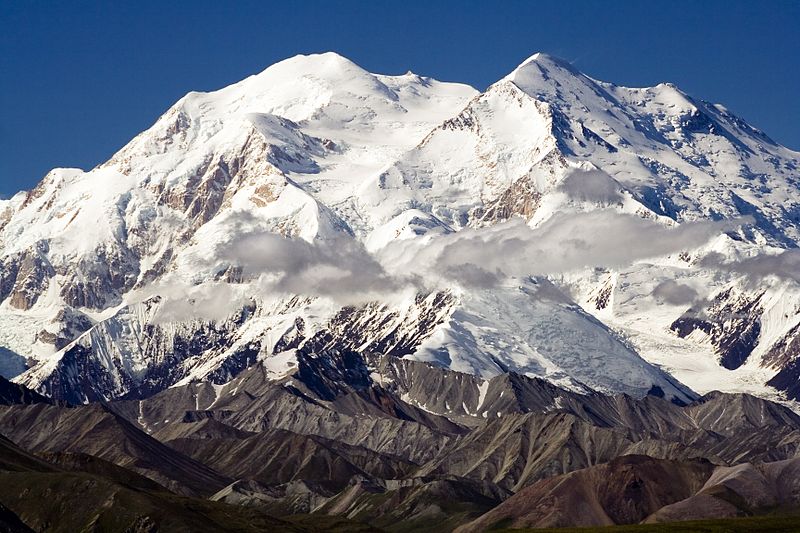
Standing 6194 meters (20,320 ft) in height, Denali is the tallest mountain in North America. It also happens to be well known for it's notoriously bad weather, even during the warmer months of the year. That makes climbing it in winter a dicey proposition at best and as a result, there have been only a handful of successful summits during that season, and none in January. Lonnie hopes to change that by becoming the first to climb the mountain during the coldest month of the year, and like his past expeditions to the peak, he'll try to do so without a tent. Instead, he'll dig a series of snow caves which will serve as his camps on the mountain and he'll spend the first few weeks shuttling gear to those points.

Hopefully the weather will clear soon and the expedition can truly get underway. Look for regular updates on Lonnie's progress in the days to come.

Antarctica 2012: Eric Waits For Pick-Up, Others Continue South

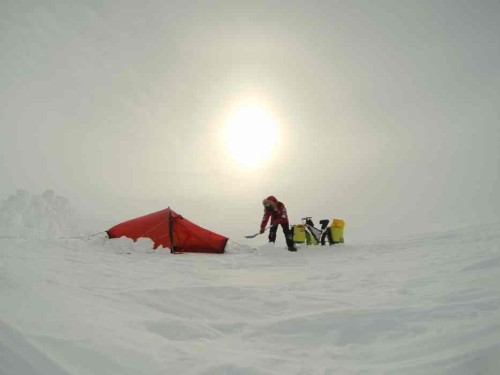
If you didn't read my entire Antarctic update from yesterday, you may have missed the news that Eric Larsen has decided to pull the plug on his attempt to ride a bike to the South Pole. He had hoped to pedal from Hercules Inlet to 90ºS, but over the holiday break he discovered that it just wasn't in the cards. High winds were making it very difficult for him to achieve any kind of meaningful milage and he was expending a lot of energy for relatively small gains. Considering his extensive polar experience, I think it is safe to say that Eric knows when to press on and when to call it a day.

For the past week or so, he's been riding back to Hercules and even though he is heading north, and the winds are working in his favor, it hasn't been a smooth ride. The snow and ice have made his bike unstable and it is not uncommon for him to go down when surface conditions change quickly and unexpectedly.

The plan was for ALE to send a Twin Otters aircraft to retrieve Eric and his bike yesterday, but poor weather scrubbed the flight. He had also hoped to arrive back at the Inlet, but was surprised to find that his GPS was telling him that he still had another 20 miles (32 km) or so to go. So, despite the challenges that he has encountered on this expedition, Larsen was actually happy to get another day out on the ice. He may not be able to ride all the way to the South Pole, but that doesn't mean he's in a hurry to head home either.

Reportedly the weather should be better today, so our next report from Eric will probably come from the Union Glacier camp, where he'll wait for a flight back to Punta Arenas, and eventually home. It's a shame that he wasn't able to continue with his Cycling South expedition of course, but I know he had other plans in the works for visiting polar regions in the future.

Aaron Linsdau continues to struggle against the elements on his southward journey. He's been battling terrible sastrugi over the past few days, which have made for slow going and physically punishing sessions. For those who don't know, sastrugi are very hard ridges that form on the ice where the snow collects and they can grow to be quite large at times. They can run for miles on end and the skiers have to slide over them as they go, which saps the strength from their legs, slows their progress greatly and can be brutal on equipment. Aaron estimates he has another three days or so of battling these ridges and after that he hopes surface conditions improve.

To add insult to injury, the cold has really started to take its toll on his body. In addition to the chillblains that he has on his stomach and thighs, he now also has wind/freezer burn on his cheeks, which isn't helping his spirits much either. Considering he has now spent two months out on the ice however, I suppose these nagging injuries are to be expected. Aaron estimates he still has about 154 miles (247 km) to go until he reaches the South Pole, which is roughly another two weeks depending on his speed.

Both Richard Parks and Vilborg Arna Gissurardóttir continue to make good time on their respetive marches to the South Pole. Parks knocked off another 33.5 km (20 miles) yesterday, despite less than ideal conditions. High winds made for a long day, but he should still be pleased with his progress thus far. Similarly, Vilborg seems to be laser focused on hitting the 20km (12.1 mile) mark each day, and this workman approach is serving her well. She reports that yesterday was a cold one since the sun wasn't out, but that was the least of her concerns. The solo Icelandic skier says that she is also dealing with sastrugi as well as large crevasses, both of which can really impede progress.

More updates on the Antarctic season soon. We're still a number of days away from any of these explorers from reaching the Pole. It'll certainly be big news when they start to arrive.

Wednesday, January 2, 2013

The Five Biggest And Best Climbs Of 2012

Obviously over the holidays I took a little time off from updating the Adventure Blog, but that didn't mean I wasn't working at all. In fact, I was extremely honored to be asked to contribute a piece to Wired magazine's Extremo Files Blog sharing my pics for the five most impressive climbs of 2012.

I don't want to spoil any of my selections here, suffice to say that each of the climbs that I singled out took place far from the slopes of Everest, which is still the mountain that gets the bulk of the attention on an annual basis. Don't get me wrong, I love to follow what's happening on Everest as well, its just that there are so many climbers on that mountain these days, and very few of them are actually trying something new or pushing the boundaries of mountaineering. Many of the top climbers have taken their considerable skills elsewhere and are trying unique things on other peaks that don't draw nearly the same about of attention.

If you read my blog on a regular basis, you'll certainly have heard me mention a few of the expeditions on more than one occasion. These are the biggest and most daring climbs of last year and definitely deserve some accolades.

I want to thank Jeff Marlow for inviting me to share my list. It was fun to reflect on the mountaineering achievements of last year while putting the story together. Jeff also did a nice job of editing my original work as well. I hope you enjoy reading the story and I'd be interested in hearing your picks for the biggest climbs of last year as well. There certainly were plenty of good ones to choose from.

Video: Take A Walk Around The World

Check out this cleverly shot and edited video from the folks at Humanity.tv, who are working on an interesting interactive series of short films to inspire us to travel. If they're anything like this video, I'm sure they'll be spectacular. In the two minute clip below, our intrepid hero moves between 12 countries that were shot in different scenes over an eight month period, although it all comes together incredibly well. It'll almost definitely put a smile on your face.

Take A Walk (Around the World) from Humanity.TV on Vimeo.

Explorer Julian Monroe Fisher Launches Phase II Of Great African Expedition

Explorer and anthropologist Julian Monroe Fisher is preparing to set out on the second phase of his Great Africa Expedition, during which he'll be trekking across that continent while conducting ethnographical field research. The aim of the five-year, nine-expedition project is to compare the current dispersion of African tribes along rivers and lakes to what was originally cataloged back in the 1800's during the Victorian Age of Exploration.

Phase I of the Expedition took place in 2012, when Fisher traveled from Cairo to Khartoum along the Nile River. Phase II will begin in Juba, the capital of South Sudan, the youngest country on the planet. From there, Julian will continue to follow the Nile south through Murchison National Park and along the Eastern Shoreline of Lake Albert, before heading into Uganda. He'll be following the path that was taken by explorer Samuel White Baker during the 1860's as he searched for the source of the great river.

When he undertook the first phase of the project, Fisher traveled solo, but this time he'll have companions on his journey. He'll be joined by filmmaker Jonathan Maguire, who will be documenting the expedition. They'll also be joined by David Baker, and his daughter Melanie. David is the great-great-grandson of Samuel Baker, whose footsteps they'll all be following in. That includes reaching the exact spot in Uganda where Samuel and his wife Florence became the first Europeans to lay eyes on Lake Albert.

Beyond the already ambitious goals of the Great Africa Expedition, Fisher and Maguire hope to create a new ethnographical film series as well as a documentary that spotlights the expeditions of Sir Samuel Baker, while simultaneously bringing real science and exploration back to filmmaking. Both men have become disillusioned by the current crop of "adventure-reality" television and they aim to bring a true dose of realism back to the small screen.

Phase II will begin shortly, with Fisher and company traveling by kayak, dugout canoe, camel, horse, felucca, ferry boat, 4x4 vehicles and of course on foot. Watch for updates on their progress on Julian's Facebook page.

Antarctica 2012: New Year, Same Direction

It has been nearly two weeks since I we last looked in on the Antarctic explorers. During that time, they've welcomed the arrival of a new year, although they still continue to head south. For some, the finish line has drawn much closer, although they still have a long way to go and many challenges to face before they're done.

No one has faced more challenges this Antarctic season than Aaron Linsdau. He was the first South Pole skier to hit the ice this year as he attempts to become the first American to make the journey from Hercules Inlet and back again, solo and unsupported. The unsupported portion of his expedition went away when he had ALE place supply caches for him in an effort to pick-up speed, but he is still pressing forward none the less. As of yesterday, Aaron was now past the 87th degree and estimated that he had another 160 miles (257 km) to go before he reached the Pole. Those won't be easy miles however, as he reports that he has been battling sastrugi over the past few days, which has slowed progress and made things more difficult physically. His intel reports that he'll have another 45 miles (72 km) of sastrugi to overcome before the ground smooths out again, which will mean about four more days at his current pace.

Aaron also reports that he has climbed in altitude and that he is now experiencing colder temperatures as a result. The temps have dropped so much that he now has to keep his water bottles inside his sleeping bag to prevent them from freezing at night, which hasn't been a particular problem until now. That isn't his only concern however, as the colder temps have brought on another case of the chilblains, this time on his stomach. This painful and irritating condition is the result of cold temperatures and humidity effecting the skin, causing itching, blisters and inflammation. He is taking steps to prevent the affected area of his skin from getting worse, but it is an irritant that he didn't need at this stage of the expedition.


At his current pace, Aaron is roughly 10-12 days away from reaching the South Pole. It is my guess that he'll abandon his attempt to turn around and go back to Hercules, as he simply isn't covering the distances he need to make a return trip, even if going back is easier and faster. He has now been out on the ice for more than 60 days and the 700+ mile (1120+ km) journey back just isn't going to be feasible. Still, he has put in a great effort to stick with his expedition, even though things haven't exactly gone as planned.

Meanwhile, Icelandic solo skier Vilborg Arna Gissurardóttir continues to make excellent progress on her way to the Pole. Today is her 45th day out on the ice and she is narrowing in o the finish line as well. Right now, she's about 10-11 days out, which means she should arrive at about the same time as Aaron. She crossed the 87th parallel a few days ago and is just systematically knocking off 20 km (12.1 miles) per day right on schedule. If successful, and I don't see any reason why she won't be, Vilborg will become the first woman from her country to complete this journey solo and unsupported.

Richard Parks celebrated the first day of the New Year by knocking off 33 km (20.5 miles) in nine hours of skiing. Those are some impressive numbers of course, but it wasn't an easy day none the less. Parks blogged about hitting a stretch of bad weather that allowed him to cover just 3 km (1.8 miles) in two hours of skiing, but once he broke free from a nasty headwind, and the skies cleared over head, he was able really pick up speed and gain momentum. After 15 days on the ice, he has already covered some serious ground, and despite some logistical challenges at the start of the expedition, he is on pace to complete the journey as expected.

Finally, while I was away Eric Larsen made the decision to end his attempt to become the first person to ride a bike to the South Pole starting from Hercules Inlet. Over the past two weeks he has discovered just how challenging that ride would be, battling ferocious winds and horrible surface conditions along the way. Yesterday he blogged about how important it is to stay on guard at all times, as the bike isn't exactly stable on the snow and ice, even with its nearly 5-inch wide tires. Eric has crashed on multiple occasions when hitting a particularly slippery piece of ground and as a result, his body is a bit beaten up as well. He is now on his way back to Hercules, and while he isn't happy with the situation, he knows that it was the correct choice. This is a man who has spent a lot of time in the polar regions of our planet and he knows from experience when things just aren't right. I'm sad that he has decided to call it quits, but at respect the decision to pull the plug.

Now that the holidays are behind us, stay tuned for regular updates once again.
Gear Closet: ECCO BIOM Lite Helion Running Shoes

The minimalist running craze has had an undeniable effect on the shoe industry. A few years ago the options for lightweight running shoes were few and far between, but today every major manufacturer has footwear that is designed to meet the needs of the minimalist runner. These options range from barely there barefoot offerings to only slightly more substantial shoes with a more traditional slant. They come in a variety of shapes, sizes and colors, but they are all incredibly light and flexible.

Recently I've had the opportunity to test a new entry into the minimalist running shoe market, with this latest design coming from ECCO. If you're not familiar with the company, it offers a variety of high quality footwear options including everything from dress shoes and sandals to hiking boots and athletic gear. ECCO is planning to make a big splash in the running market in the months ahead, releasing shoes for a variety of distances on both the street and the trail. One of their first models in this impressive line-up is the new BIOM Lite Helion, their first truly minimalist running shoe.

As you would expect from a minimalist shoe, the Helion is incredibly lightweight,  to the point that you barely even know that they are on your feet. They feature a zero-drop heel and a very thin sole that helps to keep runners more connected to the ground, while providing only the smallest of protection from impact and surface debris. The shoe has been constructed of highly breathable materials that help keep the feet cool and dry on longer runs. This not only aids in comfort, but also helps to prevent chafing and blistering too.


These shoes are designed to wrap snugly around the foot, creating an anatomically correct layer of protection from the rigors of the road. I found that while they felt comfortable from the first time I ran in them, I also had to put a few miles on them before they were truly broken in. Over time, the interior footpad molded itself nicely to foot, providing a higher level of comfort, while the entire shoe became more flexible and forgiving.

I ran in my pair of Helions with and without socks and actually found them to be more comfortable to wear barefoot. Without socks however, I did manage to rub a blister onto the top of my foot, although to be fair this is an issue I've had with similar shoes in the past as well. I actually feel this is more of an issue with the shape of my foot rather then the shoes themselves. The more I ran in the shoes, the less of an issue it became however.

As with other minimalist footwear that I've tried, the Helion provides a fantastic connection to the road. I found it absolutely sublime to run in these shoes and looked forward to putting them on each day. For me personally, there really is a magical element to running with very little between my feet and the pavement. But I will admit that I can only wear these types of shoes on shorter runs (generally less than five miles) or my feet do suffer from the impact. On longer runs I still revert back to more traditional shoes with thicker, heavier soles.

ECCO's first entry into the minimalist market is a strong one, providing everything a runner could need in a shoe of this time. They are definitely lightweight, and yet at the same time, quite durable. They are also a nice mix of retro design with modern sensibilities, giving them a unique look all of their own. They also happen to be competitively priced at $140, although there are less expensive minimalist options available.

If you're looking for a new lightweight shoe for your running needs, then the ECCO BIOM Lite Helion   needs to be on your radar. Its a great entry into a market that is getting continually more crowded, although these stand out for their comfort and well high quality construction. If you get the opportunity, take 'em for a test run. I think you'll find they make a great addition to your gear closet too.