Friday, August 16, 2013
Video: Jeb Corliss Threads The Needle On Heaven's Gate At Tianmen Mountain
In September of 2011, wingsuit pilot Jeb Corliss made history by flying through Heaven's Gate on Tianmen Mountain in China. The "gate" is actually a narrow cave which he passed through at 75 mph (120 kph), something that had never been done before at that time. The video below gives us a behind the scenes look at Jeb's historic flight and mixes in some great footage from other wingsuiters who came along for the ride. The mountain scenes make a fantastic backdrop for these daredevils who seem to have little fear when they sail off into open space.
GoPro: Jeb Corliss Flies Through Tianmen Cave from GoPro on Vimeo.

Husband And Wife Team Prep For South Pole Later This Year

The Fagans are already accomplished outdoor athletes. Both are ultra-runners and climbers with multiple 100 mile (160 km) trail runs and summits under their belt. In fact, the two first met while both were climbing Denali on separate expeditions back in 1998 and they've been practically inseparable ever since. The couple has a 12-year old son, who will not be joining them in the Antarctic.
The couple is planning on launching their South Pole expedition on November 23, although their exact schedule will obviously be dictated by the weather conditions. They'll start at the Ronne-Filchner Ice Shelf and cover 560 miles (901 km) on their way to 90ºS. They hope to wrap up the journey in just 45 days as that will be the amount of food they'll take with them when they get underway. In order to stay self-supported while out on the ice, they'll be pulling 180 pound (81 kg) sleds filled with gear and supplies. To prep for that kind of a load, the couple has augmented their traditional ultra-marathon training by dragging tired behind themselves for hours on end.
Chris and Marty have dubbed their expedition 3 Below Zero which they say is a reference to the members of their team. In addition to the couple themselves, the third member of the squad will be their friends, family and followers who will be cheering them on from home as they travel south. If thats the case, they can count me as a member of the team then as I'll certainly be following along.
Thanks to ExWeb for the tip on this story.
French Team Sailing To The North Pole

Sébastien Roubinet and Vincent Berthet set out from point Barrow in early July and have been attempting to make their way to the North Pole ever since. The voyage has not been an easy one however as they have encountered more ice this summer than they had expected. Often times they find themselves sailing south just so they can find an open waterway that will allow them to continue towards the Pole. The weather hasn't been all that cooperative either as they have at alternating times battled high winds that were too dangerous to sail and lacked wind altogether, becoming becalmed while they wait for an opportunity to move ahead.
They are making this unprecedented journey aboard a specially designed catamaran that can capture the wind to help sail both around and over the ice. They've named the boat Babouchka and for the most part it has performed remarkable well in very tough conditions. But travel has been extremely sporadic. Some days they are only able to cover just 3-4 km (2-2.5 miles) while on their best day they managed to cross 194 km (120 miles).
A few days ago Sébastien and Vincent crossed over the 78ºN latitudinal line. That means they still have a long way to go before the reach the North Pole, located at 90ºN. The duo are hoping that surface conditions will be more stable as they head north, possibly allowing them to cover longer distances more easily. Since the Babouchka is capable of traveling over both water and ice, they are looking forward to a time when they aren't necessarily battling both.
You can follow the two men on this epic journey on the expedition's official website. After five weeks out on the Arctic Ocean, their tale is a compelling one to read. But with such a long way to go yet, it will be interesting to see if they can actually complete this expedition at all.
Thursday, August 15, 2013
Video: Jimmy Chin's 2013 Director & Cinematographer Reel
There is little question that Jimmy Chin is one of the top two or three adventure photographers in the business today. He work is always fantastic and he goes to great lengths to catch the perfect shot. No where is this hammered home more completely than in the video below, which is a demo reel of his work, both in still photography and video. Many of the images are simply breathtaking and a great example of why Jimmy is so respected in his field.
JIMMY CHIN // DIRECTOR + CINEMATOGRAPHER REEL // 2013 from Camp 4 Collective on Vimeo.
Freya Hoffmeister Continues Kayaking Expedition Around South America

Freya arrived back in Colombia on Tuesday and is now preparing to return to the border between that country and Venezuela where she'll climb back into her boat and once again continue her journey. She has been back home in Germany since May and during that time she has gathered her strength, taken care of pressing business and generally been getting ready for the next leg of the journey. If all goes according to plan, she'll soon round the top of South America and start heading south, back to Buenos Aires where she first launched her expedition in September of 2011, early two years ago.
Initially Freya believed it would take 24 months for her to cover the 24,000 km (14,913 mile) circumnavigation of South America. She is rapidly closing in on that date and there is no way she can finish in the time frame that she has set for herself. She still has thousands of kilometers to go and plenty of challenges ahead. Nothing she can't handle of course, after all we are talking about a woman who managed to paddle around Australia a few years back. Yes, Australia.
If you want to follow Freya's progress as she turns for home, check out her blog, which she updates on an almost daily basis while paddling. Sometimes it's just to report her daily mileage and location and other times it's more in depth about what she is experiencing while out on the water.
Another impressive adventure. It looks like Freya will be on track to wrap up her expedition sometime later this year. There are some big challenge that remain but she is determined and razor focused. I know I'd certainly never underestimate those qualities in a German woman.
Explorers To Circumnavigate Lake Titicaca By Kayak

Belgian adventurer Louis-Philippe Loncke and his partner Gadiel Sanchez Rivera will launch their kayak journey tomorrow, August 16. The plan is to circumnavigate the shoreline of the lake, taking GPS coordinates and extensive photographs to document the current position of the water, which can then be compared to future readings to determine if Titicaca is shrinking in size due to climate change. As temperatures warm up and glaciers in the Andes retreat, the rivers that feed the lake will provide less flow. That could spell trouble for the ecosystem around Lake Titicaca and the communities that fall on its shores.
Those same communities are already facing issues with water contamination due to chemicals and sewage being deposited directly into the water. The hope is that the expedition will help raise awareness of these threats to the lake and spur those communities to plan for water treatment options before it is too late. While paddling around Titicaca, the two explorers will discuss these issues with the local inhabitants, many of whom are already suffering as a result of pollution in the water.
Neither of these two men are strangers to exploration. Loncke, who is a member of the Explorers Club, once trekked solo and unsupported across the Simpson Desert in Australia and kayaked for 600 km (372 miles) along the waterways of his home country of Belgium. Rivera, who is better known by his nickname of Cho, spent two years walking the Amazon River with Ed Stafford a few years back. LouPhi and Cho have recently become fast friends and are now ready to embark on an adventure of their own.
A paddling expedition around Lake Titicaca sounds like it should be amazing and I'm actually surprised that no one has done it before. Taking GPS readings of the shore line may prove only marginally useful however as GPS readings are only accurate to within a few meters, which isn't necessarily close enough to track retreating water lines on the lake. The photographs they take will help to alleviate this somewhat and should prove useful in creating the first ever extensive inventory of the lake's shore. We'll be able to follow along with the adventure on LouPhi's blog where he will be documenting their findings and posting updates of their progress.
The Coldest Journey Update: Still Stranded As Sun Returns At Last
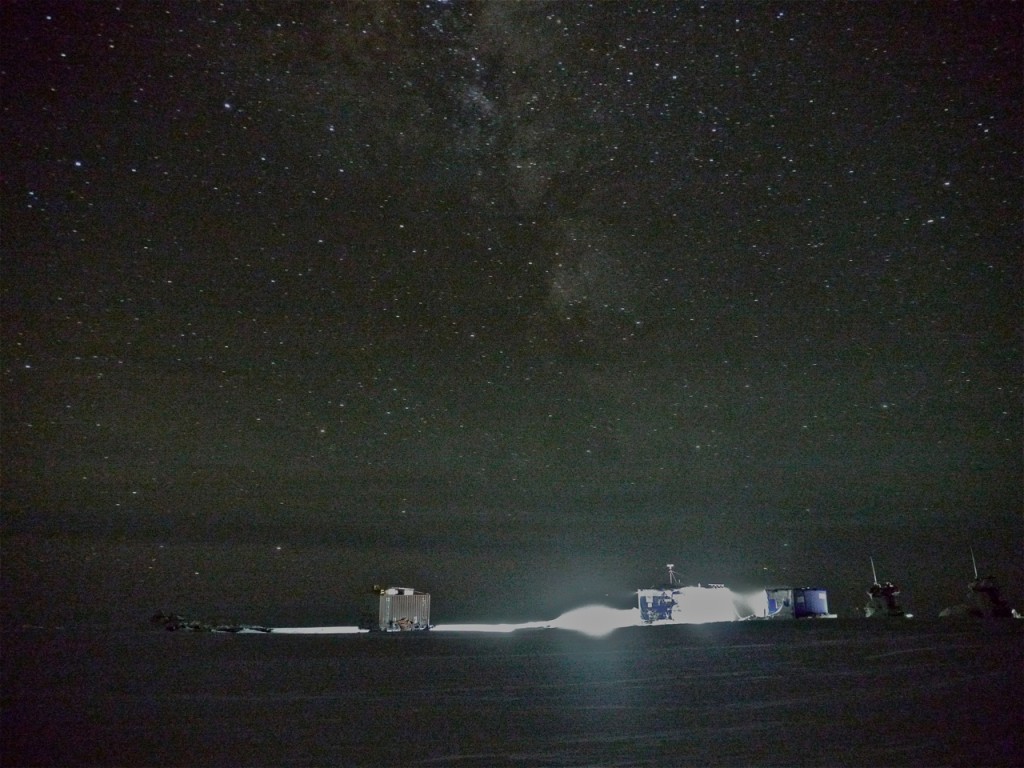
For the past two months the team has essentially been camped in the same spot while they've waited for the winter to pass. During that time they have continued to focus on the scientific aspects of the expedition which consist of taking various weather readings to measure the impact of climate change on the environment in the Antarctic. While they haven't been able to make any progress forward or back, they are still going about the business of collecting data for ongoing research.
There was a glimmer of hope on the horizon this past week however as the sun has shown itself for the first time in weeks. During the Antarctic winter the days get increasingly shorter until the sun dips below the horizon altogether and the continent is shrouded in darkness. But that long night has come to an end at last and the sun has begun appearing above the horizon for the first time in quite awhile. The days may not be all that long just yet, but it is a start. And for this embattled crew, it is also the first sign that spring is approaching. That could mean that there is a light at the end of the tunnel for these five men who have been in Antarctica for a really long time.
We're still probably a couple of months away from any kind of evacuation taking place but the return of the sun is a good sign for these men. After weeks in nearly complete darkness, they'll now have some daylight to help bolster their spirits and mood. I'm sure at the moment they feel a bit like the expedition that the world has forgotten about, but optimism comes with the sun.
Hand in there boys! Spring will be here before you know it.
Subscribe to:
Posts (Atom)