Showing posts with label Research. Show all posts

Tuesday, February 18, 2014

New Farthest Source Of The Amazon Discovered

Researchers say they have located a new source for the Amazon River and possibly adding an additional 47-57 miles to its overall length, which already extends beyond 4000 miles. But, with all things exploration related in the 21st century, there is some controversy as to whether or not this new location should actually be considered as a tributary for the longest river on the planet.

Since 1971, the Apurimac River has been considered the furthest source of the Amazon, and many explorers and adventurers have operated in the region under that assumption. According to this new report however, the Mantaro River, located in southwest Peru, now holds that distinction.

The researchers who have asserted that the Mantaro is the new source used satellite imagery and topographic maps to study the Amazon and it's numerous tributaries. With GPS tracking points, the team determined that the Mantaro is actually about 10% longer than the Apurimac, which would make the furthest source.


But as I mentioned, there is some controversy afoot. The Mantaro doesn't flow for parts of the year, thanks to a dam that was built in 1974. When defining a "source," most geographers feel that a river must flow uninterrupted. The researchers behind this new finding say that the Mantaro would flow all year if it wasn't for the dam.

Does it really matter where the true source is located? Most would probably say no. But if you're one of the many adventurers who has attempted to travel the length of the river, or explored the Amazon Basin, it means quite a lot. This revelation could invalidate certain past expeditions that paddled the entire river for instance.

Personally, I happen to enjoy that we're still discovering things about our own planet. It is stories like this one that remind us that exploration is important, even in the 21st century. Now, who wants to be the first to go upstream and actually visit the source? I'm in!

Monday, October 14, 2013

U.S. Government Shutdown Forces Closure Of Amundsen-Scott South Pole Station

Last week I wrote a post about how the shutdown of the U.S. government was impacting research in the Antarctic. With a lack of funding, the bases there are being dropped to a skeleton crew and put on "caretaker status." This has the potential to throw a lot of research projects into limbo and could set back some of the data collection by years. Now, ExWeb is reporting that one of the causalities of the budget crunch is Amundsen-Scott South Pole Station, which sits at 90ºS and could have an impact on the explorers and adventurers heading to the South Pole this season.

While the Amundsen-Scott base doesn't have any official contact with Antarctic skiers, it does serve as a hub of communications for ANI/ALE, the company that handles all of the logistics for independent travelers at the bottom of the world. ANI sets up a temporary base at the South Pole each season and welcomes all arrivals there. They also coordinate closely with the base to track incoming skiers, who often get to spend some time in the station or are given tours of the impressive operations there.

But with the base reduced in functions and down to just a small staff, it is uncertain what support can be given to the skiers in the weeks ahead. ANI will likely have to rely on their own staff and crew more so than in the past to ensure the safety of those making their way to 90ºS. It could present some complications for Antarctic skiers this year, although ANI is so good at what they do, I feel like they are equipped to handle just about any situation that will arise. Unless something changes with the budget situation however, it appears that operations in the Antarctic will be greatly scaled back this season.

Some of the expeditions that intend to ski to the Pole are already in Punta Arenas and are preparing to get underway. Traditionally the Antarctic season launches around late October or early November, depending on the weather conditions. That gives the U.S. government a bit of time to sort things out and ramp up operations, although I suspect that even if things get settled this week, the impact of the shutdown will have an effect on Antarctic operations for the entire season.


Thursday, October 10, 2013

U.S. Government Shutdown Halts Antarctic Research

As the shutdown of the U.S. government continues to drag on the consequences for the inability for Congress and the President to come to an agreement on budget issues continues to ripple into more and more programs. Of course, we already knew that the closure of the national park service would impact some of our favorite outdoor places, but now it seems that research stations in the Antarctic are feeling the fiscal crunch as well.

As fall continues on here in the Northern Hemisphere, spring is moving into full effect down south. That includes Antarctica, where the late-October and early-November are the traditional kick off the research season at the bottom of the world. In just a few weeks time I'll begin coverage of teams heading to the South Pole for what promises to be another busy and interesting season. But for American research teams, it could potentially be a very frustrating one.

The National Science Foundation has announced that unless a budget agreement is reached by October 14, the organization will run out of funds to cover its various projects, including the staffing and maintenance of Antarctic research stations. The NSF has already instructed its support contractors to prepare to move into "caretaker status." What does that mean exactly? Here's what the memo says:
"Under caretaker status, the USAP (U.S. Antarctic Program) will be staffed at a minimal level to ensure human safety and preserve government property, including the three primary research stations, ships and associated research facilities. All field and research activities not essential to human safety and preservation of property will be suspended."
This is obviously bad news for the scientists and researchers who have been planning on going to the Antarctic for months, if not longer. Most will be put on hold come Monday and if the situation isn't resolved, their research could be delayed for years. As Outside magazine says in their article on the subject, scheduling for these projects is done far in advance and any shift in that schedule could be incredibly disruptive to the work being done.

There are a few more days to get things sorted out, although at this point discussions are not looking promising. There is a major deadline looming at the end of next week however and it is my opinion that some compromise will be reached by then. Both sides seem to be playing chicken at the moment and neither wants to be the one to swerve first. Hopefully they'll come to their senses soon and things can begin to return to normal. There is still time, even if things look pretty grim right now.

Thursday, August 15, 2013

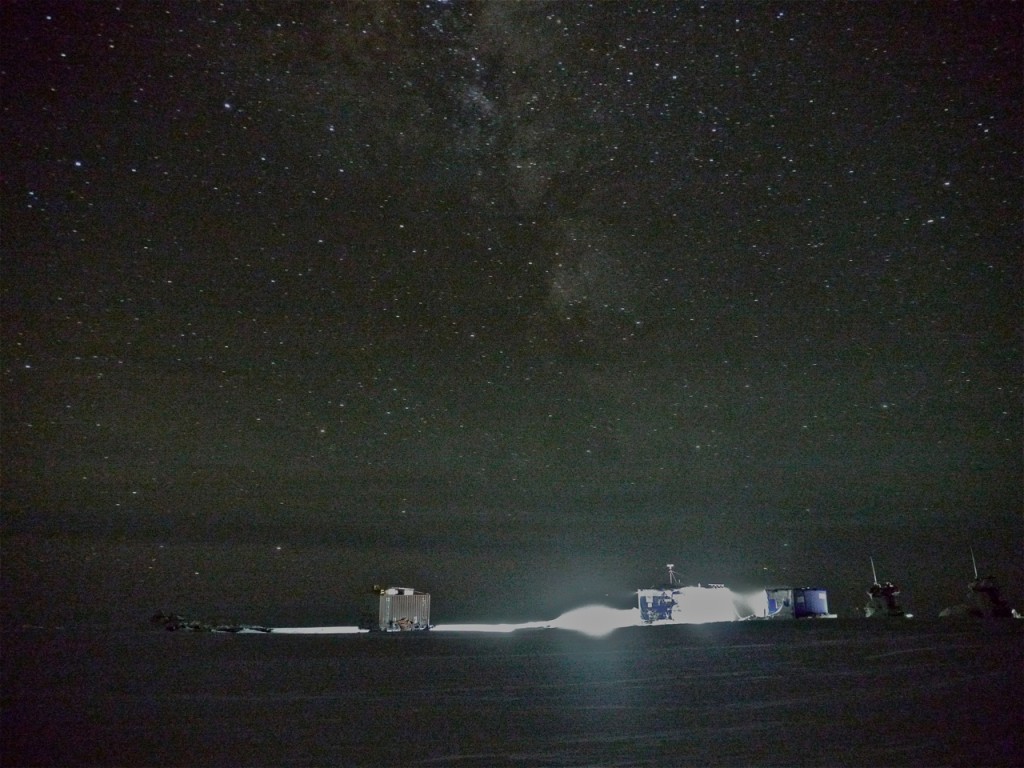
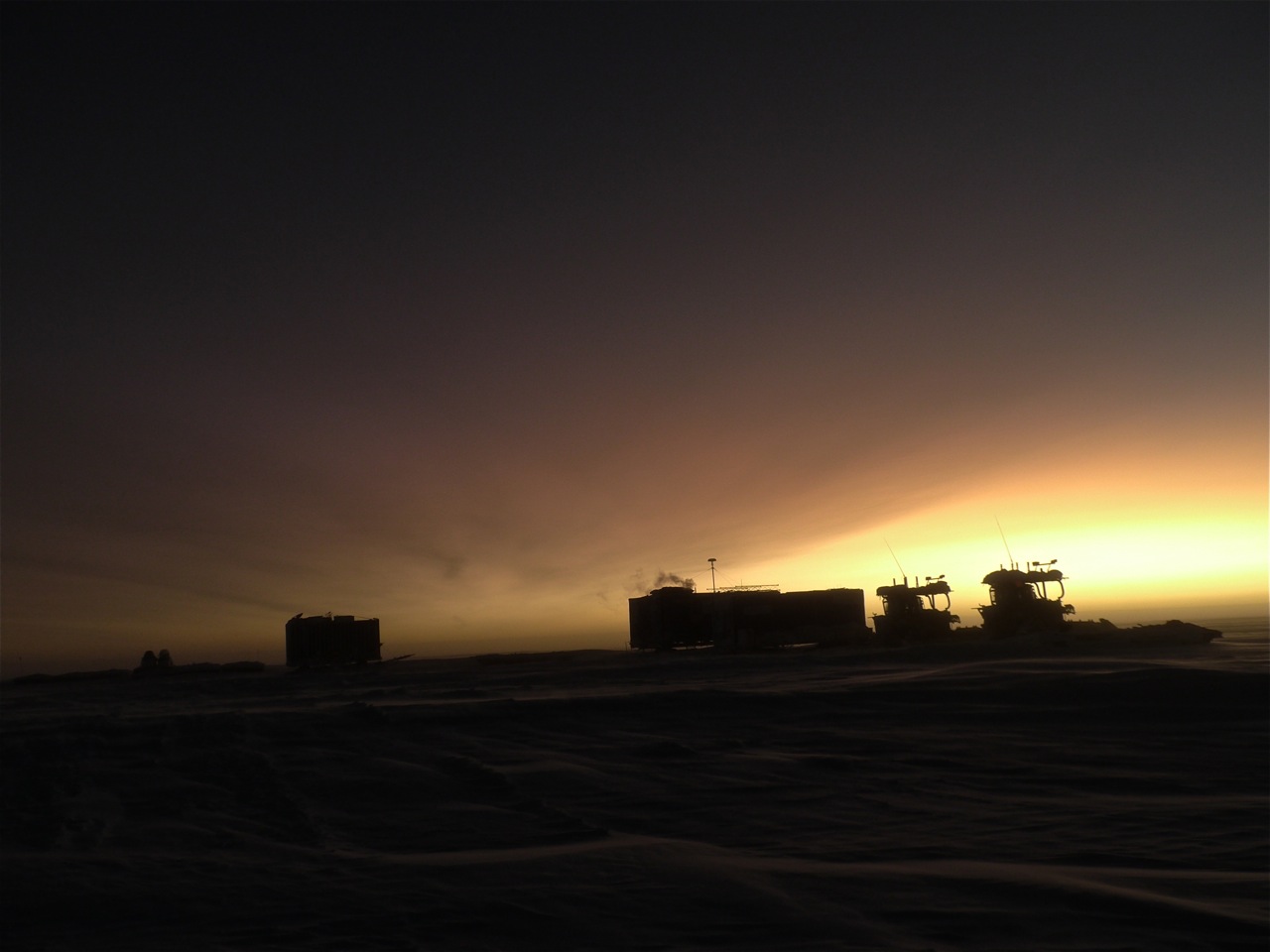
The Coldest Journey Update: Still Stranded As Sun Returns At Last

Remember the Coldest Journey expedition? It was the much vaunted attempt to cross Antarctica on skies in the winter, when the continent becomes one of the most inhospitable environments on the planet. When the expedition got underway this past March, it was with the anticipation that the team of explorers made up of Brits Brian Newham, Ian Prickett, Richmond Dykes, Rob Lambert and Spencer Smirl would traverse the Antarctic by way of the South Pole, covering some 4000 km (2485 miles) along the way. By June, that goal had become a distant memory however, as bad weather, incredibly difficult surface conditions and dangerous crevasses prevented the men from making the steady progress they had hoped. As a result, they put a halt to their journey and elected to set up camp and wait for a plane to come pick them up once spring had arrived. Two months later, they're still waiting for that plane, although they have had their first glimpse of things starting to turn in their favor.

For the past two months the team has essentially been camped in the same spot while they've waited for the winter to pass. During that time they have continued to focus on the scientific aspects of the expedition which consist of taking various weather readings to measure the impact of climate change on the environment in the Antarctic. While they haven't been able to make any progress forward or back, they are still going about the business of collecting data for ongoing research.

There was a glimmer of hope on the horizon this past week however as the sun has shown itself for the first time in weeks. During the Antarctic winter the days get increasingly shorter until the sun dips below the horizon altogether and the continent is shrouded in darkness. But that long night has come to an end at last and the sun has begun appearing above the horizon for the first time in quite awhile. The days may not be all that long just yet, but it is a start. And for this embattled crew, it is also the first sign that spring is approaching. That could mean that there is a light at the end of the tunnel for these five men who have been in Antarctica for a really long time.

We're still probably a couple of months away from any kind of evacuation taking place but the return of the sun is a good sign for these men. After weeks in nearly complete darkness, they'll now have some daylight to help bolster their spirits and mood. I'm sure at the moment they feel a bit like the expedition that the world has forgotten about, but optimism comes with the sun.

Hand in there boys! Spring will be here before you know it.

Thursday, June 13, 2013

Young Adventurers Launch 900-Mile Canoe Expedition To The Arctic

On Monday a team of six young explorers launched an epic summer paddling expedition that will see them covering more than 900 miles (1448 km) as they travel by canoe to the Arctic Ocean. Their expedition will carry them across three Canadian Provinces on this adventure as they also collect water samples to be examined by research scientists once the journey is complete.

The expedition is called the Tri-Province Arctic Canoe Expedition and it got underway from Black Lake, located in Saskatchewan following a three-mile portage that included the team shuttling 700 pounds (318 kg) of gear to their starting point. The route will take them through some extremely remote areas as they travel along the Dubawnt, Morse and Armark Rivers on their way to the Queen Maude Gulf in the Arctic. Some of their challenges will include crossing some early portage portholes on their way out of Black Lake, navigating through Lake Dubwnt, which is often frozen even in the winter, and an upstream slog on the Morse River that has never been attempted before.

The six young men on this journey include Kyle Terry, Ben Woods, Henry Cordeal, Jess Hernandez, Chris Martella and Andrew Hubb, all of which are between the ages of 22 and 26. They expect their journey to take roughly 70-days to complete, during which they'll be passing through some seldom visited sections of the Canadian wilderness. While traveling in the Queen Maud Gulf Migratory Bird Sanctuary, they hope to document some of the wildlife that they see along the way. Additionally, the water samples they take at various stages of the trip will be used in a research project at the University of Alaska to study the water cycle by creating a map of the patterns of isotopes found in the water in different locations. The hope is that it will allow researchers to study the processes that are affecting the water in unique parts of the world.

The boys have now been out on the water for four days and they have not posted any updates to their social media outlets just yet. Hopefully that will change as they get settled into the routine of the journey. You can follow them on both Facebook and Twitter if you would like to keep up with their adventure. You can also read about what they packed for a 70-day backwoods adventure in this article found at the National Geographic Adventure Blog.

Good luck guys!

Tuesday, June 11, 2013

The Coldest Journey Update: Expedition Halted, Team Weighs Options

One of the most daring expeditions to launch in recent years has been the attempt by a team of Brits to cross Antarctica during the dead of winter – something that has never been accomplished before. The expedition, which has been dubbed the Coldest Journey, set out in March with Brian Newham, Ian Prickett, Richmond Dykes, Rob Lambert and Spencer Smirl all hoping to become the first to traverse the continent during the harshest and most demanding time of the  year. I have posted a few updates on their progress over the past few months, with the most recent coming just last week. Those updates revealed that this challenge was every bit as daunting as we expected, with incredibly bad weather and treacherous surface conditions all conspiring to slow progress to a crawl. Yesterday the team's support crew back in the U.K. announced that the were putting a halt to the expedition while they assess what they will do next.

The biggest problem that the team has faced are the crevasses that spider-web across the area that they are currently traveling through. This crevasse field is so bad that they think it could stretch for 100 km (62 miles) around them. Add in the fact that the sun has now set on the Antarctic winter, leaving the men in the dark most of the time. That perpetual darkness has made it very difficult to spot the dangerous crevasses, which has slowed progress even further. With all of that in mind, the following blog post was published yesterday:
Having consolidated a position on safe ground away from the crevasses, the Ice Team are taking stock of their situation. It is clear from their recent reconnaissance work that the terrain to the south is a complex and uncharted mass of crevasses which are hard to detect in the darkness, covered, as they are, by snow bridges. Painstaking efforts have been made with the ground penetrating radar (GPR) to plot a safe route through the crevasse field which it is believed may extend for up to 100kms to the south of the present position. The situation is made all the more concerning because the efforts required to navigate and haul their many tons of essential equipment and supplies through such treacherous terrain means that they risk forfeiting much of the unique scientific work which they have been commissioned to undertake throughout the winter months. In view of this dilemma, further careful assessment is being made to decide on a workable strategy. A decision needs to be reached having researched all the relevant factors which include the safety aspects as well as the feasibility of achieving and/or prioritising all of the expedition’s aims. Such a decision needs time. For now, the team will remain where they are and continue to undertake their science and medical work while developing a plan for the months ahead. All of us at HQ wish the team well at this frustrating time. We shall keep you posted with developments as they occur.
Best wishes,
The Coldest Journey Team
So there you have it. It seems the expedition has likely come to an end, at least in the sense that there really is no way for them to cross Antarctica completely in winter. They will continue to collect data about the region they are in as part of the scientific elements of their mission, but progress has been so slow and dangerous that it is probably for the best that they abandon the crossing and play it safe for now.

The problem is, they really can't come home yet either. Conditions are so bad there right now that it would be impossible for them to be retrieved from the ice. So for the immediate future they'll have to stay where they are, stuck in limbo indefinitely. Fortunately they have plenty of food, supplies and shelter to keep them safe while they continue their research. How long they'll have to wait for an opportunity to come home remains to be seen, but I get the sense that they'll try to take advantage of the time that they have there and accomplish whatever they can.

Good luck to the team now more than ever. While progress had been difficult and slow before, at least they were going somewhere. Sitting and waiting at their current position may be the most challenging aspect of the journey that they've faced so far.

Thursday, May 16, 2013

National Geographic Announces 2013 Emerging Explorers

Yesterday, the National Geographic Society announced its 2013 class of Emerging Explorers, once again turning the spotlight on some of the brightest young minds who are working in a wide variety of fields today. In fact, this year's recipients are helping to redefine exactly what the term "explorer" means in the 21st century as the group includes a roboticist, an entrepreneur and a couple of artists, along with the more traditional biologists, geologists and conservationists. It safe to say that the world of exploration has opened up in some new and very interesting ways.

In all, there are 17 individuals who have been named to the Emerging Explorers Program this year. Each of them is recognized for having accomplished important things in their particular area of expertise during the early part of their career and their work shows significant promise for future breakthroughs as well. To aid them in their research, Nat Geo awards each Emerging Explorer $10,000 as well.

Amongst this year's class of Emerging Explorers are Bethany Ehlmann who is a planetary geologist on NASA's Rover Curiosity team. She is focused on exploring our solar system to see how planets formed over time. She is joined by Sandesh Kadur, a wildlife photographer and filmmaker who focuses on creating documentaries about endangered species and threatened habitats. Conservation Biologist Andrea Marshall earned a place amongst the Emerging Explorers for her research with threatened marine megafauna such as the stingray while adventurer Gregg Treinish is recognized for his efforts in founding the non-profit Adventurers and Scientists for Conservation.

This is just a sampling of the amazing men and women make up this year's class of Emerging Explorers. Each of them is a fascinating personality in their own right and they are all doing interesting work in an incredibly diverse number of fields. You can take a look at the entire class by clicking here.

Congratulations to the entire 2013 class. This honor is well deserved all around.

Wednesday, March 27, 2013

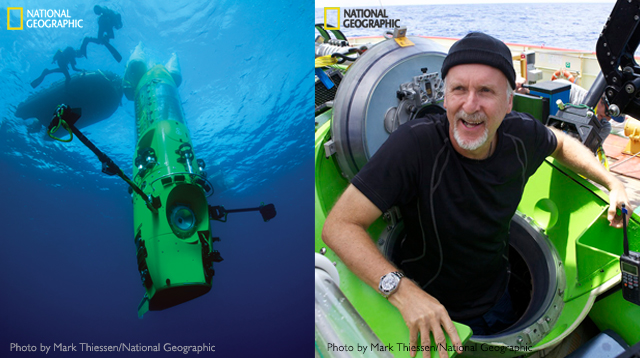
James Cameron Donates Sub To Oceanographic Institution

Filmmaker/Explorer/All-Around Great Guy James Cameron has donated his Deepsea Challenger submersible to the Woods Hole Oceanographic Institution in a bid to spur more underwater exploration and research. The Challenger is the same vehicle that Cameron used last year on his record setting dive to the bottom of the Mariana Trench.

Yesterday was the one year anniversary of that epic adventure to the lowest point on the planet, located some 11 km (7 miles) below the surface of the Pacific Ocean. Cameron, whose filmography includes the likes of Avatar and Titanic, became just the third person to visit the Challenger Deep and the first to do so solo. He spent seven years and $8 million on building the sub, which captured footage for an upcoming 3D film about the dive. Despite some rumors about making another voyage to the bottom of the sea however, the director has not gone back into the depths.

In donating the vehicle to the WHOI, Cameron also joined the organization's advisory board. Researchers at the institute will use vehicles advanced lighting and camera systems as part of their own programs as they continue exploring trenches in both the Atlantic and Pacific. Cameron will consult with engineers there on those systems as well as others that he helped develop for his dive.

It is hard not to have massive respect for Cameron. He is highly successful in his day job, to say the least, and yet he has a passion for science and exploration that is tough to deny. I get the impression he makes hundreds of millions of dollars making films for Hollywood so he can fund his other projects. And when he's done with his high tech toys that he personally helped develop, he passes them along to others who can benefit as well. We should all be so lucky to have that flexibility in our lives.


Wednesday, February 6, 2013

New Antarctic Research Station Opens

Halley VI, a new British Antarctic research station officially opened for business this week, welcoming the first inhabitants for an extended stay. The station, which is located along the Brunt Ice Shelf, just off the Weddell Sea, is designed to monitor the changing conditions and climate in the region. It will be the home for 16 scientists who will reside there throughout the long winter ahead. During the busier summer months, it can house as many as 70.

Built from a set of modular structures that can be easily moved, the Halley VI was designed to be comfortable even in the extreme conditions of the Antarctic. It is rated to withstand temperatures as low as -69ºF/-56ºC and a built-in set of hydraulic legs that can be raised or lowered to help the base withstand heavy snows. Previous research facilities have been crushed under the weight of Antarctic precipitation in the past.

The Halley VI has another trick up its sleeve that can help it survive where its predecessors failed as well. All seven of the interlocked modules can be placed on skis and moved to a different location, which will come in handy when the pack ice that it currently rests on begins to recede further. Considering the Brunt Ice Shelf moves about 700 meters in a given year, and doesn't rest over any kind of permanent ground, the mobility of the station could extend the life of the station greatly.

It has taken four years for the British Antarctic Survey team to complete the construction of the base and for now it will be manned by just a skeleton crew. As the Antarctic winter hits in just a few short weeks, those first inhabitants of the Halley VI will be cut off until the spring. At that time, the station will be resupplied and a full compliment of staff and maintenance crew will arrive on site. Until then, its going to be some very long and lonely days indeed.

Monday, January 21, 2013

Explorer Mikael Strandberg Announces Expedition Extreme Cold

In writing this little blog of mine I've been privileged enough to make the acquaintance of a number of amazing men and women who do some incredible things. When I hear from those folks, either by phone or email, I always make sure to give them special attention and listen closely to what they are thinking and planning. One of those people is explorer Mikael Strandberg, a man who has pushed the limits of human endurance on a number of expeditions to far flung corners of the globe. So when I received an email this weekend detailing Mikael's next adventure, you can bet that I read the note with keen interest.

In that email Mikael announced Expedition Extreme Cold, a journey through one of the harshest and bitterly cold environments on the planet. This adventure will take Strandberg deep into the heart of Siberia, where he'll spend time traveling with the Eveny, a group of nomadic reindeer herders who have learned to survive in that beautiful, yet unforgiving place.

Mikael's journey will begin in Oymyakon, Siberia – one of the coldest inhabited place on the planet. In Oymyako, the average temperature falls below freezing for seven months of the year and the ground is permanently frozen. In the months that Strandberg will be traveling in the region, temperatures will routinely drop below -60ºC/-76ºF as he makes his way through a wild, mountainous region that few people ever visit.

The plan is for Mikael to travel with the reindeer people from Oymyako to the Sea of Okhotsk on Russia's east coast. Along the way, they'll cover 600 km (373 miles), battling extreme weather, unexplored routes, wild animals and a host of other challenges.

Joining Strandberg on this cold-weather journey will be explorer Yegor Makarov and photographers Yuri Berezhnov and Misja and Keisja Alexandrov. The team hopes to shoot a documentary for OutWild TV on the Eveny and their way of life in such a harsh part of the world. Below is a YouTube video that serves as a "pilot" for this documentary, giving us all an idea of what to expect from the final product. It also gives us a true glimpse into what kind of conditions Mikael and his team will be dealing with over the next few months. The expedition is scheduled to run through mid-April.

The expedition won't just be about making a documentary however, as the explorers will also be conducting research on how genetics, choice of clothing, training methods and adaptation all play into how we humans survive, and in the case of the Eveny thrive, in extremely cold environments. Further, they hope to document the native and historical knowledge of the Eveny in how they have learned to survive in Siberia and came to use reindeer for the pulling of their sledges in that environment.

Mikael tells me that his preparation for this expedition has been amongst the hardest of his career, saying that he has done a year's worth of preparation in just two months. But judging from what he has planned, I can tell that he is extremely excited about this journey, which will be unlike any other that he has undertaken before.

When I received my email from Mikael he was just heading off to the airport to fly to Russia and get the expedition underway. Hopefully we'll get updates on his progress as he proceeds, as this looks to be a fascinating journey to say the least.


Friday, December 7, 2012

Antarctica 2012: On Pace For The South Pole

Yesterday I posted that good weather had made it possible for the climbing teams on Vinson to reach the summit of Antarctica's tallest peak but that good weather is being felt elsewhere on the continent too. The South Pole skiers are taking advantage of the conditions and are enjoying a bit easier going as a result. That has made for solid progress across the board and while there is still a lot of work to be done, the skiers are putting in some significant miles at the moment.

One of those skiers who has done an excellent job thus far is Vilborg Arna Gissurardóttir. She's now been on the ice for 18 days and from the start she's been making good progress, generally hitting 20km (12.5 miles) per day. Yesterday she shared her daily routine, which consists of two 90 minute skiing sessions per morning, with a brief rest between each of them, followed by a longer 15-20 minute break for lunch. After that, the afternoon repeats the process before stopping for the evening. This routine has kept her on track to reach the South Pole and become the first woman from Iceland to make the journey solo and unsupported.

Similarly, the In The Footsteps of Legends team has also hit its stride and is averaging about 11 nautical miles (20.3 km) per day as well. The group of vets who were wounded while on active duty in Iraq and Afghanistan seem to have acclimatized well to the Antarctic conditions while making a two-degree journey to 90ºS. They are currently estimating that they will reach the Pole next Monday, provide weather conditions hold and they're able to continue making good progress.

Aaron Linsdau has also picked up the pace some, although he still has significant miles to make up if he ever hopes to complete his roundtrip journey from Hercules Inlet to the South Pole and back. The good weather has allowed him to cover more ground, but he is still well off the pace he needs to cover the 1400 miles (2253 km) during the Antarctic season. His gear isn't helping him much either, as he has struggled with a number of problems along the way. Not only does he have a sled that is barely holding together, but one of his ski bindings seems to have come loose and a zipper on his snow pants has been completely destroyed as well. Throw in the fact that his shovel has been broken for days, and you can see how Aaron's frustration levels could mount. This is typical for Antarctica of course, as the place is brutal on gear and the people who use it. Anyone heading to the South Pole has to know this ahead of time and learn to adapt as needed, but any gear failure can lead to lost time, which means less milage covered on a typical day.


Over at Ellsworth Lake, the research team is now full assembled and they're going about their business. They group is still putting together their complex and sophisticated drilling rig, which will allow them to drill through 3 km (1.8 miles) of solid ice to reach the subglacial lake below the surface. They're hoping that the water that is in that lake will give them some clues about the climate of Antarctica thousands of years ago and possibly reveal life there as well. The video below shows the site from the sky and a plane landing at the base to deliver staff and supplies. As you can imagine, it looks pretty remote.

In other Antarctic news, the SA Agulhas set sail from London yesterday on its way to the frozen continent. The ship is carrying tons of equipment for Ranulph Fiennes' upcoming winter South Pole expedition. That journey isn't expected to get underway until March 21st and will mark the first trek to 90ºS ever conducted in the dead of the winter. Because of the demands of traveling in such a cold and hostile environment, there will be a full support crew and plenty of gear. Fiennes and his traveling companion won't set out for several months yet, but the ship will be en route for weeks.

We're still waiting for two other major South Pole expeditions to get underway. Richard Parks has packed his gear and shipped it to Chile, but he hasn't departed the U.K. just yet. Likewise for Eric Larsen, who will be riding his bike to the bottom of the world starting in a few weeks time. He is still home in the U.S. but should leave for Punta Arenas soon as well. Both should prove interesting to follow in the later part of the season.


Thursday, November 29, 2012

Antarctica 2012 Update: Slowly and Steadily Heading South

It has been a productive week in the Antarctic, where South Pole skiers are making good progress and the Lake Ellsworth research team has gotten down to business. There is still plenty of work to be done, but it is good to see some encouraging and positive news from frozen continent at last.

The skier who has suffered the most so far this season is easily Aaron Linsdau. He hit the ice early in an attempt to get as quick of start as possible on his Hercules Inlet to South Pole and back again journey. But so far weather conditions haven't cooperated and Aaron has had a very tough time gaining any kind of momentum. He seems to be getting on track a bit now, although he still has a long way to go and has dug himself in to a mileage deficit over the first few weeks of the season. Still, his daily distances are increasing and he's trying to put as positive of a spin on the situation as he can. Do give you an idea of how difficult it has been for him, yesterday he traveled for 9 hours and managed to cover 7 miles (11 km) and those numbers are an improvement over his first few weeks. Whether or not he can take it up a notch and still manage to reach his goals remains to be seen, but high winds, whiteouts, nasty surface conditions and blizzards have all worked against him thus far.

In contrast, Vilborg Arna Gissurardóttir of Iceland has been out on the ice for ten days now and yesterday she covered 20 km (12.4 miles) and crossed the 81st latitude. That means that she is actually gaining quickly on Aaron and picking up speed nicely as she makes her bid to become the first woman from her country to ski solo and unsupported to the South Pole. To be fair, Vilborg is carrying less gear and supplies with her, making it much easier for her to go faster. Her trip to 90ºS is one-way and she has no intention of trying to make it back to Hercules, where as Aaron is carrying twice the amount of supplies in the hopes of making the 1400 mile (2253 km) round-trip a reality.


Also now out on the ice and making steady progress is the In The Footsteps of Legends team. This it he group of British vets who were wounded on active duty in Iraq and Afghanistan who are making a last degree journey to the South Pole to raise funds for the Walking with the Wounded program as well as Alzheimer's Research UK. They've now been underway for a total of four days and have managed to cover a bit over 10 miles (16 km) so far. Their entire journey is expected to take about 19 days to complete, so they're just getting warmed up. These first few days have been spent acclimatizing to the conditions (temperatures have been around -25ºC/-13ºF) and getting use to pulling their heavy sleds filled with gear. After another day or so of getting their legs under them, I would expect that we'll start to see them pick up momentum as well.

Finally, the entire Lake Ellsworth team is finally onsite for their research project which entails drilling through 3 km (1.8 miles) of ice to reach a subglacial lake. Their intention is to take water samples from that lake in hopes of gaining insights into what the climate in Antarctica was like thousands of years ago and to see if there is any life there now. The team has already drilled the first sections of the hole, but they are still bringing their heavy equipment online, so the project has yet to ramp up fully. One of their first tasks will be to collect a massive amount of snow that they can use as melt water inside the drilling system. The estimate they will need about 90,000 liters (23,775 gallons) of water to run the drill, which means they first have to collect about 270,000 liters of snow. Fortunately they have plenty of heavy equipment to help collect the snow, but all of it will have to be fed into the drilling system by hand. That will certainly keep them busy over the next few days.

That's all for now. More teams heading out on the ice soon and activity seems to be increasing on schedule. December is going to be a busy month at the bottom of the world.

Monday, November 12, 2012

Antarctica 2012 Update: No Shelter From The Storm

The Antarctic season continues to ramp up with more teams arriving in Punta Arenas and preparing to head out to the frozen continent. As expected, unpredictable weather is still hampering operations there, but the time for travel is upon us and those hoping to reach the South Pole this year will need to get underway soon.

Before we get on with the update, I think it is important to recognize that today is a historic day in Antarctic history, as ExWeb has already noted. It was 100 years ago today that the bodies of Robert Falcon Scott, Henry Bowers and Edward Wilson were discovered by a British search party. The three men were found inside their tent, which was covered in snow, still tucked inside their sleeping bags. The story of their brutal return journey from the South Pole would be revealed in letters and journals from their fateful trek back from 90ºS, where they had discovered that Norwegian Roald Amundsen had beaten them to their goal. It has to have been a heart wrenching loss to discover the Norwegian flag already planted at the bottom of the world, and their return trip was no doubt the coldest ever. From his journals, it was clear that Scott no longer had any love for Antarctica and he simply wanted the journey to end.

He and his men struggled mightily, but Antarctica is a cruel, heartless place. The brutal conditions wore on them, claiming the lives of two other members of the team, before Scott, Bowers and Wilson were caught out in a blizzard that lasted for days. Without fuel or food, but unable to move forward, they perished their in that tent, just 11 miles from the supply depot that would have saved their lives. All indications are that Scott was the last to die.

For the past year we've been celebrating the achievements of both Amundsen and Scott and today's date brings an end to that 100 year salute to the men who raced to the South Pole. It was a different era then, and while that journey has become somewhat routine (at least in adventure circles!) these days, back then it was an undertaking like no other.

One man who is walking in the footsteps of those polar giants is Aaron Linsdau, who has yet to catch any kind of break in his round trip journey from Hercules Inlet to the South Pole and back again. So far, Aaron's progress has been slowed by a lack of snow to ski through and he has had to trudge along on hard, packed ice, which hasn't been easy while dragging a 300 pound (136 kg) sledge behind him. On top of that, the winds have been incredibly bad and whiteout conditions have persisted. As a result, he's only knocking off about 2.5 nautical miles (4.6 km) per day. That is putting him into a deficit for what he had planned that may be impossible to overcome. There is still plenty of time in the season to go, and he may be able to pick-up speed once he reaches the Antarctica plateau, but for now it has been an agonizingly slow pace.


Meanwhile, the Lake Ellsworth research team was shuttled out to the ice this past weekend, allowing them to start their expedition at last. After spending a couple of days at a British research station, the team flew to Lake Ellsworth yesterday, where the advance team is busy setting up camp. The rest of the members of the expedition will start to straggle in over the next few days, weather permitting, and they'll begin their mission of drilling through 2km (1.2 miles) of ice to reach a subglacial lake that may contain clues as to the what the environment of Antarctica was like in millennia past.

Currently in Punta Arenas, and waiting her turn out on the ice, is Vilborg Arna Gissurardóttir an Icelandic skier who hopes to become the first woman from her country to travel to the South Pole. Vilborg has hoped to fly out to Union Glacier yesterday but bad weather kept the ALE flight grounded. If conditions improve, she hopes to be on the ground and sorting gear later today, before she hops a flight to Hercules for her official start. She's making the journey solo and unsupported and is eager to get underway soon.

Far to the north, the Patagonia Icecap Team is finally making progress after spending a day and a half hunkered down in their tents thanks to a vicious storm. Winds ranged between 60-100km/h (37-62 mph), with snow blasting across their campsite. As a result, no progress was made it was a struggle just to dig out the tents and gear when they did get back underway. Yesterday the team woke to clear blue skies and excellent weather, which they're hoping to take advantage of to complete the crossing. If they're lucky, they could finish up today, although they'll spend a few days descending from the glacier and getting their gear organized.

We have a few high profile Antarctic adventures that are just now starting to ramp up. The weeks ahead promise to be some exciting ones as the season really gets going. Lets hope the weather improves in the days ahead.

Tuesday, June 5, 2012

Another Expedition Prepares Search For Amelia Earhart

The disappearance of Amelia Earhart is one of the most enduring mysteries of the 20th Century. The pioneering aviator went missing somewhere over the Pacific back in 1937 as she attempted to fly around the world, and there have been a host of search parties ever since. Now a new team says that they have found clues to her whereabouts and they believe that they have discovered her final resting place at last.

According to this story from Discovery.com, researchers now believe that Earhart and her navigator Fred Noonan crash landed on Nikumaroro Island, an uninhabited atoll that is part of the tiny nation of Kiribati in the South Pacific. They believe that not only did they survive, but that they attempted to use the plane's radio to signal for help on numerous occasions. Some of those SOS attempts were recorded and the researchers studied them, concluding that 57 of the 120 transmissions that were examined have some credibility as belong to Earhart.

The research team behind the study says that they believe that Earhart and Noonan were able to continue broadcasting signals until the plane was eventually pulled out to sea by high tides a few days after the crash. They have reviewed tidal data for July 2nd through the 9th of 1937 as well, and that data holds well to their theory. The thought is that the two survived the crash and lived on the island as long as they could before eventually dying there.

If the radio signal evidence wasn't enough, explorers have also found another clue on Nikumaroro. While searching for evidence of Earhart's eventual resting place, they found five fragments of a glass jar. When that jar was reassembled it was discovered to be Dr.‭ ‬C.‭ ‬H Berry's Freckle Ointment, which was on the market at the time of Earhart's flight. It was also known that she not only had freckles but didn't like them, and used cosmetics to cover them up or in an attempt to remove them altogether. Some of the researchers believe that this jar belonged to the aviator.

Next July the team intends to mount an expedition to the island to search once more for the aircraft. Of course, this will be just the latest attempt to find her and while efforts in the past have provided intriguing clues, the mystery of what happened to Earhart has yet to be solved. It should be very interesting to see what it is they discover.