Showing posts with label United States. Show all posts

Monday, October 14, 2013

U.S. Government Shutdown Forces Closure Of Amundsen-Scott South Pole Station

Last week I wrote a post about how the shutdown of the U.S. government was impacting research in the Antarctic. With a lack of funding, the bases there are being dropped to a skeleton crew and put on "caretaker status." This has the potential to throw a lot of research projects into limbo and could set back some of the data collection by years. Now, ExWeb is reporting that one of the causalities of the budget crunch is Amundsen-Scott South Pole Station, which sits at 90ºS and could have an impact on the explorers and adventurers heading to the South Pole this season.

While the Amundsen-Scott base doesn't have any official contact with Antarctic skiers, it does serve as a hub of communications for ANI/ALE, the company that handles all of the logistics for independent travelers at the bottom of the world. ANI sets up a temporary base at the South Pole each season and welcomes all arrivals there. They also coordinate closely with the base to track incoming skiers, who often get to spend some time in the station or are given tours of the impressive operations there.

But with the base reduced in functions and down to just a small staff, it is uncertain what support can be given to the skiers in the weeks ahead. ANI will likely have to rely on their own staff and crew more so than in the past to ensure the safety of those making their way to 90ºS. It could present some complications for Antarctic skiers this year, although ANI is so good at what they do, I feel like they are equipped to handle just about any situation that will arise. Unless something changes with the budget situation however, it appears that operations in the Antarctic will be greatly scaled back this season.

Some of the expeditions that intend to ski to the Pole are already in Punta Arenas and are preparing to get underway. Traditionally the Antarctic season launches around late October or early November, depending on the weather conditions. That gives the U.S. government a bit of time to sort things out and ramp up operations, although I suspect that even if things get settled this week, the impact of the shutdown will have an effect on Antarctic operations for the entire season.

Wednesday, October 2, 2013

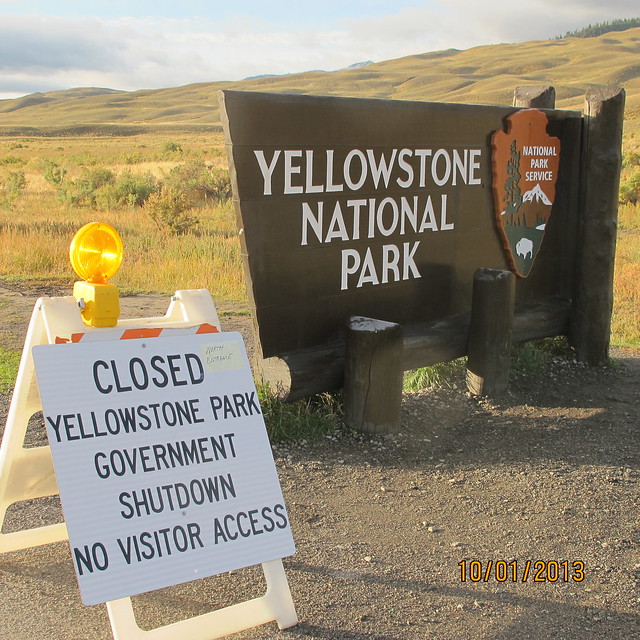
U.S. Government Shutdown Closes National Parks, Hurts Local Economies

One of the worst side effects from the shutdown of the U.S. government has been the complete closure of all of the country's national parks. Not only is this a major blow to outdoor enthusiasts who love spending time in those spectacular locations but it is also has a major impact on the cities and towns that are close to the parks. With the closure of the park system, those communities are losing important revenue each and everyday with tourism and park-related jobs coming to a standstill while the folks in Washington figure out what they're going to do next.

Just how bad will it get? That's tough to say. But the National Parks Conservation Association (NPCA) put out a memo last week, prior to the shutdown, that estimated that as much as $30 million in revenue would be lost to satellite communities each and every day that the parks are closed. This time of year the parks see as many as 750,000 daily visitors and with travelers now canceling their plans, that means that the lack of tourism dollars will be felt far and wide.

Yesterday, when the shutdown officially went into effect, the NPCA's acting president Theresa Pierno released a statement from the organization expressing their disapproval of how our elected officials in Washington are behaving. It is a sentiment that is shared by most Americans at the moment. Here is a snippet of what Pierno had to say:
“The National Parks Conservation Association is deeply disappointed that Congress and the President have failed to reach agreement on a budget deal that consequently has forced the federal government and our 401 national parks to shut down indefinitely. The closure of America’s crown jewels threatens the livelihood of park businesses and gateway communities; the more than 21,000 National Park Service staff we expect to be furloughed; and countless American families and international visitors who rely on national parks being open for business to enjoy our national heritage."
 With no real end to the shutdown in sight, it is tough to say when the parks will reopen. As the ordeal continues to drag on, more and more small towns will suffer the consequences. But even beyond that, outdoor enthusiasts, travelers and national park lovers are all being denied access to some of the best places on the planet right now. That's just wrong no matter how you look at it.

Tuesday, September 3, 2013

Diana Nyad Completes Cuba To Florida Swim

It has been big news – especially here in the U.S. – since yesterday but I'd be remiss if I didn't mention Diana Nyad's amazing swim here on the Adventure Blog. On Monday, the 64-year old Nyad became the first person to complete a swim from Cuba to Florida, covering the 110-miles of open ocean in about 53 hours. The epic endeavor began on Saturday at the seawall on Hemingway Harbor in Havana and ended yesterday on the beach in Key West, Florida, where she was greeted by a crowd of onlookers who had gathered to welcome her.

Obviously this is an amazing display of human endurance but in more ways than you might imagine. Swimming for 53 hours straight is incredibly demanding to say the least, as Nyad never left the water once she got underway. She did stop from time to time to get food and water, but for the most part she just kept on pushing forward. But if you know anything about her story, you know that is the way Diana operates. She has been pursuing the dream of swimming from Cuba to the U.S. for 35 years, first making the attempt back in 1978. That attempt was a failure but the idea of completing this challenge never strayed far from her thoughts. In 2011 she revived her plan for making the swim and over the past two years she tried three more times before finally finding success yesterday.

Diana can be an inspiration to us all on a number of levels. Obviously she is quite the endurance athlete and her focus on completing this swim tells us a lot about her determination and toughness. But her ability to grab onto a dream and pursue it until it is done is another aspect of her personality that I find amazing. The Cuba-to-Florida swim was her Everest and she didn't give up on reaching the summit. There is a lesson in that for all of us for sure.

Congratulations to Diana on finally reaching her goal. What an amazing achievement.

Wednesday, August 21, 2013

The Thunder Rolls Adventure Race Takes Places This Weekend

The 11th annual Thunder Rolls Adventure Race will take place this weekend in at the YMCA Camp in Mt. Carroll, Illinois. The race, which is now in its 11th year, will get underway at midnight on August 24 and will feature both a 12-hour and 24-hour competition.

This unsupported, expedition style race will mix the usual AR disciplines of trail running, mountain biking and paddling. But it will also mix in plenty of orienteering of course, not to mention rappelling, caving and a few other activities. In short, it is everything you could hope for out of an adventure race that just so happens to take lace in the heartland of the U.S.

The race has managed to attract a sizable group of competitors already with 30 teams signed up for the 100-mile long 24-hour race and another 15 registered to compete in the 12-hour race, which is a mere 50 miles in length. The teams are made up of 2 or 3 racers and fall into both the coed and same-sex categories.

If you're looking for a last-minute weekend adventure, registration for the Thunder Rolls is still open. Entry fees are $195/person for the 12-hour race and $235/person for the 24-hour event. That includes onsite accommodations (cabin or campsite), pre-race meal and post-race pizza and drinks. canoe rental, all land-use fees, a North Face fleece race shirt and more.

Thunder Rolls takes place near my old stomping grounds back in the Midwest. I grew up in Iowa, so I'm always glad to see a successful event taking place near there. Race director Gerry Voelliger always does an excellent job as evidenced by the fact that this race has been going on for more than a decade and it continues to attract a great field of racers. A hearty congratulations to all involved and have another great event this weekend.

Friday, August 16, 2013

French Team Sailing To The North Pole

A pair of French adventurers are attempting to sail from Barrow, Alaska to Spitsbergen, Svalbard in Norway via the North Pole this summer. That's a distance of 3300 km (2050 miles) by way the croew flies. But this route is seldom straight and easy as they pass through the icy waters of the Arctic Ocean and it's massive ice flows.

Sébastien Roubinet and Vincent Berthet set out from point Barrow in early July and have been attempting to make their way to the North Pole ever since. The voyage has not been an easy one however as they have encountered more ice this summer than they had expected. Often times they find themselves sailing south just so they can find an open waterway that will allow them to continue towards the Pole. The weather hasn't been all that cooperative either as they have at alternating times battled high winds that were too dangerous to sail and lacked wind altogether, becoming becalmed while they wait for an opportunity to move ahead.

They are making this unprecedented journey aboard a specially designed catamaran that can capture the wind to help sail both around and over the ice. They've named the boat Babouchka and for the most part it has performed remarkable well in very tough conditions. But travel has been extremely sporadic. Some days they are only able to cover just 3-4 km (2-2.5 miles) while on their best day they managed to cross 194 km (120 miles).

A few days ago Sébastien and Vincent crossed over the 78ºN latitudinal line. That means they still have a long way to go before the reach the North Pole, located at 90ºN. The duo are hoping that surface conditions will be more stable as they head north, possibly allowing them to cover longer distances more easily. Since the Babouchka is capable of traveling over both water and ice, they are looking forward to a time when they aren't necessarily battling both.

You can follow the two men on this epic journey on the expedition's official website. After five weeks out on the Arctic Ocean, their tale is a compelling one to read. But with such a long way to go yet, it will be interesting to see if they can actually complete this expedition at all.

Thursday, May 16, 2013

Video: Temporary Story - A Travel Doc That Spans 6 Months And 3 Continents

Filmmaker Vadim Sahaklan and a friend spent six months traveling through 13 countries on three continents. Along the way they documented their journey with a video camera and the result is the beautiful short film you'll find below. The two men first drove from Alaska to Los Angeles, then flew off to Africa to explore on foot, before ending their globe-trotting adventure on motorbikes in South America.

The 39-minute video manages to convey a fantastic sense of wonder and whimsey as Vadim and his friend visit some amazing places, learning more about themselves and the world around them as they go. This is definitely a video you won't want to miss. Excellent stuff.

Temporary Story from Vadim Sahakian on Vimeo.

Monday, April 15, 2013

Couple Completes 3-Year, 11,700-Mile Journey Through North America

Amy and Dave Freeman definitely know how to take a honeymoon. Three years ago, shortly after they were married, the couple set out on an epic journey that would eventually cover more than 11,700 miles (18829 km) through some of the most remote and rugged backcountry in all of North America. Traveling by kayak, canoe, dogsled and on foot, they spent their time exploring some iconic waterways in an initiative to try to engage more young people with the outdoors. On April 4, that journey came to an end when they arrived in Key West, Florida by kayak.

The Freeman's started their expedition on Earth Day, April 22, 2010. Setting out from Bellingham, Washington in the U.S., they first paddled north along the Pacific Coast of Canada. From there they moved into the interior of the Yukon Territory before setting out on challenging odyssey by dogsled that saw them travel for 40-days through remote wilderness without ever encountering a road or town. Returning to their canoe, they then continued south to the Great Lakes before transitioning to kayaks for the final leg of journey, which took them down the East Coast of the U.S. and to the Keys.

While this three-year long adventure was pretty incredible in its own right, it is what Amy and Dave did along the way that is perhaps the most inspiring. The couple launched a website called The Wilderness Classroom through which they shared their expedition with more than 80,000 elementary and middle school students from around the world. Their website provides lesson plans and activities that are designed to help connect young people with the outdoors and inspire them to learn more about the world around us. While traveling over the past three years, they've also interacted and met directly with more than 25,000 students.

Congratulations to Amy and Dave for completing this amazing journey and for sharing it with so many young students along the way. Both accomplishments are inspiring to say the least.

Tuesday, January 15, 2013

10 Remote National Parks For Those Who REALLY Want To Get Away From It All

Are you a traveler who truly likes to get away from it all? Then you'll definitely want to check out the list of 10 of the World's Most Remote National Parks from our friends over at the Adventure Journal. These parks, located in a variety of countries across the globe, are seldom visited, very wild and about as unique as any destination you could ever hope for. Just getting to them is an adventure.

One of the destinations that earned a place on the list was Kobuk Valley National Park here in the U.S. Located in a remote corner of Alaska, the park is just 1.7 miles of very rugged terrain and was visited by just 11,000 people in 2011. Surprisingly, that would probably make it one of the busier places on the Adventure Journal list, as most of the others are expensive places to get to or severely restrict those that can enter.

Some of the other parks mentioned include Quttinirpaaq National Park in extreme northern Canada, Rapa Nui National Park on Easter Island and Darien National Park in Panama. Each has their own unique qualities that would draw adventurous travelers in, not the least of which is their very remote locations that make it a challenge to just get in.

As for the park that is most intriguing to me, that would certainly be Central Island in Kenya. This park is a volcanic island within Lake Turkana and is said to be the home of the largest population of Nile crocodiles on the planet. It also has abundant zebra, giraffe, gazelles and numerous other wildlife. The island is so remote that it takes three-days just to get their by land and boat. AJ warns that it might get a bit hot their too, as temperatures routinely hit 120ºF/48.8ºC.

If you're looking for some interesting places to add to your bucket list, I'm sure this article will spark a few new additions. Just make sure you have plenty of cash to spend, because visiting some of these locations will put a strain on the wallet for sure.

Friday, July 13, 2012

The Ikkatsu Project: Exploring The Impact Of The Japanese Tsunami On

On March 11, 2011 a massive earthquake off the coast of Japan created a giant tidal wave that had a devastating effect on that country's coastline. Boats, cars, homes and countless tons of other debris were washed away in an instant. Now, months later, much of that debris is washing up on the shores of North America, which has prompted a group of three kayakers to launch an expedition to survey the shores of the Olympic Peninsula and document the junk that is arriving there.

The team consists of Ken Campbell, Jason Goldstein and Steve Weileman, each of whom have extensive experience paddling throughout the Pacific Northwest and the world. They've named their adventure the Ikkatsu Project and over the past few months they've spent time exploring the remote coastline of Washington state to examine the debris that has been washing up with alarming regularity there.

You can read about more about Ikkatsu, which means "United as One" in Japanese, on the expedition website, where you'll also find trip reports, gear lists and more details on the scope of the project. Sadly, it seems they are finding plenty of items to document from the Tsunami and the impact on the environment there probably won't be fully known for some time.

Interesting project in a beautiful part of the world. I'm both fascinated by the forces of nature that have brought this debris to the shores of North America and saddened by what those same forces did to the Japanese people and how they could now impact these pristine environments.


Ikkatsu Project - Phase 1 from Steve Weileman on Vimeo.

Wednesday, June 13, 2012

The Annual Bike Race Across America Is Underway

The annual Race Across America (RAAM) got underway yesterday in San Diego, California, where the first participants hit the road on this epic cycling challenge. The race, which is in its 30th year, will now proceed across the U.S., eventually ending in Annapolis, Maryland some 3000 miles (4828km) later.

The competition actually features a staggered start with the solo women, and men over the age of 60, setting out yesterday. Today they'll be joined by the solo men with all of the teams beginning on Saturday. It is estimated that the first riders will begin crossing the finish line around the 21st of June, which means they'll have ridden the entire distance in about eight days. Most of the cyclists will arrive between June 21-25.

RAAM is unique in its approach and scope. This isn't a stage race and riders are free to use any strategy they want to complete the course. They will have to follow a preset route and pass through several checkpoints along the way, but they can ride for as many hours in the day as they feel comfortable.

The course is definitely a challenging one. It features more than 170,000 feet of climbing and passes through 12 states on its way across the country. The cyclists begin at the Oceanside Pier in California and end at the City Dock in Maryland, in between they'll ride through 350 town and cities.

One of the riders in the race is 70-year old Michael Patterson who is part of a four-man team that will begin the ride on Saturday. Patterson its on the board of the Trust for Public Lands and he and his teammates are riding to raise funds for that organization. The TPL will use those funds to help create "parks with a purpose," setting aside lands for public use across the United States.

Good luck to all the riders and enjoy the ride.

Friday, May 18, 2012

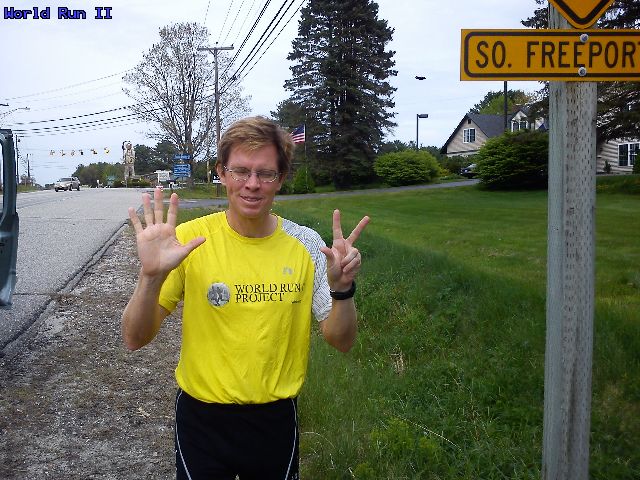
World Run II Update: Jesper Passes 35,000km Mark!

I haven't posted an update on Jesper Olson and his World Run II expedition since January, which was when he was starting the North American leg of the journey. Now he's nearing the end of that leg and has passed a major milestone along the way.

For those who aren't familiar with Jesper's epic undertaking, back in 2005 he completed the first fully documented run around the world, which for most of us would be enough of a challenge for a single lifetime. But in 2008 he decided to hit the road once again, this time running north to south and back again. He dubbed this second challenge the World Run II and starting from the northernmost point in Finland Jesper started running south. The route took him all the way across Europe, through the Middle East and down down Africa, before reaching the tip of that continent. From there he hopped a flight across the Atlantic and resumed running again, this time heading north through South America and eventually North America as well.

Currently Jesper is running through Maine and quickly approaching the U.S.-Canadian border, where he'll soon cross over and start the final leg of his journey, which will eventually end on Prince Edward Island. He still has a few more weeks of running before he reaches that point, but he is most definitely closing in on the finish line at long last.

A few days ago Jesper crossed a major milestone on World Run II. On May 15 he crossed passed the 35,000km (21,748 mile) mark. Thats an impressive distance to have run and eclipses World Run I by a considerable margin. On his original run around the world, Olson managed to cover 26232km (16,300 miles), but he passed that mark a long time ago and has passed into uncharted territory.

Recently Jesper lost part of his support crew so now he's also being forced to run while carrying a backpack. That added weight has changed his approach some, but he continues moving forward at a surprising pace. On the day that he crossed the 35,000km mark he covered 51km (31 miles), which is very impressive considering he's been running long distance nearly every day for four years.

As always, thanks to Darrell for keeping me updated wit Jesper's progress. It is such an amazing accomplishment that he is closing in on, although it sure makes my nightly five mile runs seem pretty insignificant.

Friday, March 9, 2012

Ocean Rowing: Roz Cancels Retirement To Row The Atlantic

I meant to post this news earlier in the week, but other things kept getting in the way. Better late than never however.

Over the past few years we've followed Roz Savage as she systematically crossed the Atlantic, Pacific, and Indian Oceans solo and completely under her own power. When she wrapped up that Indian Ocean crossing last October, she also announced that she was hanging up her oars for good. Late last week we found out that retirement isn't exactly in the cards just yet. Last Friday Roz posted a story to her website announcing her intentions of rowing the Atlantic Ocean, although this time she won't be going it alone.

Rower Andrew Morris had already been planning a crossing of his own that he had dubbed the Olympic Atlantic Row (OAR) as he, along with fellow rower Mick Dawson, had hoped to paddle across the North Atlantic and arrive in the U.K. in time for the start of the Olympic games in July. Mick had a conflict of schedules however and was forced to pull out of the project. Who better to take his place than Roz?

So, the plan now is to begin the ocean crossing May. The journey will cover 2587 miles (4163 km) and take roughly 60 days to complete. Crossing at that time of year won't be an easy one, as cold weather, heavy fogs, icebergs, and other dangers will conspire to provide plenty of challenge. But we know that Andrew and Roz are up to the task and it should be another good adventure to follow this spring when they set out from St. Johns in Newfoundland, Canada and begin their journey east.

Good luck Andrew and Roz!