Showing posts with label Australia. Show all posts

Wednesday, May 14, 2014

Announcing the Outer Edge Polar Challenge

The North Pole season is only just ended, and the Antarctic season is still months away, but it is never too early to start looking ahead. Outer Edge magazine, an Australian publication that I once wrote for, has released the teaser video below announcing the Outer Edge Polar Challenge, which will be taking place this November. While not a whole lot of details are shared, it appears that participants in the challenge will be attempting to break the current world ice sailing speed and distance record in unsupported fashion.

The plan is to cross more than 4000 km (2485 miles) of frozen expanse, starting at the ALCI Airbase in East Antarctica and proceeding towards the South Pole, and back, via a fuel depot and the Pole of Inaccessibility. Along the way, they hope to also set a record for furthest distance traveled in a 24-hour period.

I'm sure we'll hear much more about this is the weeks ahead. It'll be interesting to see how things unfold, and of course I'll be following their progress closely in November.

Tuesday, April 1, 2014

Guides For Mountain Biking Australia

Are you feeling the urge to head Down Under for some great mountain biking? If so, you'll want to check out this website from Yakima Australia. The company that is well known for making excellent bike racks (not to mention skis, snowboards, and other gear) for your vehicle, has put together a comprehensive guide to each of the seven Australian states, giving us plenty of suggestions on the best trails to ride.

Each of the trail guides offers multiple options for where to ride in each of the states. The summaries for the trails also include access points and a difficulty rating ranging from "easy" to "very difficult." A brief description also lets riders know what they can expect along the route, including distance, terrain, and other pertinent information.

Whether you're an Aussie yourself, of you would just like to discover what the country has to offer in terms of mountain bike trails, you'll find some good options here. Simply pick your location of choice from the Northern Territory, Tasmania, Queensland, Western Australia, South Australia, New South Wales, or Victoria.

The video below is an example of what to expect when riding Down Under. It was shot on the Blue Tier Descent in Tasmania. Enjoy!


Thursday, March 6, 2014

Stand-Up Paddle Boarders Cross Australia's Bass Strait

Update: It has been pointed out to be that this was not a SUP crossing of the Bass Strait but instead a paddle board crossing. That is an important distinction for sure, although this was still a very impressive accomplishment.

I missed this little adventure due to my hiatus/move last week, but it is a good story and I wanted to share the achievement.

Last week, three stand-up paddle boarders completed a challenge of epic proportions. Australians Zeb Walsh and Brad Gaul, along with American Jack Bark, completed a 180 mile (290 km) crossing of the treacherous Bass Strait, a body of water that begins at southern Australia and runs to Tasmania.

Calling their expedition A Date With The Strait, the trio faced waters that are twice as turbulent as the English Channel. The region is known for its often icy conditions and sharks are not uncommon there. It is a part of the world that sailors look to avoid, due to the unpredictable weather and shallow waters. Walsh called the strait the Everest of stand-up paddle boarding, saying that no one had ever completed the challenge before, and that their success was uncertain as well.

The three men set out from Refuge Cove with a plan to island hop over successive days to reach Tasmania. Over the course of several days, they managed to make their way across the strait, stopping in places like Hogan Island, Deal Island, and Flinders Island along the way. Their final push was a 40 mile (65 km) slog that put them on Tasmania on Tuesday of this week, after five consecutive days out on the water. An impressive feat to say the least.

Congratulations to Zeb, Brad and Jack on a job well done. You can read more about their adventure on the expedition's Facebook page on the official Date With The Strait page as well.

Check out a teaser video of their adventure after the jump.


Wednesday, February 26, 2014

Video: Remote And Beautiful Australia

Australia is a country that holds a special place in my heart for several reason, not the least of which is the wild and beautiful scenery that can be found there. The video below gives you a glimpse of those landscapes, sharing them in timelapse fashion. These are stunning images taken in remote sections of Central and Western Australia. Breathtaking stuff.

Remote Central Australia - Timelapse from Jody Brown on Vimeo.

Monday, January 20, 2014

Video: Beautiful Light In Victoria, Australia

As I take a bit of a day off here today, I have a few videos queued up for your enjoyment. The first is a stunning timelapse of the shifting light in Victoria, Australia. The video was shot throughout 2013 in numerous places throughout the state, capturing some of its best natural settings in beautiful fashion.

VICTORIAN LIGHT from Daniel Johnson on Vimeo.

Friday, December 20, 2013

Pacific Ocean Row: Fedor Konyukhov Returning To Chile

It has been a rough week for some of the adventurers we've been following lately. Yesterday we learned that the Dark Ice Project has been cancelled, only to find out later that Pacific rower Fedor Konyukhov is returning to land as well. You may recall, a few days back he launched his attempt row solo across the Pacific, departing from Valparaise, Chile with the intention of crossing the ocean all the way to Brisbane, Australia. But four days in, he has suffered a set back is on his way back to shore.

According to a post on his website, Fedor suffered a failure of his solar charging system on Tuesday, with both of his onboard batteries running out of juice. Those batteries power a number of systems on  his custom built rowboat, and without the solar panel to recharge them, he would never have a chance of crossing the Pacific. His GPS devices, satellite phone and other electronics all require the batteries to function properly.

After he called for assistance, his support team back on land chartered a boat to go out to tow him in. He should be back in Chile today, as he had only made it about 40 miles from shore when he ran into trouble. According to his website, he has been using a manual satellite phone to stay in contact and has several handheld GPS devices to call in his coordinates. His team was en route on Wednesday, but so far there haven't been any updates on their progress. They do say the situation is under control and that Fedor is not in any danger.

Once back on shore, the entire electrical system will need to be examined and repaired before the Russian can attempt to set out again. How long that take remains to be seen. Considering the voyage was suppose to take more than six months, it's just a good thing he wasn't further out from shore when the malfunction occurred. Hopefully he'll be back rowing soon.

Monday, December 16, 2013

Russian Adventurer Begins Solo Row Across The Pacific

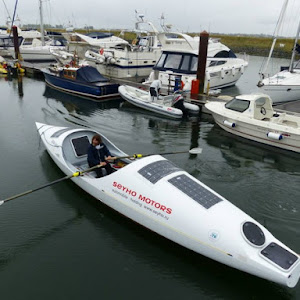
At the beginning of November I posted a story about Fedor Konyukhov, a Russian adventurer who was planning a solo, unsupported, non-stop row across the Pacific Ocean. At the time, he was still in the planning stages of the journey but had hoped to set off sometime in December. This past weekend he hit the water at last and now faces 8000 nautical miles (14,816 km) of open sea as he travels under his own power from Valparaise, Chile to Brisbane, Australia.

According to this update from ExWeb, the Pacific crossing should take Fedor roughly 200 days to complete. During the first stage of journey he'll have to navigate through a maze of lightly mapped islands and atolls, while on his arrival in Australia he'll have to negotiate the Great Barrier Reef. In between, he'll have thousands of miles of open sea that he'll have to row entirely on his own in what is set to be the longest ocean row ever.

Konyukhov's boat has been equipped with the latest in ocean rowing technology. Solar cells will power all of the onboard electronics such as GPS and satellite communications equipment. Desalinization pumps will turn salt water into drinking water for him, while an autopilot system will help ensure that he stays on course throughout the journey. The boat arrived in Chile several weeks back, and it has undergone extensive testing on the ocean prior to Fedor's departure on Saturday morning. It passed those tests with flying colors, so hopefully it'll now be up to the task ahead.

You'll be able to follow along with Fedor's progress on his website, which does offer an English version. He also has a blog and Facebook page, both of which are in Russian. If you don't read that language, you'll need to use Google Translate or something similar to understand what is being said.

Good luck to Fedor on this epic journey. Hopefully the sea is kind to him over the next 6+ months.

Monday, December 9, 2013

Mark Webber Tasmania Challenge On Hiatus For 2014, Preps For Future

The Mark Webber Tasmania Challenge wrapped up a week ago, and at the time I mentioned how it has become a staple on the adventure racing calendar each fall. Turns out I spoke a bit too quickly, although the future does continue to look bright for the event.

Late last week I received word that the Challenge will go on hiatus for 2014 as race organizers prepare for the future. Details are a bit light right now, but I'm told that they are preparing for a "significant step up" when the race returns in 2015. The press release accompanying the note that I received indicated that the race has positioned itself nicely to move into a premium position moving forward. It also indicated that Webber, who has now retired from F1 racing (although not automobile racing completely), will have a bit more free time that he'll use to grow the Tasmania Challenge further.

It seems that there is something big in the works and the race will return with a vengeance in 2015. Until then, we'll have to wait to hear more once the details emerge. Considering the Tasmania Challenge has now been around for ten years, finding out where it is headed next should prove very interesting.

Wednesday, December 4, 2013

Mark Webber Tasmania Challenge Wraps Up Down Under

While we were celebrating the long weekend here in the States, teams of adventure athletes were battling it out in the Mark Webber Tasmania Challenge in Australia. The five-day, stage race featured plenty of running, mountain biking and paddling as competitors challenged each other across a course that was more than 340 km (210 miles) in length. The video below, which includes highlights from the final day of the competition, is a good indicator of what this race is all about.

After five days of racing, the race was won by the team of Richard Ussher and Braden Currie. They completed the entire course in 18 hours, 54 minutes, which was more than two hours faster than the second place team that consisted of Alex Hunt and Mark Hinder. Third place went to Jarad Kohler and James Pretto, who finished in 26 hours, 52 minutes and 2 seconds.

This was the 10th annual Tasmania Challenge and over the year the race has become a staple on the adventure racing calendar each season. With another strong turnout this year, it appears that the race is poised to continue well into the future.

Tuesday, November 26, 2013

Mark Webber Tasmania Challenge Set To Begin Tomorrow

Wednesday marks the start of the 10th annual Mark Webber Tasmania Challenge, a 341 km (211 miles) adventure race held in the remote Tasmanian wilderness. The event is hosted each year by F1 star Mark Webber, who happens to be a huge fan of endurance sports and adventure racing in particular. Webber ended his long racing career last Sunday after competing in the Brazilian Grand Prix.

The course for this year's Tasmania Challenge runs along the West Coast of the Australian island. The five-day race features coed teams with some incredible athletes mixed into the field. While Webber himself is unable to compete this year, fellow F1 driver Mitch Evans is giving the Challenge a go for the first time. He's joined by Olympians Emma Snowsill, who competed in the triathlon, and Kenny Wallace who is a world class kayaker. As is usual with an adventure race of this kind, the stages will include mountain biking, trail running, paddling and various other disciplines.

The elite teams will be competing for a piece of the $30,000 purse, while others will be taking part in the charity fundraiser. Most of the proceeds generated from the Tasmania Challenge goes to Whielion, an organization which provides a number of service for at-risk youth in Australia. Additionally, some of the funds also go to the Save The Tasmanian Devil fun as well.

Once the race gets underway you'll be able to follow the progress of the teams and get updates on daily standings from the official website.

Friday, November 1, 2013

Russian Adventurer Announces Non-Stop, Solo Pacific Row

Rowing across an ocean is an incredibly challenging endeavor. After all, it requires the rower to spend hours each day working the oars, often for weeks at a time. Isolated and alone, it takes dedication and determination to make a solo journey across a body of water that at times seems endless. There is a reason that fewer people have rowed across one of the Earth's oceans than have been in space. Quite simply, it is really tough to actually complete such a voyage.

That isn't stopping Russian adventurer Fedor Konyukhov from trying. According to ExWeb, Konyukhov intends to make a solo row across the Pacific, non-stop from Chile to Australia. Fedor believes that it will take him roughly 200 days to complete the crossing, which will cover approximately 8000 nautical miles (14,816 km).

The Russian, who is a polar skier, mountaineer, and sailor, says he'll set out on his Pacific crossing in December. Leaving from Valparaise, Chile, he'll first have to navigate through islands and atolls off the coast of South America, before he makes his way out into the deep ocean. As he approaches Brisbane, Australia, he'll encounter more islands and the massive Great Barrier Reef. In between, Fedor believes he'll have to dodge potentially nasty storms that could potentially bring an end to his voyage at any time.

In order to successfully complete this ocean crossing in 200 days, Konyukhov will need to average 40 nautical miles (74 km) per day. That doesn't sound like a lot, but considering the challenges he'll face out on the water, particular as the grind of rowing begins to take its toll, covering those distance can get extremely difficult. High winds and turbulent seas will work against him, even in the spring of the Southern Hemisphere when things are better than other times of the year. Hopefully he is well prepared for those difficult conditions, as he will be hundreds of miles away from rescue should anything go wrong.

Expect to hear more in a few weeks as Fedor gets closer to his departure.

Thursday, October 31, 2013

Australian Scientists Explore Lost World For First Time

A team of Australian researchers have quite literally gone where no man has gone before. Scientists from James Cook University recently crossed into a region called Cape Melville, which is completely cut off from the outside world by millions of large boulders that make passage into the remote mountain range nearly impossible. The team of four used a helicopter to gain access however and what they found inside was quite amazing.

Once inside the cape, the team determined that the entire region, which is encircled by impenetrable mountains, is 9 miles (14 km) long and roughly 3 miles (5 km) across. The region contains remnants of a rainforest left over from Gondwana, a reference to an ancient super-continent that existed millions of years ago. They also discovered a variety of new species as well, including three very unique reptiles. Those species included a new frog that lives under boulders and is capable of hatching its eggs without water and a skink that hunts insects by leaping from rock to rock. A third species was the most impressive however, an odd looking gecko that is unlike anything anyone had seen before.

The initial expedition to explore Cape Melville lasted just four days with the team seeing less than a tenth of the area contained there. The group is already planning a return trip to plumb further into the depths of the region to see what else they can find. The team believes that considering what they discovered in just a preliminary scouting mission, they could find some really unique species of birds, plants and even mammals once they really get the opportunity to check out the forests there. Considering that the Cape has been evolving on its own, almost completely cut off from the rest of the world for millennia, there could be some very unique creatures just waiting to be discovered.

These store always fascinate me. I love that our world is so vast that we still don't have regions to explore, even in the age of satellite mapping, GPS navigation and instant communications. It must have been a humbling experience for these scientists to become the first humans to step into this lost world and lay eyes on the wonders there for the first time. What an amazing world we live in.

Friday, October 25, 2013

Video: Escape To Beautiful Australia

Want to take a little virtual getaway? Then check out this great video that was shot entirely in Australia. It does a wonderful job of capturing some of the more brilliant highlights of the country that is a fantastic playground for outdoor enthusiasts. There is some great camera work done here and the shots are wonderful. If you haven't been "Down Under" just yet, this will probably make you want to go.

Wednesday, September 4, 2013

Top 10 Things To Do In Australia's Northern Territory

My July escape to Australia may be a bit of a distant memory at the moment but I'm still sharing the experiences from that great trip wherever I can. Last week, the PacSafe blog posted my list of the Top 10 Things To Do In The Northern Territory which is my overview of the places and activities you absolutely can't miss while visiting that part of the country. The NT is the rough and tumble Outback for sure but it has some surprising options for travelers who like to escape into a beautiful, remote wilderness from time to time.

Some of the options that made my list include taking in an incredible sunset on the bay in Darwin, the Northern Territory's largest city. I had heard about the spectacular sunsets there long before I ever arrived, and they did not disappoint in the least. I also recommend spotting crocs on the Mary River, hiking the Larapinta Trail and visiting Kakadu National Park for both its cultural and natural wonders. My suggestions include options for both the very active and for those who would like to take things easy from time to time as well. The NT is a nice blend of laid back lifestyle and thrilling adventures, which when paired with the famous Aussie hospitality makes it a great destination for just about anyone.

I want to thank my friends over at PacSafe for allowing me to share more of my Outback adventures with readers. If you're not familiar with PacSafe they are a company that makes some excellent products designed to keep your valuables safe while traveling. They have everything from laptop bags to money belts and passport pouches, amongst a host of other gear that can come in handy when visiting places where thieves may be looking to separate you from you belongings. Most of their products have integrated some ingenious ideas that will be appreciated by travelers who want to avoid losing their most precious items while on the go.

Also, the PacSafe Blog, where my latest article was posted, offers up some fantastic stories, tips and suggestions for travelers of all types. If you love to travel it is a great addition to your Internet favorites and a site that you'll likely want to visit often.

Monday, August 12, 2013

Tales From Down Under: Trekking The Larapinta Trail

Australia's Northern Territory is an adventure travelers paradise. Not only does it have some of the most spectacular landscapes on the entire continent, it also has a number of very diverse and unique ecosystems to explore as well. For instance, Kakadu National Park offers visitors is an intriguing mix of stunning scenery and ancient culture, while the Mary River puts them in close contact with all kinds of wildlife including both freshwater and saltwater crocodiles. Of course, the NT is also home to Uluru – aka Ayers Rock – which just might be the most iconic destination in the entire country. But for the truly adventurous there is the Larapinta Trail – a 223 km (139 mile), 12-stage hiking route that stretches through the West MacDonnell Mountain Range,  taking trekkers into some of the roughest, yet utterly breathtaking, backcountry that they will ever see.

Located in Australia's "Red Center," access to the Larapinta Trail is gained via Alice Springs, a small city that serves as the gateway to the Outback in the Northern Territory. Although the region has been home to the Arrernte tribe of Aboriginals for centuries, Alice Springs grew to prominence in the 1870's when it became an important repeater station for the Overland Telegraph Line, which eventually connected Adelaide to Darwin and then out to the rest of the world. Over time, it the city became an important way post for those traveling through the wide-open expanse that is the Australian interior and today it is an excellent base of operations for those exploring the southern region of the Northern Territory.

Fitting with the history of Alice, the trailhead for the first section of the Larapinta Trail is actually located at the old telegraph station. That makes for a convenient start for those who want to hike the route and once on the trail, it isn't long until the trappings of the city are left behind and the true wilderness starts to set in.

The Larapinta wanders through some wild and remote places over the course of its run and the challenge of the walk should not be underestimated. The path climbs up and down some steep gradings and although the distances of each leg may not seem all that great, the reality of the actual hike is much different. The trail is rocky and uneven, which can slow even the best hikers down to a crawl at times. It is also very well marked, which make it easy to navigate from end to end.


It will take most people roughly two weeks – give or take a few days – to walk from the start at Alice Springs to the official end of the Larapinta on the summit of Mt. Sonder, a 1380 meter (4528 ft) mountain that caps the trek. Along the way they'll pass through a number of memorable canyons and gorges, along high ridges and across wide open expanses. Some of the highlights include the famous Simpson Gap, Standley Chasm and Serpantine Gorge. Each of those locations happens to be an access point between two segments of the trail, but perhaps more importantly, they are each scenic locations that highlight just how amazingly beautiful the Larapinta truly is.

On my recent visit to the Northern Territory I didn't have enough time to hike the entire length of the Larapinta but was instead given an abbreviated introduction to what it has to offer. What I saw was enough to convince me that this is one of the premiere long distance hiking routes in the world both in terms of natural beauty and challenge. I hiked a section called the Ormiston Pound but also visited the Simpson Gap, Standley Chasm and other outstanding points along the route. I even visited the Finke River, which is widely regarded as the oldest river in the world. It was fun to take a dip in that waterway but the temperature of the water didn't encourage me to stay in too long.

Hiking the Larapinta isn't just about walking through spectacular scenery, although it is some of the best you'll ever see. The trail is lined with beautiful wild flowers and a variety of other trees and plants that only enhance its character. Sharp eyed hikers will also have the opportunity to spot rock wallabies keeping watch amongst the high cliffs and dozens of unique species of birds too. One of the highlights of my visit was also spotting a white dingo while sitting on a ridge watching the sun come up, which is further indication of the wild nature of the trail.

Like most long distance trekking routes, the Larapinta can be walked end-to-end or in segments depending on how much time you have available. It can also be hiked independently or you can hire a guide in Alice Springs to help lead you through the route. If you choose to make the trek independently, you'll have to deal with the logistics of getting resupplied while out on the route, although the local guide services can assist with that, as well as transfers to and from the trail too. Although the trail is still relatively unknown and hasn't been in operation for all that long, there is already a nice infrastructure in place to help backpackers to gain access to the Larapinta and enjoy it to its fullest. Since traffic on the route remains relatively light, permits aren't even currently required, which is a bit surprising considering the remote nature of the hike. Log books at each end of the 12 sections help to ensure the safety of those out on the trail.

While I was in Alice Springs I worked with the fine folks from Trek Larapinta to get my brief taste of what the trail has to offer and I'd recommend them to anyone thinking of making the trek themselves. You'll have a hard time finding anyone who knows the trail better and this team and they are available to assist independent hikers and those who want the full guided service too. I spent an overnight in one of their camps – even sleeping out under the stars – and was impressed with their dedication to preserving the environment and interacting with it in a natural way. Eco-tourism that puts the emphasis on the "eco" is something that I always appreciate and the Trek Larapinta camps are comfortable, full featured and yet still dedicated to leaving zero impact on the natural setting where they sit.

If your idea of a great vacation is a long hike on beautiful trail, then you'll want to add the Larapinta to your bucket list. It is an unbelievable walk that will stay with you for a lifetime. It also has the added benefit of being in Australia, which is one of the most enjoyable places I've ever had the pleasure of traveling in. The people there are friendly and accommodating and the infrastructure for travelers is top notch. Aussie hospitality is legendary and you'll have an opportunity to discover that first hand while still experiencing the Outback in its purest, wildest form. What more could you ask for?

Thursday, July 25, 2013

20 Famous Hikers Pick Their Favorite Trails

Looking for a new backpacking or hiking challenge? Want to experience some of the best trails in the world? Then you'll definitely want to check out the list of 20 top trails as picked by 20 famous hikers that was put together by the team over at National Geographic Adventure. They poled some well known figures from the world of exploration and adventure and shared their selections for their ultimate dream hikes. The results are a list of hikes that range from legendary to those you may not even have heard of.

Some of the walking routes that earn a place on the list include the Sierra High Route in California, which was selected by über-hiker Andrew Skurka and the Pacific Crest Trail, which is a favorite of ultrarunning phenom Scott Jurek. Unsurprisingly, American mountaineer Jim Whittaker names the trek to Everest Base Camp as his favorite hike, while Sally McCoy, the CEO of CamelBak loves the 200-mile (321 km) Snowman Trek in Bhutan.

As you can tell, there are some very diverse and interesting hikes on the list that were selected by a very diverse and interesting group of people. But one of the hikes isn't even officially open yet, although it continues to evolve into a true world-class trekking route that will draw backpackers from around the globe. That is the Sir Samuel and Lady Florence Baker Historical Trail that runs through South Sudan and Uganda. This route, which I first told you about several months back, is 360 miles (580 km) in length and runs from Gondokora near Juba, in South Sudan, to Baker’s View, which overlooks Lake Albert in Uganda. This particular trail was suggested for the Nat Geo list by explorer Julian Monroe Fisher, who has been instrumental in its creation. It is set to open in 2014 with the first trekkers walking its length shortly there after. The photo above is actually a shot of an existing plaque commemorating the Bakers in one of the villages along the trail. Official trail markers will be added alongside it soon.

If you're planning a new treking adventure in the near future then you'll certainly want to check-out the trails that made Nat Geo's list. There are some excellent options for sure and whether you want to hike a well known classic route or take on a complete new one, there is a little something for everyone.

Wednesday, July 24, 2013

Latest Issue Of Trail Run Magazine Now Available

While we're on the topic of trail running today, I wanted to point out that the latest issue of Trail Run magazine is now available online in .pdf format, as well as in the Kindle Fire and Apple app stores for your favorite tablet device. If you haven't had a chance to look at this excellent e-zine in the past, now is the perfect time to check it out. It has the same level of quality that you would expect from a traditional print magazine delivered in an environmentally friendly electronic format.

In this issue, you'll find gear reviews for new shoes and winter gear (the magazine is focused on trail running in Australia and New Zealand), as well as some thoughts on PocketFuel for keeping your energy up while on a long run. There are also a couple of athlete profiles, trail guides for Oz and NZ, rundowns of some upcoming events and plenty of other articles that will be of interest to avid trail runners, whether they run "Down Under" or not.

The .pdf version of Trail Run is absolutely free while issues on the Kindle or iPad will set you back a few dollars for each back issue, although a discount given for a year (4 issues) subscription. I happen to be a big fan of electronic magazines (that's how I get several of my favorite mags now!), particularly when they are this high in quality. The only thing that separates this from something you would pick up  on a newsstand is the method of delivery. Give it a go. It think you'll like it too.

Tuesday, July 23, 2013

Tales From Down Under: A Picture Is Worth A Thousand Words!

Since I returned from Australia last week I've been sharing stories about some of the things I did there. Things like go to a regatta in which all the boats were made out of beer cans, spend an afternoon at the camel races and explore the amazing Aboriginal artwork found in Kakadu National Park. That is barely scratching the surface however and I have more to share about the hiking and camping I did while there as well and eventually I'll get around to telling those tales too.

Today I wanted to share some of the photos I took while in the Northern Territory, which featured some of the most dramatic and breathtaking scenery I've ever seen. The Outback is a wild and remote place, mostly untouched by man and there are places there that are still overgrown with prehistoric plant life that isn't found anywhere else on our planet. The sheer expanse of the place is mind boggling as it is at times both desolate and foreboding, yet oddly inviting and intriguing at the same time.

They say that a picture is worth a thousand words and if what I've written about Australia's Northern Territory hasn't inspired you to want to visit yet, perhaps some of these images will. The sunsets at the "Top End" of the NT are some of the best you'll find anywhere on Earth and the sweeping vistas of the "Red Center" will compel you to want to explore more. This is a part of the world that is still open for exploration and you get the sense that there are still secrets to be discovered deep in the heart of the Outback.

I had fun capturing these photos and I hope you enjoy seeing them as well. Check out the full gallery by clicking here.


Monday, July 22, 2013

Tales From Down Under: The Camel Cup

On my recent trip to the Northern Territory in Australia I had the chance to really soak up the culture and take in a lot of what the region has to offer visitors. That included making a visit to Kakadu National Park to take in the Aboriginal artwork that adorns the rocks there and while in Darwin I had the opportunity to witness the famous (infamous?) Beer Can Regatta. But those two experiences were just the tip of the iceberg for what the NT has to offer and in the days ahead I'll be sharing more of my experiences from the Outback.

One of the more unique events that I attended while visiting Australia was the Lasseters Camel Cup, which I wrote about this past weekend for Gadling. The Camel Cup is an annual event held in the town of Alice Springs that pits professional camel riders against one another in a series of races that are held on an oval track not unlike what you'd find horses racing on. And while the event didn't hold the same prestige of a Triple Crown event, you wouldn't know it by looking at the stands, where many in the crowd came dressed in their finest clothing and wildly cheered on the riders – and their mounts – in each race.

If you know anything about horses, you know that they often love to run, which is why horse racing can be such a compelling sport. If you know anything about camels, you probably already know that they are not the most cooperative of animals. They can be stubborn, strong willed and down right nasty at times, all of which came out on the track in Alice Springs. Sometimes the camels refused to run and sometimes they refused to slow down. I saw camels throw their riders, run in the wrong direction and trot around the course completely ambivalent to the fact that there were 5000 people in the stands watching them go. The personalities of the beasts manifested themselves on the track in various ways and that helped to give the event a personality all of its own as well.

For more than 40 years the Camel Cup has taken place on the second Sunday in July and it doesn't look like that will change anytime soon. The locals absolutely love this event and support it whole heartedly. Most of the proceeds go to support the local Lions Club and revenue generated helps to fund projects within the community. On top of that, the camel has played an important role in Australia's history and is now a part of the culture in the Outback. That legacy is celebrated in the event which has a feel that is undeniably Aussie.

Read more about the Camel Cup in this post at Gadling.com.


Thursday, July 18, 2013

Tales From Down Under

I've only been home from Australia for a couple of days and I'm still trying to shake the jet lag, but I've already started to share some of my experiences over at the travel blog Gadling.com. Yesterday two of my stories went live and if you're interested in what I was up to while I was in Oz, you can check them out now.

The first story is about a fun event I discovered in Darwin on my first full day in the country. It was called the Darwin Lion's Beer Can Regatta and as the name implies, it is a series of boat races with the boats being made primarily out of beer cans. The event is fun, wild and 100% Aussie with the teams competing having a blast while not taking themselves all too seriously. The boats showed a great deal of charm in their design, not to mention dedication from the designers who spent a lot of time emptying all of those cans. On shore, spectators cheer on their favorite crews, take part in tug of war and thong throwing competitions, while enjoying a few cold ones of their own. It is an all-day affair that culminates with an ultimate battle out on the water during which teams toss water balloons and flour bombs at one another, with some boats even employing water cannons. You can find out more about the Beer Can Regatta in my story found here.

The other story that went live yesterday was about my visit to the amazing Kakadu National Park. The park is a UNESCO World Heritage Site thanks to its natural and cultural wonders. The beautiful landscapes there speak for themselves and are a testament to how amazing the Outback can be, but what was truly awe inspiring was the Aboriginal artwork that adorns the rock faces at several sites there. I visited a place called Ubirr where the images on the rocks range from hundreds to thousands of years old and show a clear connection between the land and the people that have inhabited it for more than 40,000 years. It was a humbling and eye opening place that also happens to offer one of the best views you'll find anywhere. Really a fantastic place.

This is just the start of my stories on Australia's Northern Territory. I'll be posting a few things here eventually as well and I have some plans to share other stories elsewhere on the web and possibly print as well. As those get published, I'll be sure to post here too. I'm also in the process of organizing photos from the trip and when I get that gallery online, I'll share it too.

If you're looking for a destination that offers a bit of everything – culture, history, beauty, adventure, etc. – it's tough to beat the Northern Territory. Whether you like to relax on the beach, sail the oceans, hike in remote backcountry or soak up Aussie culture, you'll get the opportunity to do that and more. Just keep your eyes peeled for wild crocodiles and dingos.