Showing posts with label Russia. Show all posts

Friday, March 28, 2014

North Pole 2014: Driving In The Arctic

It has been another long, and sometimes frustrating, week for the skiers who are  North Pole-bound this season. The frozen surface of the Arctic Ocean remains very rough, which slows the pace to a crawl at times. They are doing their best to locate routes through to the smoother ice that is promised on the other side, but it has made for slow going in the early stages of their expedition.

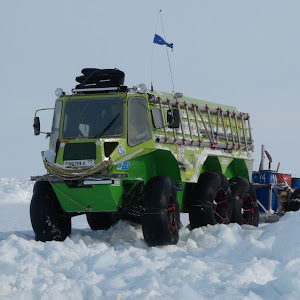
But one team is making better progress, mainly because they aren't skiing, but are driving instead. According to ExWeb, a group of explorers, who drove specially designed vehicles from Russia to Ward Hunt Island, via the North Pole, last year, have returned to the ice to drive those same vehicles home this year. The 2013 expedition lasted for 61 days and covered more than 2000 km (1242 miles), before the Russians parked their vehicles in Resolute Bay. Now, they've set off into the arctic once again, as they attempt to drive back home to Russia via the frozen Bering Strait.

Just like their counterparts who are headed to the North Pole on foot, the Russian team has also experienced plenty of rough ice at the start of their journey. That has kept them at a more measured pace as they search for ways through, or around, these difficult sections. Progress is so slow, that the drivers rarely have to take their vehicles out of second gear, although they are covering 50+ km (31 miles) on a daily basis. While the skiers envy those distances, that is extremely slow for the Russians.


At this rate, it'll take them weeks to reach Russian territory, and they'll still face a long crossing through Sibera, which won't be easy this time of year either. To help them get there, the specially designed arctic trucks are pulling trailers filled with gear and supplies, including 1000 liters (265 gallons) of fuel, and plenty of spare parts to make repairs.

Meanwhile, Eric Larsen and Ryan Waters continue to make slow, steady progress north. They have been covering their best distances yet this week, as they have reached 3+ nautical miles (5.5 km) on more than one occasion. That may not seem like much, but considering the conditions they boys have faced early on, and the slow pace they were forced to endure during their first days on the ice, it is a small triumph for them to say the least. The further north they get, the better the ice conditions should be, so they are hoping to pick up the pace in the days ahead. For now, it is sometimes an exercise in frustration as they battle the rough ice, inhospitable weather, and their own nagging doubts.

That's all from up north today. Hopefully next week we'll have more news and better progress reports all around.


Friday, January 24, 2014

Adventurers Reach The Pole Of Cold

Back in November I wrote an article about a team of three adventurers who were setting out on one epic road trip. That team included veteran polar explorer Felicity Aston, filmmaker Manu Palomeque and mechanic Gisli Jonsson, who at the time had just left the U.K. on a drive to the "Pole of Cold," which is defined as the coldest inhabited place on the planet. Now, more than two months after setting, out, the team has finally achieved that objective, having just arrived Oymyakon, a remote village in Northeast Siberia.

In order to reach the Pole of Cold, Felicity, Manu and Gisli drove more than 20,000 km (12,427 miles) through a variety of terrain that ranged from extremely well maintained highways to barely-there backcountry roads. Traveling in a Land Rover Defender, they were able to comfortably carry all of their gear and supplies, without fear of being hampered by the conditions. The Defender has a legendary background for use on off road expeditions, and it continues to show its worth today.

The team arrived in Oymyakon on Wednesday, but that point is far from the end of the actual journey. On the contrary, the Pole of Cold is actually just the halfway point. They will now travel back to their starting point at the Royal Geographical Society in London, albeit along a more southerly route. It is still the dead of winter in Siberia however, so they will face many of the same challenges along the way back to the U.K. as they have in the first half of their expedition.

You can follow along with their progress on the Pole of Cold website or on Facebook, where they are posting regular updates and photos from the field.

Personally, I think a journey like this one would be fantastic. What a great way to explore Europe and Asia. If anyone wants to loan me a Land Rover Defender, I'll be happy to report on my journeys as well! :)

Tuesday, November 26, 2013

Chasing The Pole Of Cold Across Siberia

Not all of the cold weather adventures are taking place in Antarctica at the moment. Case in point, the just launched Pole of Cold expedition that got underway last week which plans to cross Northern Europe and Siberia on a three-month long, 30,000 km (18,641 mile) journey to reach the coldest inhabited place on the planet in the dead of winter.

The three-person team on this expedition include veteran polar explorer Felicity Aston, mechanic Gisli Jonsson and filmmaker Manu Palomeque. The trio were the winners of a Land Rover bursary which provides funding for this expedition. They set out from the Royal Geographical Society headquarters in London and are now making their way through Norway, where they encountered their first bits of snow. Eventually the journey will take them into deepest Siberia however, where they will make their way to Oymyakon, which is widely considered the coldest inhabited place on the planet. How cold you ask? The thermometer once recorded a temperature of -67.7ºC (-89.8ºF). Now that's cold!

The journey will be a road trip of epic proportions. The route will take the team into some of the most remote places on the planet where temperatures will routinely plummet to dangerous levels. They'll have to deal with non-existant roads, plenty of snow and ice and a complete lack of infrastructure once they get out into the heart of Siberia itself. This will be a round-trip journey that begins and end in London, with a stop at the northernmost point in Europe and plenty of other cold places along the way.

The purpose of the journey is to explore cultural attitudes toward winter while also assessing how lifestyles are different in places that deal with extreme ends of the climate continuum.

You can follow the Pole of Cold team on their website and Facebook page.


Friday, May 31, 2013

Nobody's River Project: 4000 KM Down The Amur River

Running along the remote border of Russia and China in the Far East, the Amur River stretches across thousands of kilometers of wilderness. It is the tenth longest river in the world, but more importantly it is the single longest river to remain completely undammed. The waterway begins in Mongolia, not far from the birth place of Genghis Khan, and flows east across the wide open Mongolian Steppe and into Siberia, before eventually emptying into the sea of Okhotsk. Along the way it is surrounded by some of the most wild and unexplored territory on the planet.

This summer, a team of four adventurous women intend to paddle the length of the Amur beginning at its headwaters in the Onon River, which have their origins in the Khentii Mountains of Mongolia. Their journey will cover more than 4000 km (2485 miles) taking them source-to-sea before ending in the Pacific Ocean Delta. Along the way, they hope to collect data about this important watershed, while capturing images of the wild places they visit. They also hope to speak directly with the locals to get a better sense of the environment in which the Amur River flows .

With their gear packed, their basic plan outlined and their travel plans made, the ladies are about to embark on this ambitious adventure. The team includes Becca Dennis, Sabra Purdy, Amber Valenti and Krystle Wright, all of whom are about to depart for Mongolia and the launch of their expedition. They have named this endeavor the Nobody's River Project and they have invited us all to follow along with their progress. Over the next few months, they will be posting updates to their blog and Facebook page, as well as sharing stories on the National Geographic Adventure website and its Facebook page as well. It is sure to be quite an experience and one that will certainly be worth following.

Good luck to Becca, Sabra, Amber and Krystle as they depart for Mongolia and the adventure of a lifetime.

Thursday, March 21, 2013

Video: Frozen Frontier - Post Expedition Update From Mikael Strandberg

One of the expeditions that I've written about a few times already this year is Mikael Strandberg's Frozen Frontier journey with the Reindeer People of Siberia. The explorer has spent the last couple of months traveling through one of the coldest inhabited regions on the planet and yesterday he released a post-expedition update in the form of the video below. It gives us a good sense of what he's been up to these past weeks and what we can expect from the documentary he is working on from this adventure.


Post-Trip Update from Outwild TV on Vimeo

Wednesday, March 20, 2013

North Pole 2013: Work Begins On Barneo Ice Camp

Thanks to climate change and shifting conditions in the Arctic, there won't be much of a North Pole season this year. In fact, I'm not aware of a single person attempting a full expedition to 90ºN in 2013 although there are sure to be some doing a last degree journey to the Pole. Most of those who undertake that endeavor will do so starting from the Barneo Ice Camp, a temporary base that is built each year on a floating slab of ice in the arctic ocean. Due to the shifting nature of that ice, the entire camp must be rebuilt every spring and construction is now underway for the 2013 edition.

Dispatches from the team in charge of establishing Barneo indicate that their "assault team" is now on the ice and doing the preliminary work to get the station ready for its first visitors. That includes setting up tents, organizing supplies and building an ice runway that is long enough to accommodate an Ilyushin IL-76 aircraft. The team charged with completing these tasks parachuted onto the ice a few days ago to begin their work, while a second wave of support is en route via helicopter. Part of the team has been held-up in Khatanga do to bureaucratic red tape. They hope to have that resolved soon and get the aircraft moving again ASAP.

We're told that conditions on the ground are extremely cold at the moment with temperatures hovering around -39ºC/-38ºF. But other than that, the weather remains good with minimal winds and no snow. At least for now. That can change rapidly of course, but it seems that there is a window of opportunity for work to proceed at the moment.

The base is looking to open for its first visitors by April 1. After that there will be a string of scientists, researchers and adventurers making their way to Barneo over the following few weeks. The lifespan of the station is brief however, and operations there should wrap up by late April, sometime around the 24th of the month.

It seems any action in the Arctic this year will be centered out of the Ice Camp. We'll have to wait to see if anything interesting arises.

Tuesday, March 5, 2013

Mikael Strandberg Completes Expedition Extreme Cold

Back in January I told you about explorer Mikael Strandberg's latest adventure which he had dubbed Expedition Extreme Cold. That seemed like a fitting name considering he planned on traveling through one of the coldest and most demanding environments on the planet. Mikael's journey would start in Oymyakon, Siberia and cover more than 500 km (310 miles) before ending at the Sea of Okhotsk. Along the way, he would face temperatures that could routinely plunge to -60ºC/-76ºF while exploring a vast wilderness with the indigenous inhabitants know as the Eveny or Reindeer People.

Yesterday, Mikael posted an update from the field saying that the expedition had come to an end several weeks earlier than expected. He had originally expected the journey to take until mid-April or so, but he and his team, which consisted of photographers Yuri Berezhnov and Misja and Keisja Alexandrov, along with their Eveny guides, made better time than they expected. They arrived in the village of Arkah over the weekend where they were greeted by the entire population. Word of their arrival had proceeded them by days and everyone was eager to greet them.

Mikael documented the entire journey on his blog, sharing his experiences from the remote wilderness that remains seldom visited by outsiders even in the 21st century. Along the way, he and his team also gathered video footage that will also serve as the basis for an upcoming documentary for OutWild TV on the region and the hardy Reindeer People who have lived there for centuries. He also hoped to study the Eveny and learn how they have adapted to survive in such harsh conditions.

Strandberg says that he is content that he has reached the end of his journey, yet he is eager to tell more stories of the Eveny and the amazing landscapes that they inhabit. Look for more of those stories to come soon and watch for the full documentary down the line.

Congratulations to Mikael and company on a job well done.

Update: As you'll see in the comments below, Mikael himself has posted a little update from Siberia. He wanted to point out that his full team consisted of Egor Makarov, Yura Stepanovich Berezhnev, Bolot Bochkarev, the Eveyns Slava Sergovich, Vika Andrejevna, Tolya Andrejev and Yura Grigorovich Osenin.

Monday, January 21, 2013

Explorer Mikael Strandberg Announces Expedition Extreme Cold

In writing this little blog of mine I've been privileged enough to make the acquaintance of a number of amazing men and women who do some incredible things. When I hear from those folks, either by phone or email, I always make sure to give them special attention and listen closely to what they are thinking and planning. One of those people is explorer Mikael Strandberg, a man who has pushed the limits of human endurance on a number of expeditions to far flung corners of the globe. So when I received an email this weekend detailing Mikael's next adventure, you can bet that I read the note with keen interest.

In that email Mikael announced Expedition Extreme Cold, a journey through one of the harshest and bitterly cold environments on the planet. This adventure will take Strandberg deep into the heart of Siberia, where he'll spend time traveling with the Eveny, a group of nomadic reindeer herders who have learned to survive in that beautiful, yet unforgiving place.

Mikael's journey will begin in Oymyakon, Siberia – one of the coldest inhabited place on the planet. In Oymyako, the average temperature falls below freezing for seven months of the year and the ground is permanently frozen. In the months that Strandberg will be traveling in the region, temperatures will routinely drop below -60ºC/-76ºF as he makes his way through a wild, mountainous region that few people ever visit.

The plan is for Mikael to travel with the reindeer people from Oymyako to the Sea of Okhotsk on Russia's east coast. Along the way, they'll cover 600 km (373 miles), battling extreme weather, unexplored routes, wild animals and a host of other challenges.

Joining Strandberg on this cold-weather journey will be explorer Yegor Makarov and photographers Yuri Berezhnov and Misja and Keisja Alexandrov. The team hopes to shoot a documentary for OutWild TV on the Eveny and their way of life in such a harsh part of the world. Below is a YouTube video that serves as a "pilot" for this documentary, giving us all an idea of what to expect from the final product. It also gives us a true glimpse into what kind of conditions Mikael and his team will be dealing with over the next few months. The expedition is scheduled to run through mid-April.

The expedition won't just be about making a documentary however, as the explorers will also be conducting research on how genetics, choice of clothing, training methods and adaptation all play into how we humans survive, and in the case of the Eveny thrive, in extremely cold environments. Further, they hope to document the native and historical knowledge of the Eveny in how they have learned to survive in Siberia and came to use reindeer for the pulling of their sledges in that environment.

Mikael tells me that his preparation for this expedition has been amongst the hardest of his career, saying that he has done a year's worth of preparation in just two months. But judging from what he has planned, I can tell that he is extremely excited about this journey, which will be unlike any other that he has undertaken before.

When I received my email from Mikael he was just heading off to the airport to fly to Russia and get the expedition underway. Hopefully we'll get updates on his progress as he proceeds, as this looks to be a fascinating journey to say the least.


Tuesday, January 15, 2013

10 Remote National Parks For Those Who REALLY Want To Get Away From It All

Are you a traveler who truly likes to get away from it all? Then you'll definitely want to check out the list of 10 of the World's Most Remote National Parks from our friends over at the Adventure Journal. These parks, located in a variety of countries across the globe, are seldom visited, very wild and about as unique as any destination you could ever hope for. Just getting to them is an adventure.

One of the destinations that earned a place on the list was Kobuk Valley National Park here in the U.S. Located in a remote corner of Alaska, the park is just 1.7 miles of very rugged terrain and was visited by just 11,000 people in 2011. Surprisingly, that would probably make it one of the busier places on the Adventure Journal list, as most of the others are expensive places to get to or severely restrict those that can enter.

Some of the other parks mentioned include Quttinirpaaq National Park in extreme northern Canada, Rapa Nui National Park on Easter Island and Darien National Park in Panama. Each has their own unique qualities that would draw adventurous travelers in, not the least of which is their very remote locations that make it a challenge to just get in.

As for the park that is most intriguing to me, that would certainly be Central Island in Kenya. This park is a volcanic island within Lake Turkana and is said to be the home of the largest population of Nile crocodiles on the planet. It also has abundant zebra, giraffe, gazelles and numerous other wildlife. The island is so remote that it takes three-days just to get their by land and boat. AJ warns that it might get a bit hot their too, as temperatures routinely hit 120ºF/48.8ºC.

If you're looking for some interesting places to add to your bucket list, I'm sure this article will spark a few new additions. Just make sure you have plenty of cash to spend, because visiting some of these locations will put a strain on the wallet for sure.

Tuesday, May 1, 2012

Pen Hadow Announces Solo Arctic Crossing For 2013

British polar explorer Pen Hadow has announced an epic and ambitious expedition for 2013. Yesterday he announced that he'll return to the North Pole as he attempts to traverse the Arctic solo and unsupported.

The journey will cover approximately 1600km (1000 miles) and will begin in Russia. The plan is for Pen to proceed north to the Geographic Pole and then continue south into Canada, ending the expedition on the opposite side of the planet. Hadow estimates that it will take about 100 days to cover the distance, which will do completely under his own power. That means he won't use machines, dog sleds or even kites to cover the distance. He also plans to do it without resupply.

Pen is no stranger to the Arctic. In 2003 he became the first person to go solo and unsupported to the North Pole from the Canadian side. That experience will prove invaluable this time out as well, as he is likely to find conditions at the top of the world have changed dramatically since that trip. The past two seasons have seen no successful full-length journeys to the Pole and as the polar ice caps shrink due to global climate change, there are now larger leads of open water to circumnavigate or cross.

The expedition isn't just about the adventure however as Pen has plans to take scientific readings along the way. It is estimated that he'll take as many as 50,000 measurements of environmental and ice pack conditions along the way, and that data will help scientists to get an idea of how the Arctic is changing.

Hadow's expedition will likely start next March and of course I'll be following along.

Update: This story has been edited slightly after I was reminded that Norwegian polar explorer Borge Ousland made the same journey, Siberia to Canada via the North Pole, back in 2001.

Tuesday, February 14, 2012

The Ice Run: 1500km Through Siberia On A Motorbike

The Adventurists are up to their old tricks. The same group that brought us the Mongol Rally and the Rickshaw Run, launched their latest overland adventure – The Ice Run. This time, they're racing across 1500km (932 miles) of frozen Siberian wasteland using old Russian motorcycles, complete with sidecar.

The inaugural Ice Run got underway yesterday at the southern end of the River Ob. The riders will now follow the frozen river north to the town of Salekhard, which sits above the Arctic Circle. During the brief summer months, the only way to complete that journey is by boat or airplane, but during the long winter, the frozen tundra, and even the river itself, allow for passage. Of course, the riders still have to deal with the snow, ice, and incredibly cold temperatures along the way.

Just how cold does it get there? According to this page on the Ice Run site, temperatures will fall between -10ºC and -60ºC (14ºF to -76ºF). Throw in winds that regularly hit 40mph and the windchill shaves another 40º off of those temperatures. As a result, machines start to break down and oil begins to freeze. The local police will even close the roads to prevent drivers from leaving town and getting stranded, quite literally, in the middle of nowhere.

There are currently 13 teams entered into this unique, and dare I say crazy, race. You can track their progress online by clicking here, and as of this writing they've covered roughly 150 miles so far. As with all the other events from the Adventurists, this road rally is helping to raise funds for charity. The live tracker also says that the teams have currently raised £11,980 ($18,770), with more to come.

And while we're on the subject of raising money for charity, I think it is worth pointing out that all of these great road races that the Adventurists have sponsored over the past few years have brought in more than £3.5 million ($5.5 million) for a variety of organizations. That's a pretty impressive number.

So, just what are the Ice Run riders dealing with out on the "road?" The video below, which was shot during an initial test run of the ride, will give you some indication. It's a toss up which looks colder, this video, or one of those shot on those winter climbs we've been following.